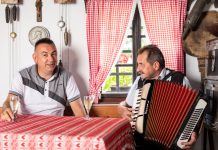
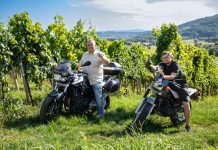
When I suggested to my Belgrade friend Dejan that he join us on a visit to Božo Aleksandrović, he did not hesitate. He only asked where exactly the winery was.
He heard Vinča and was delighted, convinced we would be there in no time.
“Vinča is a suburb of Belgrade. It’s just around the corner,” he explained.
“But we’re not going to that Vinča. I mean the village near Topola. And along the way, your dream will come true: you’ll finally get to see me in Šumadija.”
“What other Vinča is there in Serbia?”
There is indeed another one: a village whose three historical names-Vincea, Vinica and Vinča-are now set into a large mosaic of marble from Mount Venčac on the terrace of the Aleksandrović winery. Above them stands Bacchus, holding a staff bearing the letter A, large enough to leave no doubt about whose world of wine we have entered.
Božo sees those names as confirmation that wine has long been part of his village’s identity. Yet among the scenes of celebration, he also had two words of warning inscribed: Meden agan.
Nothing in excess.


It seems curious that a man who has spent almost his entire life expanding his vineyards, cellar, range of wines and the horizons of Serbian wine should put a warning against excess on the wall of his own winery. But Božo Aleksandrović sees no contradiction.
“I’m not saying winemakers aren’t hedonists. It rather comes with the job. But if you want to succeed, you have to live with wine, grapes, barrels and the winery. For me, this is my business, my home and my holiday retreat. The vineyards are my park, and my whole family is involved in this way of life. In this business, I can no longer tell when I’m working and when I’m enjoying myself.”
Behind that seemingly relaxed account lie decades in which there was little time to relax: sanctions, wars, hyperinflation, military call-ups, loans, storms, markets where Serbian wines were regarded as complete curiosities, and vintages in which fifteen minutes could destroy an entire year’s work.
In 2026, Božo published his autobiography, Deo neba i komad zemlje–A Share of the Sky and a Piece of Land. Writing it, he admits, was no intoxicating experience.
“It was more exhausting than anything. In conversations over drinks, we often returned to everything we’d been through since the 1990s. I used to say that perhaps one day, when I retired and became a little more literate, I’d write it all down. It would be a shame for it to be forgotten. Then, during a panel discussion in Mokra Gora, I told part of my story, and afterwards the editor Slobodan Guberinić came up to me. He said, ‘Sir, I see a book in this.’ That’s how I surprised my friends, Vladan Nikolić, and most of all myself.”
At the book launch in Belgrade, Ivan Stanković reassured him that his arrival as a writer was perfectly timed.
“Božo, you’re right on trend. There are more people writing in Serbia these days than reading anyway.”
Božo was more nervous that day than before a harvest. A harvest was familiar territory; a bookshop full of literary people was something else entirely. Maja Žeželj read the opening lines of his autobiography:
“I was born in the midst of a golden age, on Christmas Day in 1966…”
The doctor who delivered him told his mother, Nada:
“Nadica, you’ve been given a gift from God.”
That was how he came to be called Božidar, a name meaning “God’s gift”, although he would be simply Božo all his life. Born at Christmas and raised in Vinča in a winegrowing family, he later liked to say that his calling had been decided before he was old enough to choose it.
But between God’s gift and success, there was still plenty of room for work.
He and his sister Snežana walked four kilometres to school, whatever the weather. At six, he was tending sheep and cleaning out the livestock shed, before moving on to picking fruit and grapes. His parents, Slavko and Nada, took the children to the markets, as the family grew large quantities of plums, peaches and other fruit.
“By the time I was ten or twelve, I was learning how to use a steelyard balance at the market in Zlatibor, handle money and look after customers from the moment they arrived until they left. Two or three years later, I was doing it on my own.”
His earliest wine memories are of Prokupac, known in his part of the country as Kameničarka. It was a late-ripening variety, harvested in early November, often with the first frost.
“To get good red grapes, you had to risk frostbite. And I got it.”
Prokupac, he jokes, bit his fingers long before he ever made wine from it.
In the tasting room at the Aleksandrović winery, the walls tell stories of family, faith and the king. Among the photographs is one of Miloš Aleksandrović, Božo’s great-grandfather and the founder of the family’s winegrowing tradition. In 1903, Miloš was among the founding members of the Venčac Winegrowers’ Cooperative in Banja, between Topola and Aranđelovac. His work was continued by Božo’s grandfather Aleksandar, known as Lesa.
At the time, the family had around twenty thousand vines on two hectares. They were planted densely, one metre apart in each direction, and tended by hand.
After the Second World War, the family tradition was not entirely broken, but it changed. The Aleksandrović family continued growing grapes and making a little wine for their own consumption, while their grapes went to large companies such as Navip and Rubin. There were no private labels on the market. Božo therefore describes the period between 1945 and the late 1980s as a gap in the family’s wine history.
In the late 1980s, regulations changed, opening up opportunities that private producers had been denied for decades. Božo was just completing his studies in fruit growing and viticulture at the Faculty of Agriculture in Zemun.
He did not have to think about it for long.
In the 65-square-metre cellar of the family home, he began making his own wine alongside his grandfather Lesa.
He had announced that wine would shape his life long before that.
In his third year at the agricultural secondary school in Topola, he visited a friend whose father asked them:
“What are you boys planning to do with your lives?”
Božo replied that he was from Vinča, that he had a vineyard and that he was going to make wine.
The man laughed.
“With that attitude, you’ll beat both Navip and Rubin!”


It was 1984. Serbia still largely divided wine into white, rosé and red, and the idea that a young man from a village might challenge Yugoslavia’s biggest producers with his own label seemed far-fetched enough to make a good joke.
Seven years later, the joke began to look rather more serious.
Božo had two hectares of vines, one of them planted with the table grape Muscat Hamburg. He sold the grapes at the market and used the proceeds to buy wine grapes, so that he could make wine and launch his own label.
He produced his first wine, a white blend in one-litre bottles, in 1991. In technical terms, he admits, he lacked just about everything it was possible to lack. Yet word that some young Aleksandrović from Vinča had bottled his own wine quickly spread through Šumadija.
Through Šilja Tadić, it travelled all the way to Canada, reaching a man who had left the region after the Second World War and never returned.
His name was Živan Tadić, and he had been the cellar master at the royal winery on Oplenac.
Leaving the country had not made him forget either the people he had worked with or the vineyards he had left behind. He had known Božo’s great-grandfather Miloš and grandfather Lesa well. When he heard that Lesa’s grandson had graduated from university and begun bottling wine under the family label again, he packed up something he had kept for decades.
In 1992, an envelope from Canada arrived in Vinča. Inside were a short letter from Živan and 111 pages of yellowed handwritten notes on winemaking at the Royal Cellar.
History had found the right address.


“We were self-taught pioneers,” Božo says. “These were the beginnings of modern winegrowing and winemaking in Šumadija, and indeed across Serbia. Suddenly, I was holding the accumulated experience of people who had taken this work seriously before the Second World War.”
Among the papers was the recipe for Trijumf, the Royal Cellar’s best-known white wine. It had been devised by the German oenologist Otto Kabej, whose notes Živan Tadić had preserved. The blend consisted of 85 per cent Sauvignon Blanc, 10 per cent Pinot Blanc and five per cent Riesling. Sauvignon Blanc and Pinot Blanc provided structure and fullness, while the small proportion of Riesling supplied the necessary acidity.
Božo immediately understood what he had been given.
These were more than instructions for making wine. They were history, a name, a pedigree and a connection linking his little cellar in Vinča to the Royal Cellar on Oplenac. In a country only just rediscovering private wineries, he had been handed something modern marketing talks about endlessly but cannot manufacture: an authentic story.
“I realised it was a golden egg. If I could preserve it and present it properly, a great deal could come from it. The recipe and that first Trijumf in 1992 gave me a real boost.”
Božo still keeps the original notes at the winery. Not as evidence of royalist sympathies, but of a continuity that history had once interrupted for his family, then returned to them in the post.
Trijumf also helped him understand something else: good wine must command a price that allows its maker to produce good wine again the following year.
Miodrag Mija Radovanović once asked him how much he intended to charge for a bottle.
“Ten German marks.”
Mija looked at him in astonishment.
“Have you decided to get rich quick? My Cabernet costs two and a half marks!”
Not long afterwards, Božo spotted Mija’s Cabernet priced at six marks.
“So you’ve decided to get rich quick too?”
For years, they joked about that conversation. Behind the joke, however, lay one of the defining decisions of Serbia’s new wine industry. Domestic wines were undervalued, associated with bulk sales, one-litre bottles and prices that left no room for serious investment in vineyards, equipment or knowledge. Foreign wines could be expensive; domestic wines were expected to be cheap.
Božo decided he would not accept that.
“If we’d stayed at two euros a bottle, none of us would be anywhere near where we are today. By charging a high price for quality wine, we weren’t just developing our own wineries. We raised the bar for Serbian winegrowing as a whole and showed that this could be a viable business. And then even Dedinje started drinking Serbian wine.”
He does not believe there was any particular magic involved. In the early 1990s, the field was almost empty. A handful of private winemakers had been given the green light and Božo, as he puts it, simply put his foot on the accelerator.
He pressed it rather hard.
From its original two hectares, the Aleksandrović winery has grown to approximately 89 hectares of vineyards, producing an annual average of around 300,000 litres of wine. Its vineyards occupy different sites within the Oplenac winegrowing district. Decades of observing individual plots have enabled Božo and his long-serving oenologist, Vladan Nikolić, to know precisely which parts can produce fresh, approachable wines and which can yield grapes for wines intended for long ageing.
Božo and Vladan have been through 24 harvests together.
They reckon perhaps two of them were easy.
One of the hardest blows came in the form of hail. In about fifteen minutes, it battered 57 hectares of vineyards.
“One moment you’re looking at a vineyard in all its glory, and a quarter of an hour later it’s no longer the vineyard you knew. It’s as though it’s no longer your child, but something that has been disfigured before your eyes. The financial damage isn’t the worst part. The hardest thing is the psychological blow that makes you no longer want to walk among the vines.”
Winemaking, he says, looks very appealing from the outside. From a business perspective, it is one of the most complex ventures anyone can choose. Five or six years pass between planting a vineyard and making the first serious wine, while wines produced in 2017 or 2018 bring in revenue much later. Throughout that time, money must keep going into the next harvest, the vineyards and the cellar.
“In this business, you can buy everything except the one thing that isn’t for sale anywhere. You can’t buy time.”
That is precisely why he has little faith in wine projects started by people who have money, enjoy drinking wine and believe that is enough. Winemaking is not a sprint towards an attractive tasting room, but a marathon whose finish line keeps moving.
“You can have the best equipment and the most beautiful winery, but our business stands on four legs. The first is the vineyards, the second knowledge, the third technology and equipment, and the fourth sales and marketing. If one leg is weak, the whole thing wobbles. A vineyard that’s five or six years old is still like a young colt. Only later does it begin producing grapes capable of making a wine with an identity.”
They did not look for that identity solely in the history of Trijumf. They also sought it in the variety that had first bitten Božo’s frozen fingers.
The Prokupac used in the first Rodoslov, from the 2006 vintage, came from a contract grower. When Božo decided to make wines exclusively from his own grapes, he removed it from the blend. He had not given up on it; he had simply concluded that a serious commitment to the variety could not be built around whatever happened to be available.
For almost ten years, the Aleksandrović winery worked on Prokupac selection with the Faculty of Agriculture in Zemun, Professor Nele Marković and the Italian vine nursery VCR Rauscedo. They imported clean clonal planting material and planted two selected clones. Their first harvest came in 2017.
“We didn’t want to plant just anything simply so we could say we had Prokupac. Old vineyards often contained a very mixed population of vines, and we wanted to know what we were working with. Nor did we want to copy anyone else’s style. We were looking for our own expression of the variety.”
They did not try to turn Prokupac into Cabernet Sauvignon. They knew its greatest strength was not massive body, but drinkability, fruit and a freshness that made you want another glass. They approached it much as they would Pinot Noir, reducing yields, adapting their vineyard work and allowing the variety to show its true character.
On the label, they also restored the name Božo had known in childhood: Kameničarka.
At the 2026 Decanter awards, the wine scored 97 points and won a Platinum medal. It was the winery’s greatest accolade to date, achieved with Serbia’s most important indigenous red grape variety.
Decanter Platinum might have provided a fitting conclusion to a winemaking journey. Božo and Vladan Nikolić did not see it that way.
One of their newest wines, the 2020 Chardonnay Aberdar, came about precisely because they wanted to do something they had never done before. Its name comes from an old word for a herald, someone who brings news. In Serbian history, an aberdar was also a cannon used by Karađorđe to summon the insurgents. Aleksandrović’s Aberdar does not fire, but its voice carries a considerable distance.
The grapes fermented on their skins for three days before the wine was transferred to wooden barrels. There, with regular stirring and additions of fresh lees from subsequent Chardonnay vintages, it aged for four years. For the first two, it was rough; in the third, it began to change; only in the fourth did it acquire the fullness and elegance they had been seeking.
“There were stages when we were quite disappointed,” Vladan Nikolić admits. “The method we used wasn’t written down in any books. It grew out of our own experience, and we couldn’t know the final result until the very end.”
When the conversation wandered too far into the cellar, Božo brought it back among the vines.
“We’ve neglected the vineyard. That’s where wine begins, after all.”
The grapes for Aberdar come from a 22-year-old vineyard on soil dominated by stone and sand, with some clay. On such sites, roots can reach depths of five and a half metres. For years, they carried out small-lot vinifications to establish which parts of the same vineyard could provide grapes for Harizma, and which for a wine such as Aberdar.
The difference, Božo says, is not simply a matter of grape varieties or tools.
“All painters have the same colours and brushes, but their paintings differ because of the artist and the artist’s vision. It’s the same with wine.”
Art at his winery is more than a comparison. Works by well-known Serbian painters hang on the walls, while a monument to a bunch of grapes by the sculptor Nebojša Savović Nes stands at the entrance. Božo does not consider himself a collector, but painting and wine belong to the same world for him. One takes shape through the choice of colours; the other through the choice of grapes, sites and time.
The future of the Aleksandrović winery, however, no longer depends solely on Božo’s and Vladan’s vision.
Božo has six daughters, and Jelisaveta Aleksandrović has joined the family business. Alongside her, Vladan’s daughter Ana Nikolić has also come to work at the winery. Both studied winemaking and have spent the past few harvests learning alongside fathers who have worked together for almost a quarter of a century.
“We’re doing everything we can to catch up with them, and perhaps even surpass them,” say Jelisaveta and Ana. “It isn’t easy. There are differences of opinion and a clash of generations, but only your parents will pass on everything they know so selflessly and sincerely want you to become better than they are. It’s both a privilege and a burden.”
Božo considers their arrival his greatest achievement.
“The great European wineries are great because they remain in the family for generations. That’s why winemaking is called a generational business. Only the third or fourth generation truly reaps the rewards of what someone before them began.”
His great-grandfather Miloš was a winegrower. His grandfather Lesa carried on the work at a time when a family winery could not market wine under its own label. Božo put the Aleksandrović surname back on a bottle, and the fifth generation is now entering a business that has long since outgrown a 65-square-metre cellar.
He is also developing wine tourism alongside the winery, but has no plans to expand his vineyard holdings further. At a time of falling wine consumption and increasingly difficult climatic challenges, his priorities are stability, quality and ensuring that what is in the bottle justifies its price.
When he first ventured into foreign markets, Božo often stood alone at stands at major international fairs, trying to persuade passers-by to taste wine from a country about which they knew almost nothing. Getting someone to stop was an achievement in itself.
In 2009, he also presented Serbian wines at the House of Lords in the British Parliament. They were curiosities there too, but those who tasted them once often returned, surprised by a quality they had not expected.
Today, Serbia attends wine fairs with large stands, dozens of labels and wineries that no longer feel obliged to explain themselves for coming from a country less familiar to wine drinkers. Aleksandrović wines are sold from the United States to Japan, China and Russia, although Božo admits that Asian markets often accepted them more readily than Western Europe did.
“In Western countries, we spent a great deal of money and time trying to explain who we were. We carried the legacy of cheap mass production under socialism, so modern Serbian wines suddenly seemed too expensive to many people. In China or Japan, they knew it wasn’t French, Italian or Spanish wine, but they knew it was European. That immediately gave us a chance.”
For Božo, competition has always been more useful than protection. When you have to measure yourself against wines from France, Italy, Spain or Australia from the outset, you quickly learn where you stand. That is precisely why he has never believed Serbian wine could develop by closing off the market or persuading domestic consumers to drink it out of patriotism.
They should drink it because it is good.
Asked what still drives him after everything he has been through, Božo replies that even if you are on the right road, others will run you over if you stand still for too long. Vines know nothing of Sundays, public holidays or Good Friday. Hail does not check whether a vineyard is insured before striking it. The market does not care how difficult a harvest was, and wine cannot be hurried because a loan repayment has fallen due.
Yet he finds the most beautiful part of the job neither in Platinum medals nor in hectares, cellars or export markets.
“People. The moments you share with good people, their smiles and the conversations that make you forget how much work went into that bottle. Wine has no time for a bad person.”
On the wall of his winery, Meden agan still warns against excess in anything. And Božo, a man who has expanded almost everything that could be expanded, has ultimately placed the greatest value on a measure expressed neither in hectares nor in bottle numbers.
“What matters most is honour, honesty and knowing that the only person you truly have to answer to is yourself in the mirror.”
That is why his saying that sometimes you need to be in the right place at the right time turns out to be only partly true.
He was fortunate to graduate just as opportunities were opening up for private winemaking. He was fortunate that news of his first label reached Živan Tadić in Canada. He was fortunate that the preserved recipe for Trijumf came into his hands at a moment when Serbian wines desperately needed both quality and a story.
But luck did not plant the vineyards, set the price at ten marks, survive sanctions, invest almost ten years in selecting Prokupac, wait four years for Aberdar to lose its roughness, or persuade the next generation to carry on the work.
History did arrive in the post.
Everything else, he had to do himself.