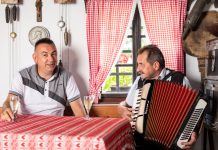
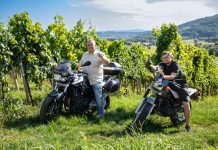
Vladimir Dragičević had already designed an entire series of labels when an agricultural inspector explained that geographical coordinates were not allowed on them.
To the architect from Bačka Palanka, it seemed perfectly natural to put the precise location of a wine’s birthplace beside its name. He was particularly pleased to have found information online suggesting that his vineyard in Neštin lay at almost exactly the same latitude as Château Lafite in Pauillac. Not merely the same degree and minute, but, according to those coordinates, almost the same second.
“If that means something to someone and they want to draw parallels, they’re welcome to. I found it a pleasing piece of information.”
The inspector did not. Regulations would not permit the coordinates to remain on the labels, so he had to change the entire series. Bureaucracy thus prevented a vineyard in Neštin from getting any closer to Château Lafite on the bottle than the authorities allowed.
There is just one serious complication in this whole story: before making his first wine, Vladimir Dragičević did not drink wine.
He did not avoid it on principle or have anything personal against it. It simply did not interest him. He had not grown up in a vineyard, inherited a family cellar or spent years dreaming of leaving architecture to become a winemaker. The vineyard entered his life in the same way that many of his winery’s names, labels and ideas would later emerge—by chance.
His wife Željka’s mother, Vida, worked abroad and did not want to leave her savings in a bank. Letting the money sit there seemed pointless, so she decided to buy land. Vladimir saw a vineyard in Neštin advertised on local television and suggested they go and look at it.
They did more than look.
It was September 2011, harvest time, and the seller, Slavko Orlović, knew when a vineyard looked its best. The vines were lush, the bunches ripe, and from the edge of the plot the view dropped towards Neštin’s rooftops, some thirty metres below. Beyond the village lay the Danube, with Croatia on the other side, while around them stood an old vineyard offering far more answers than they knew how to ask questions.
Grandpa Slavko was selling the vineyard with its entire crop. Vladimir had no idea what he would do with so many grapes. He knew the plot’s area and the number of vines, remembered a variety or two because he had heard their names in passing, and did not even know how old the vineyard was. Yet they decided almost immediately.

Vida’s savings went into the ground.
“We bought it spontaneously, without a single rational thought.”
For an architect working professionally in urban planning, where plans, conditions, areas, permitted uses and regulations must be checked before the first move, it was not a particularly architectural approach. Nobody drew up a project, calculated the investment or decided what the final result would be. They bought a vineyard, then began discovering what they had actually bought.
The Dragičević family had no winegrowing tradition of their own, but they had not arrived on land without a past. They took over the vineyard from the Orlović family, who had lived in Neštin and worked with vines and wine for more than a century. Vladimir did not grub it up or replace it simply because a new planting would be easier to explain. He filled the gaps where, after almost four decades, individual vines had reached the end of their lives, and tried to understand what he had inherited.
His first proper harvest came in 2012. A fire-damaged, ruined earthen cottage stood in the vineyard, which Vladimir and his father restored. Their cellar equipment consisted of a plastic vat, glass demijohns and a wooden press around 120 years old. Grandpa Slavko helped them crush the Vranac.
Once the grapes were in the vat, the vineyard’s new owner asked a question that encompassed the entirety of his winemaking knowledge:
“What now?”
“Nothing,” Slavko replied. “Leave it for ten days. Just punch down the cap.”
Vladimir did as he was told. He punched down the cap and waited, without great expectations or the knowledge to judge whether everything was going as it should. After a month, the wine was clean. And, to his surprise, good.
First he made it. Only then did he begin drinking it.
“When, out of sheer curiosity and for fun, I made and tasted my first wine, I knew there was no going back. You enter a labyrinth and can’t get out.”
They bottled their first wines in Vida’s garage. What was supposed to remain a few demijohns for home and friends began demanding more work, time and space. A vineyard of two thousand vines was hardly large by the standards of serious production, but it was too big for them to drink or give away all the wine themselves. Bigger still were the investments that followed every new decision.
Vladimir would later admit that he had wanted to walk away countless times. By the following day, the urge would pass.
He would come to say that he had not decided to take up wine; wine had found him.

Wine had found him, but it had not explained what he should do with it.
He learned wherever he could. He spoke to older people in Neštin, read books, searched online and turned every new harvest into practical training. Initially, he did not even know which questions to ask, let alone how to recognise a good answer. What he would now consider a mistake was then an experience he had to acquire.
Nor did he try to turn a beginner’s ignorance into a romantic virtue.
“When you do everything yourself, you learn as you go: from older people in the village, from books, from something you see online. But let’s be honest, without consulting proper experts and oenologists, it’s difficult to make it a serious undertaking.”
For the first few years, he was not even sure the venture would become a winery. He thought they would drink the wine at home and share it with friends, then discovered that every step demanded another. Grapes had to be processed, wine stored somewhere, bottles filled and sealed, and labels designed. If the wine was to meet the public, it needed a name. If it had a name, it needed a place to belong.
The earthen cottage in the vineyard offered his first solution. He planned to call the winery Kućerak u Sremu—Little Cottage in Srem—after the well-known tamburica song. The cottage really was in Srem, it was built of earth, the vineyard stretched above it, and the whole place had enough intimacy to evoke lyrics about youth, time and wine.
He thought he had found the perfect name.
He had not.
Kućerak u Sremu was only one of around thirty proposals he considered before registering the winery. At one point, he contemplated Arhaica. Then he was drawn to Serendipity, a word for a fortunate, unexpected discovery made while looking for something else. Few words could better describe a man who had set out to help his mother-in-law buy land and ended up with a vineyard and his first wine.
“That was my favourite. Then I saw that several wineries in Georgia had that name, and some in America too. I didn’t want anyone accusing me of copying.”
There was also Vinochio. He had a long-nosed figurine wearing a hat in the vineyard, the name combined wine and Pinocchio, and its playful irreverence appealed to him. Then he discovered someone in Italy had already thought of it.
Registration was approaching, and the architect who could draw an entire winery could not settle on two or three words for its façade.
The solution came at the winter Interfest on Kopaonik. There, he met Dutch wine journalist Paul Balke and complained about his struggles to find a name. During their conversation, he also mentioned the journey he made almost daily between his flat in Bačka Palanka and the vineyard in Neštin.
The distance was only eight kilometres. The journey, however, was much longer than the number suggested.
To reach Neštin from Bačka Palanka, Vladimir leaves Serbia, enters Croatia, drives through it for approximately a kilometre and a half, then leaves Croatia and re-enters Serbia. In one direction, he passes through four border checks, with another four on the way back. His vineyard is practically opposite his home, except that an international border and a road indifferent to straight-line distances stand between them.
Balke, a Dutchman accustomed to a world where European borders had long ceased to dictate everyday routes, found the story extraordinary.
His enthusiasm was enough for Vladimir. A boundary had to remain in the winery’s name.

Yet there were more than the administrative borders between Serbia and Croatia. Beside the vineyard lay an area called Hrastova Međa-Oak Boundary. Two international borders and an old local boundary thus provided the first part of the name: Tri međe-Three Boundaries.
A cloud was still missing.
His friend Tomislav suggested it, thinking it suited the imagery of the Pannonian Plain. Vladimir then remembered a conversation with Grandpa Slavko when they bought the vineyard. Understandably, the seller had praised the soil, vines, site and view. Then he said something Vladimir had not expected:
“You’ve got a good cloud here.”
He could understand good soil and healthy grapes, but had no idea how the quality of a cloud might be judged. Slavko explained that storms generally approached Neštin from the west. At the beginning of Fruška Gora, the clouds split, heading towards the Danube or turning further south towards the Sava and Mačva. That was why, he claimed, hail almost always bypassed Neštin’s vineyards.
Others later told Vladimir they could not remember serious hail at that site. So far, at least, the good cloud had kept its promise.
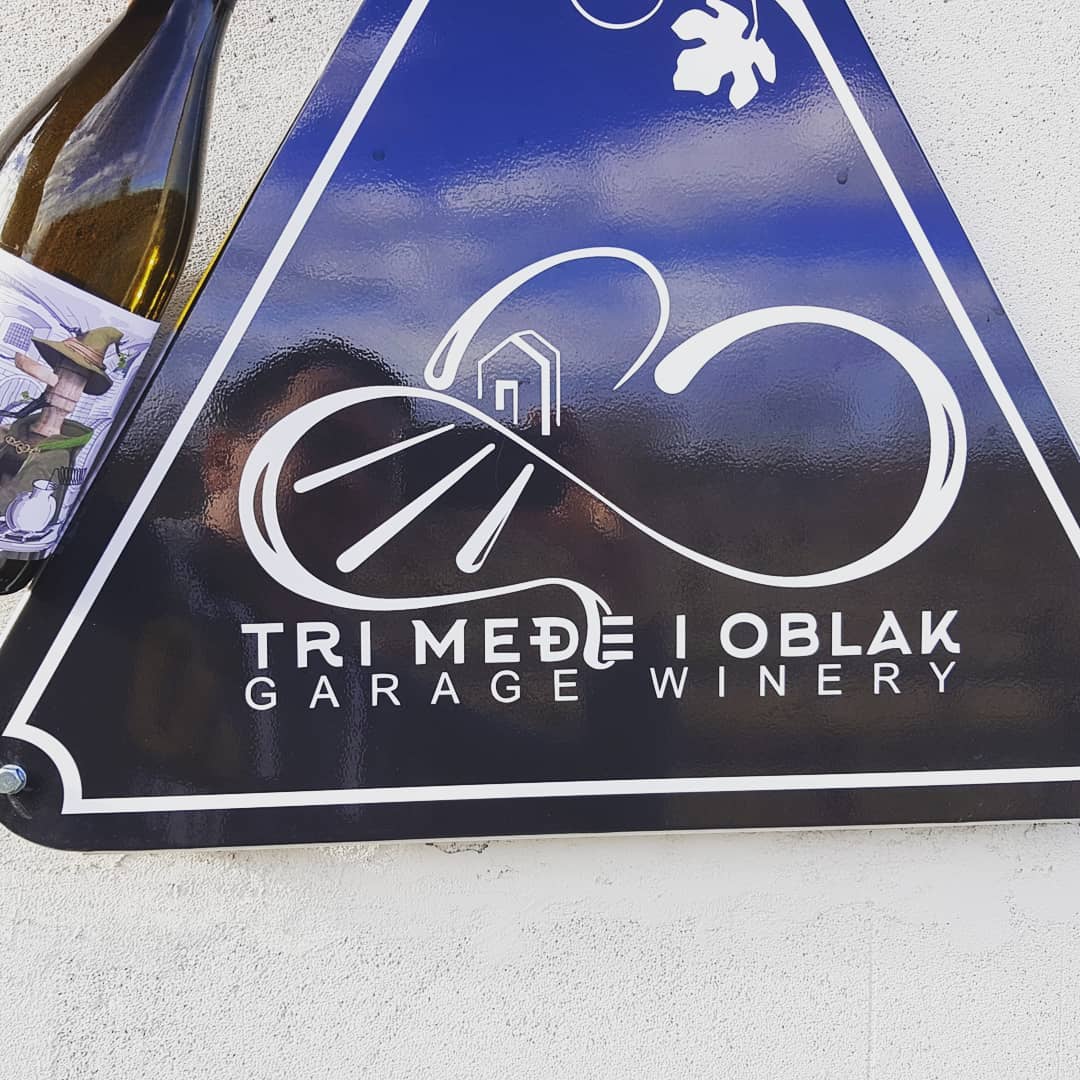
That was how Tri međe i oblak-Three Boundaries and a Cloud-came into being: two countries, eight border checks, Hrastova Međa and a meteorological recommendation from the man selling the vineyard.
Vladimir wanted a name that was different and memorable. He did not want his surname on the façade, because it said nothing about the wine. Nor did he want another Latin name of the kind already plentiful on Fruška Gora.
After rejecting around thirty proposals, he found a name whose meaning could not be explained in a single word.
It required an entire story. That was exactly what he wanted.
Once he had finally found the name, he still had to build everything that would stand behind it.
The winery was registered in 2016, five years after the vineyard purchase. It was not conceived as an investment property whose size predetermined future production. They built it gradually, by hand and through craftsmanship, as a family estate where cellar, vineyard and guest spaces would belong to the same story. They filled their first bottles in the garage and developed the winery at a pace both the business and the family could bear.
When it was described as officially Serbia’s smallest registered winery, Vladimir did not see that as a disadvantage. Small quantities allowed him to offer something large wineries struggle to provide: attention to every bunch, bottle and label.
“Our product is genuinely handmade. The amount of wine we produce allows us to devote ourselves to every detail.”

Annual production in 2020 was approximately seven thousand bottles. Vladimir did not dream of hundreds of thousands, nor measure success by the number of tanker loads leaving the cellar. He believed twenty thousand bottles would be enough to make the estate self-sustaining, while remaining small enough to preserve the way of working that had brought it into being.
“My aim is to leave this estate to my children. I think twenty thousand bottles is a scale at which I can give this the attention it deserves, alongside the architectural work I still do.”
Architecture and wine proved less distant from one another than they had initially seemed. In both, he had to connect place, material, function and form. As an architect, he was accustomed to imagining a space that did not yet exist, then making it real. At the winery, he thought similarly about the building’s position, the route by which guests entered, the view that greeted them and the relationship between the new structure and the old vineyard.
On the rise above Neštin, the vineyard ends almost at the edge overlooking the village. Below are the rooftops, beyond them the Danube, while above the vines stands a tasting room clad in the reddish colour of roof tiles. No grand asphalt road leads to it, only an unpaved farm track where dust and mud are part of the arrival.
Vladimir did not want a hotel with a tasting room, or a hospitality operation assigning guests to reservations and time slots. He imagined a cellar welcoming friends, wine lovers and chance passers-by. A place where wine could be tasted where it was made, beside the vineyard that explained every bottle.
For that road, he also needed a suitable vehicle.
He wanted a car that could cross fields, haul loads, get muddy without causing its owner despair and keep going after encounters with branches, potholes or stakes. Whenever he described his requirements, the answer was the same: a Renault 4.
He found one in Novi Sad in 2016. The deciding factor was something another buyer might have regarded as irrelevant. The car had been made in 1980, the same year Vladimir was born.
He bought it for three hundred euros.
A friend helped him tidy it up, refresh the paintwork and add the Tri međe i oblak logo to the body. The Renault soon acquired more names than the winery had before registration. Some called it Ranger, others Boot, others Little Giant. It could pull a surprising load, used little fuel, had hardly anything to go wrong and did not need protecting from the life for which it had been bought.
“It’s old, so I’m not afraid of scratching it or getting it dirty. There’s nothing to go wrong unless you actually break something. It’s perfect for my wine story.”
It was also a moving advertisement nobody could overlook. Like the winery’s name, it stood out without an expensive attempt to appear luxurious. People remembered the car, then the cloud painted on it, and then wanted to know about those three boundaries.
The Renault 4, dirt track, old wooden press and hand-built winery might suggest that Vladimir had deliberately staged a rustic setting. He had not. He had bought nothing to make the estate look older, more romantic or more photogenic. The press was already there; he restored the cottage because he needed it; he bought the car because he did not want to worry about its paintwork; and he preserved the vineyard because he saw no reason to tell healthy old vines they had gone out of fashion.
In that imperfection, he recognised his own measure of beauty.
The architect could give the winery its shape. Wine would teach him that its most important elements could not be drawn in advance.
Labels were a space where he could be an architect again without a building permit.
Even the first wine, intended only for himself and friends, needed something to wear. Design was familiar territory, so he began putting ideas together. He made around thirty labels. Some, he admits, were bad, others only slightly less bad, but none was good enough to stop working on.
Then he saw an old barrel.
On the label, he added wheels and turned it into a traveller belonging nowhere permanently. As soon as he developed the drawing, he knew he had found what he wanted. He called the wine Vagabundo.
“A vagabundo is a wanderer, a drifter, someone you can’t settle in one place. Through the vintages, I realised every wine is different. Every time, you discover something. For me, winemaking is a constant search, and a little wandering too.”

The name was understandable in different languages, resonant and international enough, but it had not emerged from research into potential export markets. It grew from his first encounter with wine and the feeling that he did not know where the next harvest would take him.
For the rosé Pagan, he drew an old wooden press with legs in boots, seemingly walking out of the vineyard. He connected the name with the original meaning of the Latin paganus: a country dweller, someone tied to the land.
“The vineyard is the essence of wine. Wine begins in nature, and in the cellar you can only preserve what you’ve achieved in the vineyard.”
The labels were therefore no mere decoration attached to a finished product. They arose from the same thinking as the wine. A barrel on wheels described each vintage as a journey without a certain destination, while a press in boots recalled the land someone had to work behind the contents of every bottle.
Vladimir oversaw everything, from vines and cellar to names, drawings and paper. It could weigh on him, but he found it difficult to hand over something of which he already had a clear vision.
“Enthusiasm still carries me.”
The first white Vagabundo was made from Sauvignon Blanc, later with the addition of Grašac. Its fresher component matured in stainless steel, while another gained fullness in wood and on fine lees. Red Vagabundo combined Cabernet Sauvignon and Vranac, ageing for approximately a year in Serbian-oak barriques. Pagan was a fuller-bodied rosé of Cabernet Sauvignon, Vranac and Muscat Hamburg, a wine with more to offer than a chilled glass before lunch.
Initially, he gave little serious thought to the market. Yet two thousand vines produced more wine than family and friends could drink, while new investments arrived much faster than consumers within his immediate circle. If he wanted to continue, the wine had to leave Vida’s garage and meet people who knew nothing about it.
The first official year was an experiment.
Vladimir wanted to see how the public responded to the wines, varieties, labels and story. He was not yet certain whether every idea should remain, or how close a small winery could come to self-sufficiency without losing what had inspired it.
The answers came quickly. At Belgrade’s Wine Jam-Young Guns festival, white Vagabundo was named best white wine. Pagan took second place among the rosés, and the labels won the award for best design.
The man who had not drunk wine before his own first harvest returned home with recognition for both his wine and its packaging.
The awards could not replace the knowledge he still lacked, but they confirmed that the winery’s unusual character interested others too. People remembered the barrel on wheels, the press in boots, the three boundaries and the good cloud, but returned because the contents of the bottle also had something to say.
After the initial excitement came the much harder task: making good wine again in a year that would be different.
Now Vagabundo had to live up to its name. Every new harvest sent it travelling again.
The first six vintages were enough to show Vladimir how mistaken he had been in expecting to learn a procedure once and then simply repeat it.
The vineyard changed from year to year. The same variety from the same plot arrived in the cellar with a different balance of ripeness and acidity, and a decision that produced an excellent wine in one vintage would not necessarily do so in the next. Each new experience answered one question while opening several more.
Vladimir gradually came to understand the sites around Neštin, particularly Petrov Breg and Rastova towards Vizić. He followed Sauvignon Blanc, Grašac, Cabernet Sauvignon, Muscat Hamburg and Vranac, trying to establish where each performed best. Some grapes came from their own vineyard, others from neighbouring plantings, but exclusively from Neštin sites. If the winery carried three boundaries and a cloud in its name, the wine could not lose the address from which it had set out.
“For years, we studied the vineyards, the potential of each variety and the techniques that could bring out its best. That patient work has begun to repay us. At last, we can show the imprint of this terroir in our wines.”
It sounds assured, but he did not reach that point without expert help. The experience of the village’s older growers was precious, as was Slavko’s first instruction beside the vat of Vranac. Serious cellar management nevertheless required oenologists. Vladimir had no wish to play the self-taught genius whose intuition supplied every answer. He made many decisions himself, but knew where curiosity ended and responsibility towards the wine began.

After Vagabundo and Pagan established the winery’s initial style, two new wines emerged from the 2020 vintage. The varietal Grašac Beli and the Chardonnay Bigfoot matured for ten months in barriques, followed by another six in bottle. Fuller and more characterful than the first releases, they showed how far the winery had travelled from the plastic vat and the question of what to do after crushing.
By name, Bigfoot naturally belonged in the same world as Vagabundo and Pagan. Vladimir did not want his wines sounding like members of a board of directors or approaching buyers burdened by the solemnity of a producer forever needing to prove himself. They could be playful on the outside, provided the wine inside had been made seriously.
Grašac brought a different kind of responsibility. The old vineyard amid which the winery was growing was itself a Grašac vineyard. The variety connected him with the place he had bought without knowing its history, and with a Fruška Gora winegrowing tradition far older than his own family’s story. There was no need to invent a legend. It was enough to preserve what already grew there.
In 2021, Tri međe i oblak ranked among Serbia’s ten best small wineries. The recognition was pleasing, but to Vladimir the word “small” mattered as much as “best”. He did not want production to exceed his ability to oversee the grapes, the wine and every bottle leaving the cellar.
By 2022, the range comprised five wines. White Vagabundo offered Sauvignon Blanc’s precision, aromatics and freshness; Pagan the fuller body of a rosé; and red Vagabundo a blend of Cabernet Sauvignon and Vranac with soft tannins matured in Serbian oak. Grašac Beli and Bigfoot revealed the ambition of a small cellar determined to prove itself through its wines.
A traditional-method Chardonnay sparkling wine was already ageing in the cellar. It was another step that promised no quick result. The wine needed time in bottle, on its lees, while the man who made it waited to discover whether he had chosen the right harvest date, base wine and all the decisions that followed.
Even ten years after buying the vineyard, he did not want to speak as a man whose work was finished. Asked where he saw the winery in another decade, he did not list new hectares, tanks or markets.
“I don’t think that far ahead. I’m dealing with the challenges in front of me. The only thing I’m certain of is that in ten years we’ll have better wine than we do today. Hopefully, the story will have developed further too.”
It is an unusual answer for an architect. His profession rests on imagining what does not yet exist. Before building begins, the future appearance, purpose, dimensions and relationship of every part to the whole must be determined. Winemaking had allowed him, for the first time, to work seriously on something whose final form he could not draw in advance.
He could design a cellar and tasting room. He could change a label thirty times, reject dozens of names and decide where to put the cloud on the Renault 4. He could choose barrels, processing methods and ageing periods. But he could not design the year, sunshine, rain or the moment when the grapes chose to reveal the site’s character.
His goal was therefore a sustainable winery, small enough to remain handmade and serious enough to leave to his children one day.
What began with Vida’s decision to turn savings into land was continued by Željka and Vladimir, transforming a vineyard bought by chance into a family estate that would outlast their first enthusiasm. They shared the work and the time that small-scale production consumes as relentlessly as large-scale production.
A small winery does not necessarily mean little work. When an owner oversees vineyard, cellar, bottles, labels, guests, sales and the dirt road to the estate, there are few people to whom responsibility can be passed. What looks from outside like an architect’s romantic escape into nature often ends in washing equipment, filling bottles or worrying about the weather when he ought to be working on urban plans.
So there were days when he wanted to give up.
The following day, he would go back to Neštin.

Perhaps for the vineyard, perhaps for the wine waiting in the cellar, perhaps for the view towards the Danube. Or perhaps because a man who had entered the wine labyrinth could no longer find the exit. He was not looking particularly hard for it anyway.
The borders still stood on the road from Bačka Palanka to the vineyard. Eight kilometres and eight border checks for the round trip. What others might regard as daily administrative harassment, Vladimir had incorporated into the name.
And the cloud still remained above the winery.
It was no logo invented in a design studio, but Slavko’s recommendation for the land he was selling: a good cloud that, he said, steered storms away from Neštin’s vineyards. Vladimir did not need to be certain of the story’s meteorological science to respect it. It was enough that local people passed it down and that, during his own years in the vineyard at least, it had mostly proved true.
Just as he did not need to prove that his Grašac vine stood at the same second of latitude as Château Lafite.
The coordinates had to disappear from the label anyway. After all the changes, they were no longer needed. The wine had acquired its own address through names, drawings and character: an old barrel on wheels, a press in boots, three boundaries to cross and a cloud that supposedly knew where to go.
Vladimir Dragičević had not dreamed of becoming a winemaker. He went to look at land his mother-in-law wanted to buy and returned with a vineyard, an old press and a question he would answer with every new harvest.
“I didn’t find wine. Wine found me.”
The inspector would not let him put coordinates on the label.
It turned out he had never needed them to find his way.