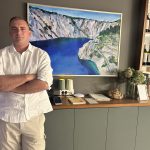
“Texas drinks more Bikicki wine than the whole of Serbia.”
Đorđe Bikicki said this in early 2025 without triumph or false modesty, as a fact that still struck even him as slightly unusual. Besides, it was not just Texas. During 2024, wines from his organic vineyards in Banoštor reached 23 countries, from Mexico, the United States and Canada to Japan, Australia, China and South Korea. Around 75 per cent of production was being exported, although the quantities were generally modest: a pallet to one destination, ten to another, somewhat more to America.
More unusual still is that the man whose wines now travel the world barely drank wine until he was well into his twenties.
“My level of knowledge was zero.”
Family tradition did not open the door to wine for him. Born in Belgrade, he spent part of his childhood in Buzet, his secondary-school years in Kovin, trained in Grocka and eventually returned to Belgrade. Wherever he went, he seemed to remain slightly on the outside for a while-close enough to observe everything, but never so rooted that he accepted things had to remain exactly as he found them.
He started school in Istria at six, skinny and small. He was the shortest in his class, then the smallest in water polo, then the shortest in basketball.
“When you’re the smallest in the pool, people keep dunking you. Then you realise you have to find your strength somewhere else.”
When he finally grew taller, he remained a point guard. He had learned to read the whole court, look for openings others missed and make decisions before the space closed down. He played in Serbia’s first and second leagues, but at 21 he drew a line.
“If I can’t be among the best, I won’t do it at all.”
He left basketball, decided to complete his civil engineering degree, specialising in hydraulic engineering, and join the family business. Yet another arena-this time a musical one-continued to draw him in.
He discovered drum and bass on his own. Nobody took him to a club or told him what to listen to. He downloaded software, bought decks and taught himself to mix. At first, he played in flats and small clubs. Later, as DJ Bitz, he reached Belgrade’s Barutana, sharing a stage with major names from the drum-and-bass scene, including S.P.Y. and MC Stamina.
Yet the biggest shows were not his favourites.
“Dot is where I enjoy it most. Two hundred and fifty people, an intimate atmosphere, everyone knowing exactly why they’ve come.”
Many years later, he would speak about wine in much the same way. What mattered was not that everyone should drink it. What mattered was finding the people who had come precisely for that kind of music-or that kind of wine.


The Bikicki family’s involvement in wine began in 2009. His father, uncle and a business partner joined forces with Banoštor local Jovan Radošević, bought land and established Vinarium. Within three years, they had planted 26 hectares of vineyards.
Đorđe entered the venture without any wine experience. He watched Jovan oversee production, learned about vineyards, varieties, the cellar and harvest, and worked to a rhythm set by someone else.
The first wine that truly struck him was a Traminer from the 2009 vintage.
“I’ll never forget it. Everyone who tasted it was stunned. That was when I realised something great could come out of Banoštor.”
It was not the prospect of markets, exports or building a brand that set him in motion. It was the excitement of a wine he had not expected.
The Vinarium partnership did not last. In 2012, Đorđe decided to leave, but he did not want to abandon either the vineyards or what he had begun to discover.
“When Vinarium broke up, I didn’t want to let everything fall apart.”
At that point, he still did not know what kind of wines he would make. He knew only that he did not want to carry on where he had left off.
At a wine fair, he found himself opposite Oszkár Maurer’s stand. He tasted wines that did not fit what he had learned about technically correct, controlled and predictable winemaking. They were different, unusual and alive. He did not see them as products whose rough edges needed smoothing, but as something with a character of their own.
He began visiting Maurer in Hajdukovo, watching him work in the vineyard and cellar, asking questions and tasting.
Then one day, he simply asked:
“Will you be my winemaker?”
Maurer thought for about fifteen seconds.
“Sure.”
Đorđe gained not only a winemaker but also a teacher, a cellar and a place where he would spend years developing his own relationship with wine. Maurer did not offer him a ready-made formula. He showed him how many decisions he could leave to the grapes, the vineyard and fermentation without abandoning his own responsibility.
Here, the DJ and the winemaker do meet, though not because fermentation sounds like drum and bass. In a club, a poor transition can be corrected with the next track. In the cellar, an entire vintage carries the consequences of a bad decision.
“In the club, everything takes four minutes. In the cellar, four years.”
His first independent harvest was in 2013. He made three hundred bottles of dry Traminer and gave them to friends. He was not looking for a market. He wanted to find out whether anyone would understand what he was doing.
The first label read Prirodno vino-Natural Wine. Later, he removed the word “wine” from the name to avoid legal arguments. Only Prirodno-Natural-remained.
He did not want that word to conceal a marketing invention. To him, it meant organic grapes, spontaneous fermentation, indigenous yeasts and as few corrections in the cellar as possible. He was not claiming that the winemaker did nothing. On the contrary, the winemaker had to keep observing, making decisions and accepting the consequences.
“I didn’t want to shape the wine according to a predetermined idea. I wanted to allow it to come into being.”
Four years after his first independent harvest, his quantities were still small enough for a large winery barely to notice: 750 bottles of late-harvest Traminer from 2013, the same number of Sauvignon Blanc from 2015, and 1,200 bottles of Pinot Noir from 2014.
His wines acquired names that had not emerged from brand-positioning meetings. He named the Traminer Makana after his wife Marija’s nickname: she is sweet, he says, and has a sweet tooth. The rosé Nadia was named after his daughter. The Pinot Noir Pinotte after his dog.
After their dog died, the family wanted to bring some joy back into the house as soon as possible. A breeder offered them several possible names for a new dog, including Pinotte.
“We looked at each other and said, ‘That’s it.’”
Victor, Nikka, Lilly, Moma and Veca would follow in much the same way. The names of Bikicki wines resemble a roll call of the people and creatures in his life more than a conventional wine portfolio.


In December 2016, Đorđe Bikicki made his first independent appearance before a wider wine audience at the Wine Salon in Belgrade’s Hyatt hotel. There was no elaborate stand, no advertising displays and no aggressive promotion. Just a table and his wines.
People approached out of curiosity. The whites disappeared first.
He did not want to make wine for everyone.
“I don’t want the wine to have an audience. I want it to have an audience of its own.”
That audience turned out to extend far beyond Serbia.
Exports gathered momentum during the pandemic. Enquiries first began arriving from Denmark, then Texas, and a succession of markets opened up. Bikicki wines found buyers in northern and western Europe, North America and Asia. Organic production, unconventional styles and small batches, long regarded in Serbia as Đorđe’s fringe experiment, proved an advantage internationally.
“Perhaps I was in the right place at the right time. Oszkár used to tell me I’d understand once exports took off. I didn’t understand him then.”
Now he does. A new generation of buyers wants to know where the grapes come from, how they were grown and what the winemaker did-as well as what he chose not to do. Large volumes and loud promotion are no longer the only routes to market.
Yet Đorđe has no faith in the romantic idea that good wine will sell itself.
“Anyone who makes good wine and thinks it will sell itself is badly mistaken.”
A small winery, he says, cannot afford to compete with the big producers using their weapons. It has to be more agile, more creative and prepared to go further. He attends fairs, tastes, listens and asks questions.
“I think what drives me most is a childlike curiosity. I ask a hundred questions about how something came into being, and then I listen to the answers.”
That curiosity eventually led him out of Maurer’s cellar too.
After roughly ten years of working together, he felt he had learned enough to take full responsibility once again. He moved his winemaking equipment and vessels to Veliki Radinci and made the 2023 vintage there with brothers Nenad and Đorđe Siriški, who had also learned from Maurer.
He had gained what he wanted:
“Now I depend on myself.”
With the move, he also dropped the name Bikicki Natural Wines. Only Bikicki remained.
“In some overseas markets, the word ‘natural’ has already become a little ridiculous. The future of wine isn’t natural wine, but good wine. Besides, this was never intended to be Đorđe Bikicki’s winery. It’s the Bikicki winery, where a team creates something beautiful.”
Moving to the cellar in Veliki Radinci opened a new chapter. Three major accolades soon followed: Bikicki was named the best winery producing up to 30,000 litres, the 2022 Uncensored Traminer won the orange-wine category, and Vino.rs named Bikicki its Brand of the Year for 2024.
His next big idea is not another label, but a biodynamic farm in Banoštor: an integrated whole in which vineyards coexist with other plants and animals. He plans to acquire a flock of the indigenous Karakachan sheep breed, plant fruit and vegetables, and perhaps even olive trees in the village.
“The dreams have grown and expanded. I’m no longer interested only in the vineyard, but in the whole farm.”
For him, organic production is neither a decorative claim on a label nor a trend to exploit. He considers it the only truly sustainable path because it improves soil microbiology, helps vineyards cope with climate change and produces better grapes.
That is why he becomes irritated when spraying less in good years and more in bad ones is described as sustainable viticulture. He is also troubled, he says, by the fact that some Serbian wines are made from much cheaper grapes bought in Macedonia.
“Why would anyone take on organic farming when they can buy grapes from the south for a third of the price? That’s the crux of it.”
He does not see the future of Serbian wine in the endless expansion of international varieties. He believes a time will come when Serbia offers its Chardonnay at three euros and buyers offer a euro and a half, because the whole world already makes that kind of wine. In his vineyards, he therefore wants to return to varieties with historical roots on Fruška Gora: Kadarka, Furmint, Grašac and Blaufränkisch. He is particularly interested in Sremska Zelenika.
“The name alone tells you, through simple common sense, that it’s the right variety in the right place. I’m not inventing anything, just listening and adapting.”
Adaptation has also become more important because of climate change. The 2025 growing season in Banoštor worked in their favour: rain came at the right moments, without torrential downpours or severe drought. In the cellar, they used carbonic maceration as part of an approach that allowed them to pick somewhat earlier, with lower potential alcohol, and produce lighter wines without losing character.
“Year after year, nature is pushing us towards more alcohol and heavier wines. I think we’ve found a balance between what nature gives us and what today’s market wants. Perhaps we’re taking a gamble, but we’re happy with the direction.”
In May 2026, he presented eleven wines at Belgrade’s Wine & Pleasure wine shop. The new vintages and labels included Sfera White, Sfera Orange, Nikka, Veca, Victor, Moma, Uncensored, Cu, Lilly and Makana. Meanwhile, the winery in Veliki Radinci had also opened its doors to wine tourism.
At that tasting, a common thread running through the wines was clearly apparent for the first time. After years of exploration, spontaneous fermentations, different vessels and a search for new expressions, a recognisable winery signature was beginning to emerge.
Đorđe himself reckoned they had reached around 90 per cent of what they wanted to achieve.
There was still room, then, for questions, experiments and the occasional new label.
As the tasting drew to a close, someone asked whether there would be any more that year.
Đorđe looked at the eleven open wines. “How many more can we possibly make?”