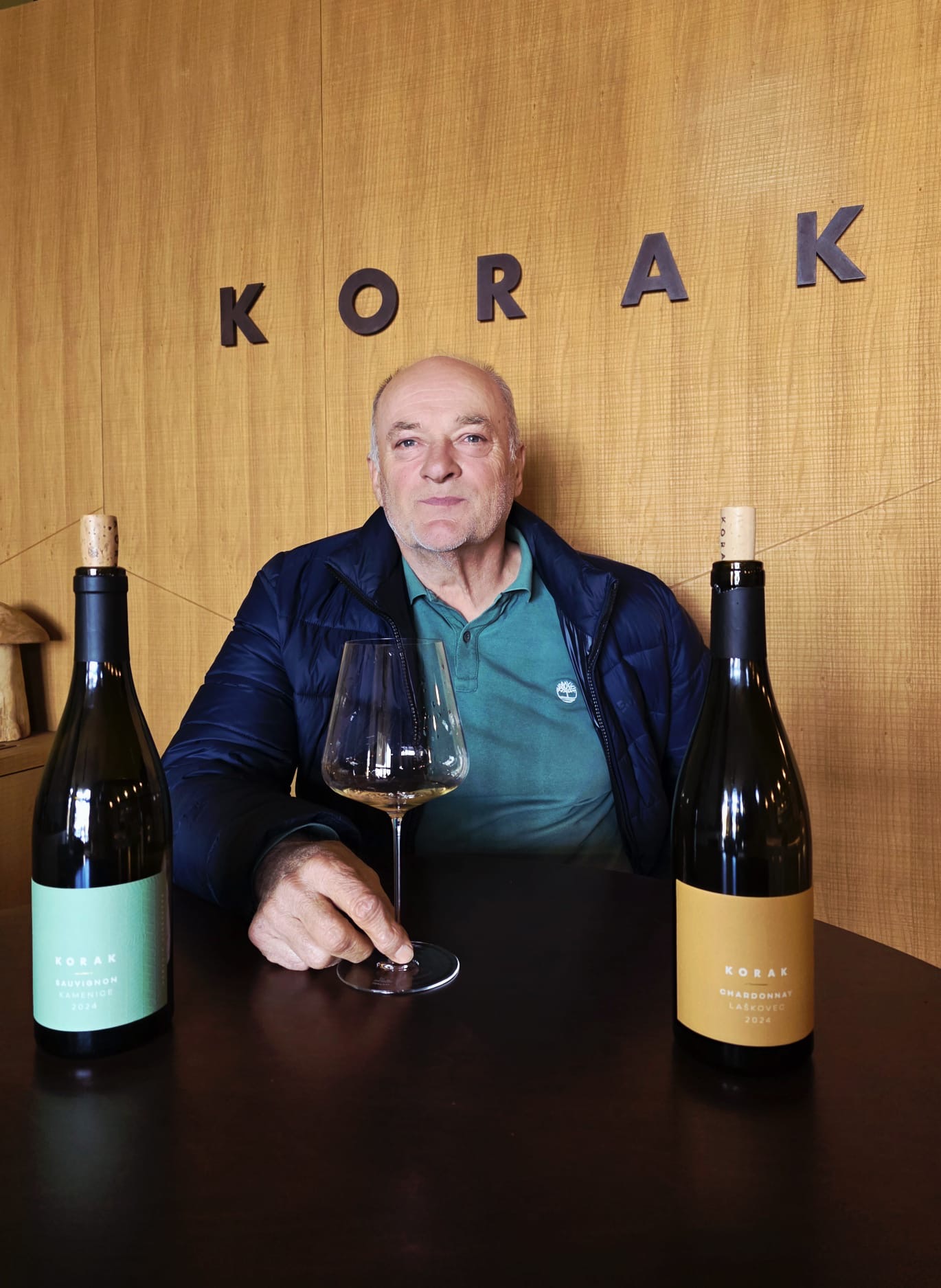
Velimir Korak was preparing to head to Ljubljana for a Bob Dylan concert, but before setting off he had a few complaints about what the man was doing with his songs these days. He admits he had not followed Dylan particularly closely since the late 1990s or early 2000s. Now he had been listening to some recent performances, trying to recognise what he used to listen to.
“Even the old songs have new arrangements. They’re unrecognisable. I was listening to ‘One More Cup of Coffee’ and thinking: come on, that can’t be! His language and diction are quite hard to understand. He’s turned everything upside down. I’ll be very interested to hear what it’s like at the concert.”
He knew he would not simply be hearing a string of the best-known songs. He had looked at what Dylan was playing on tour, listened and grumbled a little. He was going to the concert all the same.
I remind him that it was he who once told me: life must not become a routine; you must always have something to play with! Perhaps Dylan is playing too. He knows the song; now he wants to see what else he can do with it.
“That’s more how jazz works. Every performance is different.”
I had not quite convinced him. Velimir would clearly also like to recognise the song he had come to hear. But as we discussed those arrangements, I already had a question for his cellar: would he make all his wines today exactly as he had twenty years ago? The answer would bring us to a Sauvignon from 2000 that he once defended, but for which he would now hurry to harvest earlier.
We would soon establish that someone born in the same year as Dylan lives with the Koraks. Katarina, the mother of Velimir’s wife Mirjana, was born in 1941 and still cooks for the whole family. Her grandson Bernard is the chef of a Michelin-starred restaurant, but Grandma still takes care of the family lunch.
“She hasn’t worked in the vineyard for quite a long time. Grandma is special.”
I remember Katarina from a photograph in the tasting room: eight months pregnant, working in the vineyard with a large basket on her head. Mirjana has not yet been born, but she is already among the vines with her mother.
“It was taken by an uncle of theirs who had come from America. He had a camera and stayed with them for two months. A hardworking woman, like all the women of that generation who lived in the countryside.”
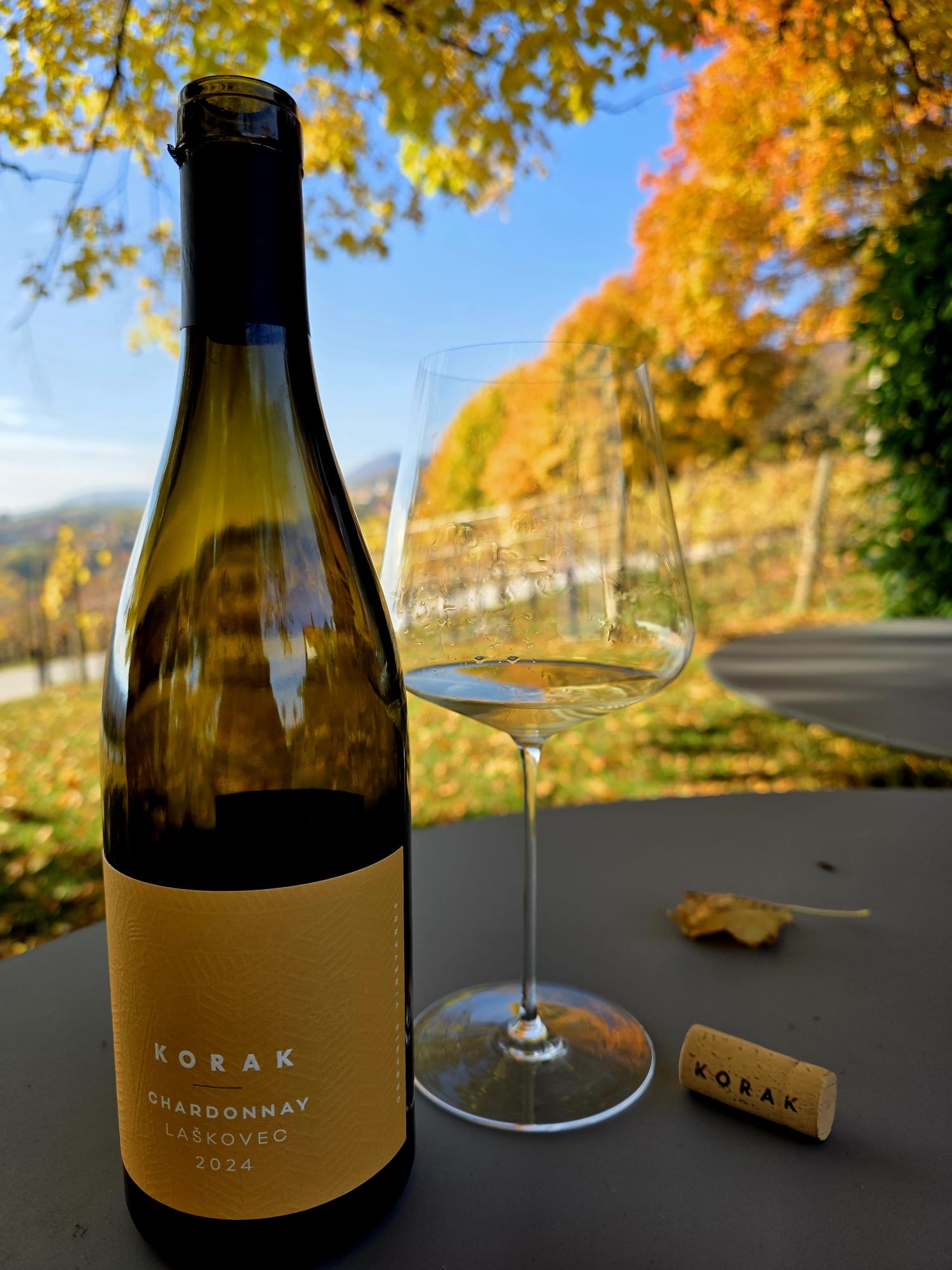
The estate brings together the winegrowing heritage of two families: the Koraks and the Trumbetić family, from which Mirjana comes. Velimir says that even their grandfathers’ grandfathers made their living from wine. Yet he did not grow up planning to open a private winery one day.
“I come from a time when people said: ‘Go to university, study, so you won’t have to work as hard as we do.’ That’s what our parents told us. Even when I finished university, we weren’t thinking of becoming private winemakers. I’d be lying if I said otherwise. Those were different times.”
He graduated in agronomy, took a job as an oenologist at an agricultural cooperative and left in the early 1990s to make his own wine. I ask how difficult it was to walk away from a secure salary.
“There are always doubts, but in my case they weren’t that great. In fact, I stayed too long. I should have left sooner. The year I left, and for a few years afterwards, especially that first year, I was the happiest man in the world. You feel a kind of freedom. It’s wonderful.”
Leaving the cooperative allowed him to devote himself fully to the family vineyards and his own wine. Customers, however, had to be convinced that Plešivica could produce great wines. He used to speak about that with far more fire than he does today. Stories of adulterated wines from a region where his family had lived by making honest wine hurt him particularly deeply.
“People in Plešivica have always grown grapes and made wine. Between the two world wars, all the larger producers had their own innkeeper as a customer. So my family had long been producing for the market, because the wine almost automatically ended up on a table, whether it went out in a bottle or a barrel. At home, we always discussed whether the wine was good or not. That was everyday conversation over lunch.”
The family’s wine, he told me, was also delivered to Lovački rog and the Esplanade. Later, small winemakers lost that direct connection with their customers, and Plešivica was spoken of primarily as a source of light wines for spritzers. Velimir kept explaining what its vineyards could produce. Today he answers the same question in a single sentence:
“There’s no longer any need to convince people that this is one of the best areas for wine.”
What has not changed, however, is his belief that good wine requires far more knowledge than some are willing to admit. He objected to the “enormous amount of anti-intellectualism that has gathered around wine”, as though the rule were: “The less I know, the more natural and honest I think I am!”
“We’re not that kind of winemaker. Quite the opposite: you need to know a great deal to make good wine! Anyone can happen to make a good wine, but producing good wines year after year takes a lot of knowledge. It’s a fantastic feeling to make good, honest wine and earn your living from it. You can’t imagine how satisfying it is.”
I ask where a wine’s personality ends and a fault begins. Has he ever rejected a wine that others defended as interesting or natural?
“I don’t like faulty wines. I’m very sensitive to that. Being natural cannot be an excuse for sloppiness. Nature is ruthless. If you don’t look after things, it all goes wrong.”
Korak has considerable experience of wines made with as little human intervention as possible. When we discussed his 2011 Pinot Gris many years ago, the conversation was prompted by a colour that had surprised me at a tasting at the Esplanade. I had barely managed to reach him by phone: there was no signal in the cellar, and Velimir was difficult to find anywhere else.
“The colour of this Pinot Gris keeps changing. When it was bottled, it was darker, onion-skin coloured and slightly reddish. Since then it has turned pink. This is a German clone of Pinot Gris with very deeply coloured skins, and in the vineyard it’s planted just below the Pinot Noir. We pick it first, and if I don’t warn the pickers in time that it needs harvesting, later on they won’t be able to tell the two varieties apart, even if they try.”
He made that Pinot Gris as though it were a red wine. Maceration and alcoholic fermentation on the skins lasted three weeks. Only then was it pressed, and the wine spent twelve months on its lees in older barriques, in their fifth, sixth or seventh year of use. Another year in a large wooden cask followed before bottling.
“This Pinot Gris was definitely not made as a fresh, youthful wine!”
Then came experiments with white varieties left on their skins for more than two hundred days. Velimir kept them there from harvest until shortly before Easter, aiming to make wine without added sulphur or other treatments. He knew that long maceration would diminish some of the varietal character, so he intended to combine them in a blend. The range was named “U traganju za zaboravljenim vremenom” – “In Search of Forgotten Time”.
Today he looks back on those experiments without feeling any need to repeat them every year.
“You get a completely different type of wine. You can’t look for the variety in it; it’s something else entirely. That’s not where my head is at the moment.”
He was particularly pleased with a 2025 wine made from old varieties grown in vineyards trained to individual stakes, some of which still survive in Plešivica and which the family is gradually buying. Maceration is shorter, around seven days, while fermentation takes place, followed by pressing. He would like to bottle these lighter wines early enough for them to be enjoyed young. The 2025 had about eleven per cent alcohol. They made no skin-macerated whites in 2026: hail had reduced the crop, and the berries contained too little juice in proportion to the solids.
His explanation of how wine used to be made here is much simpler than today’s debates about orange wine. People did not have large presses. They put the grapes in casks, waited for fermentation to begin and for the cap to rise. They then drew off the liquid, leaving a much smaller volume to press.
“They were lovely wines. Fermentation had only just started in the cap. That was the traditional way of doing things here.”
When he made his first sur lie Chardonnay in 2000, customers needed to understand what ageing on the yeast lees brought to the wine. That was why the method appeared on the label. The wine found its customers, and the wording stayed.
“That way of making wine is a little more honest. It demands that you put your whole self into the process. You can’t fool anyone,” he explained.
But the wine has to live up to everything said about it:
“We can tell our story, but wine is mostly drunk where our story isn’t there, and where we aren’t there to tell it!”
He is just as strict about that today. A bottle may leave the cellar and wait for years before someone opens it.
“We would never bottle a wine that wasn’t fit for bottling. We never have. Every bottle carries your signature.”
And then we reached his 2000 Sauvignon, with fourteen and a half per cent alcohol. He defended it then; today he would not make it that way.
“Back then, if you made a wine with fourteen per cent alcohol, everyone automatically said: ‘That’s a great wine!’ Today it’s seen as carelessness. Why would you harvest grapes that give you that much alcohol? We’d be rushing to pick them.”
There was his own new arrangement. The same variety, the Plešivica setting, but what once satisfied him was no longer something he would repeat.
The climate has changed in the meantime, too. In Plešivica, grapes used to be picked around Michaelmas, on 29 September, and into October. The vineyards contained various old Belina varieties and others that did not accumulate high levels of sugar. Today, picking can begin in August, vineyard protection treatments end in early July, and the changes are felt in the cellar as well.
“The rainfall pattern is different. The climate is moving towards extremes. The pH of our grapes is changing dramatically. That’s a major problem.”
With a higher pH, he explains, malolactic fermentation finishes much earlier, so the wine also needs protecting with sulphur sooner. At a lower pH, the process could stretch into spring; there was gas in the cask, and the wine developed at a different pace.
“When we open a Pinot from twenty years ago today, it’s wonderful in the bottle. How long these wines made in this climate, with these extreme temperatures, will live – time will tell.”
Riesling remains one of the wines that gives him particular pleasure, and one that makes him grumble. He has always believed that the variety receives less attention, and attracts fewer buyers, than it deserves.
“Riesling has a hundred faces, perhaps like no other variety in the world, and the potential to be excellent in all those forms! It also has an ability to age in bottle like no other variety. We’ll never abandon Riesling, because we have so much emotion and faith invested in it,” he told me.
He has not given up. Nor, he says, has the market rewarded him with any great shift in fashion.
“There was Chardonnay, then came Sauvignon, then Pinot Gris. The Germans hoped Riesling’s time would come, but it simply isn’t fashionable. We can’t give up on Riesling here. It would be foolish. We can produce truly outstanding Rieslings.”
With similar persistence, he defended Plešivica’s right to recognition despite its lack of a major, widely known indigenous grape variety.
“We don’t have a blockbuster variety like Malvazija in Istria or Graševina in Slavonia. Although I’m sure this area is excellent for Graševina. It would just take me a very long time to convince people that we have good Graševina, or at least one as good as our colleague Krauthaker’s in Kutjevo! We don’t have time for that kind of persuasion, and that’s why we never wanted to plant it.”
And on indigenous varieties, he concluded:
“If being indigenous is an end in itself, then it’s a souvenir.”
Today he would not expand the range of varieties simply to have something more to offer. Chardonnay and Pinot Noir are important for both still and sparkling wines. When I asked him to choose three wines from the archive that would explain the family’s history, he picked Riesling, Chardonnay and Pinot Noir.
He now runs the winery with Josip. Even as his son was finding his feet in the business, Velimir spoke of gradually stepping aside in the face of his passion and energy.
“Everyone is entitled to their twenty or so harvests, because there’s always someone behind you knocking, asking for their place.”
But Josip had not chosen that path for himself from childhood. When his parents steered him towards agricultural secondary school, there were tears.
“It was a shock to him. He cried. His classmates were going to academic secondary schools, and he was going to agricultural school. We didn’t want to lose him, for him to drift off somewhere. In the end, he saw that the world of wine is exciting and very challenging, especially for a young person. It isn’t always toil and suffering. There are wonderful encounters, friendships, journeys. A winemaker’s life can be wonderful.”
He later graduated in agronomy and gained experience at Warwick in South Africa. Velimir says that his time there also gave him a better appreciation of the advantages of his home region.
“They acidify there. We’re lucky: if everything is done properly in the vineyard, there’s no need to intervene in the must or the wine. That’s how the soil is, and for now the climate is good too.”
Sharing the decisions in the cellar brought no revolution. Josip had worked alongside him since boyhood, so the work gradually became a shared undertaking. Velimir recalls no great clashes over how to make a wine. I tried to tease him: so he had trained his son well, then?
“You shouldn’t be pleased just because someone does things your way. If all parents were satisfied with their children doing things their way, the world wouldn’t move forward very much. I haven’t done the same thing throughout my working life either.”
Josip’s sparkling wines now call for an additional cellar. They made them for years, waiting until they were ready for the market. Today they are brut nature, with no dosage, but each new harvest means more bottles that need somewhere to lie on their lees.
“When the vintage is good and the wine has the right characteristics, the longer it stays on the yeast lees, the better the sparkling wine. We’ll have to build another cellar, because sparkling wine takes up an enormous amount of space.”
Bernard’s entry into the family business was quite different. He was studying civil engineering and dropped out in his third year. He did not tell his parents straight away. Then he announced that he wanted to be a chef.
“I asked him: ‘Do you know what being a chef means? It’s incredibly hard work.’ And he said: ‘I’d like to be a chef.’ I said: ‘All right.’”
While still a student, he spent time with the Gastronomadi culinary team. After a season working on the coast, he went to Dubravkin put in Zagreb.
“Who’s going to employ you? You haven’t worked anywhere; you haven’t been to culinary school. For a month or two he turned up and worked for free. I didn’t get involved after that. Then they hired him. He was good.”
Priska Thuring recognised his talent and recommended him to Ana Roš. He began by working without pay there too, then was hired. He also gained experience with Massimo Bottura in Modena. Even then, his father was not encouraging him to stay somewhere simply because things were going well.
“I told him: ‘You’ve been in one place too long.’ If someone is talented and has a good head on their shoulders, if they want to grow, they mustn’t get stuck somewhere.”
Eventually he came home. Today Bernard runs the kitchen, his sister Vera the restaurant, while Velimir and Josip look after the wines. But hospitality had come to the estate long before Bernard’s return, thanks to Mirjana.
“We certainly wouldn’t have gone into the tourism side of things without her. She started it. Of course, we were all involved, but eventually all of that grew into this restaurant.”
Mirjana and Katarina cooked duck with mlinci – baked flatbread softened in the cooking juices – roasted knuckle, strudel and other dishes that encouraged people to linger over their wine longer than planned. Mirjana also knew just how deeply her husband was immersed in wine: for their twentieth wedding anniversary, he took her to the cinema to see Sideways! A love of Pinot Noir evidently needed celebrating in the dark of a cinema too.
“Mirjana remembers that from time to time and tells it as an anecdote.”
Velimir has never been the sort of winemaker most at home in the middle of a noisy party. He admits that gatherings on the estate used to get on his nerves. The family lives there too. That is why the restaurant they have today, strange as it may sound, brings him more peace.
“The restaurant can be full and we don’t even realise there are lots of people here. Everything is calm. I often say that coming to this restaurant is like going to the theatre. We live alongside it. It’s a real pleasure.”
When it closes for holidays, he sometimes misses that little buzz. Through Bernard’s work, he has also met chefs and seen at close quarters what it takes to produce what a guest receives on the plate.
“There’s no routine here. You have to stay focused all the time. Your passion mustn’t leave you. So many dishes are created here. As each ingredient comes into season, the dishes change. It’s never the same. It’s exciting work, but physically and mentally demanding. There’s no letting up. Being a chef is an extraordinary thing.”
Naturally, the family’s own wines are the most popular in the restaurant, but the list also includes other Plešivica producers and an international selection. There is no requirement for every one of Bernard’s dishes to be accompanied by a bottle of their own.
“We’re not in love only with our own wines.”
The winery produces around fifty thousand bottles a year. Velimir sees little scope for a family business like theirs to increase production substantially while maintaining the standard they want. That would require more exports, and exports do not guarantee a better price. The restaurant helps, but it cannot replace having their wines on other people’s tables.
“A winery can’t function just by selling its wine at home. The wine needs to be available elsewhere for people to have a reason to come to us in the first place. Good cellar-door sales certainly make the business easier.”
Towards the end, when I ask what he would preserve on the estate and what he would leave his children to change completely, he begins talking about uncultivated land. Every suitable vineyard site has already been planted, but their families also used to keep livestock and grow field crops. Some of that land is now used by no one.
“That land could be put to use, but the family would have to operate differently. We’d need someone to take care of it. We could do it; we’d just need the labour.”
Not everything, he says, has to turn a profit straight away. He could afford to take on work for which that was not the first requirement. What matters is that the land should be cultivated again, both theirs and their neighbours’.
“If that land were brought back into use, the countryside would look more like it used to. There wouldn’t be scrub and abandoned plots. It would look different.”