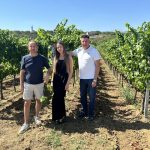
For three years, Tatjana Trivić and Mihajlo Narančić waited for apricots. And for three years, instead of a crop, they received the same answer: nothing.
The first year brought frost; the second, frost again. By the third, they knew the sequence well: first hope, then anxious glances at the sky, and finally calculations in which apricots no longer featured. The trees flowered beautifully. They simply never made it to harvest.
“I hear the beginning of your Fruška Gora adventure provided quite a good example of not knowing what you were doing,” I tease them.
“Oh, you’ve heard about the apricots!” Tatjana laughs. “We planted them and learned as we went. First year, first frost, nothing. Then the second, then the third…”
After the third attempt, they looked around. As far as they could see, vineyards covered the slopes of Fruška Gora.
“We just looked at each other and said: let’s plant a vineyard too!”
They knew nothing about vineyards. Mihajlo did not even drink wine. It is difficult to imagine better conditions for founding a winery.
“Wait, you had absolutely no previous knowledge? Neither of growing grapes nor making wine?”
“Nothing. Zero,” Mihajlo admits. “I worked at Autogas, servicing cars, and Tatjana was in sport.”
“So you knew nothing about viticulture, and you didn’t even drink wine?”
“He never drank it,” Tatjana interjects, almost as though she needs to defend him.
“Then you’re either very brave or completely mad.”
“A bit of both.”
Before planting the first vine, they faced six months of clearing woodland, ploughing and preparing the soil. The ground then rested over winter, and planting began in spring. This was no romantic escape from the city into the vineyards. They were entering a business about which they knew almost nothing, on land that had already warned them three times, through the apricots, that it had more say than its owners.
Yet the apricots had taught them at least one important lesson. Once ripe, they gave you a day or two to sell them. If you failed, you could throw them away. Grapes offered another possibility: they could become wine, and wine did not demand the same haste.
Mihajlo had had enough of haste.
“The noise, the travelling, the constant rush… It all began bothering me enormously. Then you come here: peace, quiet, not a sound.”
They moved from Novi Sad to Srednji Matej, above Sremski Karlovci. Today, they have four and a half hectares of vineyards there and Trivić & Narančić Winery. They began the journey from the first frost-damaged apricot blossom to their first bottle of wine without experience-or any opportunity to pretend they knew more than they did.
“We really started from zero,” Tatjana says.
As it turned out, zero was quite a good place to begin.
Tatjana Trivić, admittedly, was not accustomed to starting from zero. An associate professor at the University of Novi Sad’s Faculty of Sport and Physical Education, she has a CV resembling an inventory of sporting and academic achievements rather than an introduction to a future winegrower: judo, sambo, wrestling, a fifth-degree black belt, more than a hundred scientific papers, international conferences, editorial work, awards and honours.

The European Judo Union named her Researcher of the Year in 2010, and in 2021 she received Vojvodina’s award for scientific excellence. She is president of the Serbian Sambo Federation and a member of the International Sambo Federation’s Executive Committee.
“So that was your life before wine?”
“It’s still my life,” Tatjana corrects me. “At least as far as my employment record is concerned.”
Neither scientific papers nor a black belt helped much in the vineyard. There was no opponent to study, no technique to practise, no competition for which to time her peak condition months ahead. Weather changed the plan, disease appeared when it pleased, and vines were unimpressed by titles or medals.
Discipline, on the other hand, proved extremely useful.
From the beginning, they decided to grow grapes and make wine according to organic-production rules. For people who knew almost nothing about viticulture, it made an already difficult start harder still.
“Once you enter organic production, there are no shortcuts or adjustments afterwards. An inspector arrives, takes whatever they want from the vineyard and sends it for analysis. You can’t tailor things to what they’ll sample, and there’s no argument. It is what it is.”
Organic farming was the foundation of everything they intended to do, rather than an appealing word for the label. They wanted grapes clean enough to pick and eat without a second thought.
“And for visitors to eat straight from the vines!” Tatjana adds.
That decision also shaped their choice of the first variety. When they abandoned apricots, the man supplying their planting material mentioned Morava, a resilient grape suited to organic growing.
“Did you even know what Morava was then?”
“No.”
“Had you tasted it?”
“No.”
“And you planted it anyway?”
“Yes.”
Evidently, their most important decisions did not simmer for long. First, they decided to establish a vineyard without knowing anything about viticulture; then they planted a grape they knew nothing about either. Morava nevertheless proved a better decision than any they had previously made at Matej.
Alongside it, they planted Cabernet Sauvignon, Merlot and Marselan. They chose Marselan on recommendation, attracted by its quality and the fact that it did not grow in every other vineyard. Having set off along an unfamiliar road, they saw little sense in following everyone else for the final few steps.
“From the beginning, we wanted the wines to have their own identity, with aromas expressing where they came from.”
Achieving that required more than beginners’ courage. They needed someone who could explain, in time, when courage stopped being a virtue and became an expensive mistake.
Enter winemaker Nikola Jelovac, employed at the Institute of Viticulture, Oenology, Fruit Growing and Horticulture in Sremski Karlovci. He brought experience from several substantial wineries and, more importantly for Tatjana and Mihajlo, a thorough understanding of organic production.
“He knows best when and how to guide us,” Mihajlo says.
Jelovac did not spoil them with praise. When they passed on the enthusiastic reactions to Morava, he gave them little time to bask.
“That means we can’t make a mistake this year. It has to be better!”

Tatjana knew that language well. In sport, a good result means an obligation to improve the next one, rather than permission to rest. Viticulture may have happened by accident, but raising the bar after every success was nothing new.
Chance had determined the winery’s beginnings, but not its name. They chose Klopka-“The Trap”-as the shared name for all their wines.
In a conversation about wine, Klopka might sound like a warning. In their vineyard, it is part of daily life. Coloured panels, lures and other traps help them monitor and control pests without products prohibited in organic vineyards. The word moved from the vineyard to the label and acquired another meaning.
“You taste the wine, fall into the Trap and come back for more,” Tatjana explains. “That’s our best test of quality.”
Apparently, she was the first to fall into one. Choosing the name was insufficient; she decided to design the labels herself too.
“Who designed them?”
“I did.”
“Alongside university work, scientific papers, judo, sambo and the vineyard, you found time to become a designer?”
“I spent six months at the computer working on them. I had software at the faculty, so I learned.”
The labels are colourful, playful and filled with plants and animals. There is no vineyard melodrama, no crest from an invented family history and no château the winery never owned. The Traps look exactly as the winery began: curious, cheerful and unafraid of colour.
“As far as I’m concerned, I’ve been caught in the Trap,” Tatjana admits.
Mihajlo had no time to spend six months at a computer. As the vineyards grew, his former job remained in the city, and Matej became full-time work.
“I do nothing but the vineyard. Just this.”
At four and a half hectares, it was no longer a weekend pastime for two people whose apricots had failed. The work had become serious, even if their machinery did not yet give that impression.
As we talk, someone reports that Bojan Baša is passing through the neighbouring vineyard.
“Here comes Bojan on his tractor!”
To them, Baša’s tractor is a Ferrari. They still drive an old Tomo Vinković, consoling themselves that it will last until they sell enough wine for something newer.
“Another two years,” Mihajlo estimates.
“The tractor or you?”
“Hopefully both.”
Selling wine introduced another kind of competition, in which even organic certification offered limited help. When we spoke, their bottles had only just begun leaving the winery.
“We started less than a month ago. We’re gradually entering bars and shops, visiting restaurants and looking for a distributor in Novi Sad,” Tatjana says.
It proved easier to plant a vineyard on cleared woodland than find an opening on a wine list.
“Restaurants fill up with labels. How do you compete with another fifty wines?”
They sought an advantage where customers already paid attention to production methods: health-food shops, organic sections and events attracting people willing to look beyond familiar labels. One early opportunity was the Novi Sad Night Bazaar, held on the first Friday of each month. Exhibitor places disappear almost as soon as registration opens. Then, from afternoon until midnight, there is standing behind the stall, pouring, explaining and persuading people that their particular Trap is worth falling into.
“A stand costs 5,500 dinars, around fifty euros. It isn’t terrible, and it’s good promotion.”
That part of the wine story appears less often in photographs. The pictures retain vineyards, sunsets and glasses raised towards the Danube. They omit telephone calls, distributor meetings, carrying cases and attempts to squeeze one’s own bottle onto a shelf already full of other people’s.
Tatjana had learned that on the tatami, you know your opponent in advance. In the wine market, the opponent is everyone and sometimes nobody: the list is full, the shelf occupied, the restaurant owner satisfied with what is already available.
Trivić & Narančić therefore seeks to distinguish itself from the crowd of young Fruška Gora wineries. Organic production is its principal difference; Morava and Marselan should keep it from disappearing among more familiar varieties; and Klopka should persuade a customer to pick up the bottle at least once.
After that, everything depends on the wine.
Their range nevertheless extends beyond wines from their own vineyard. At Matej, they also acquired a fragment of a much older Karlovci story: a recipe for Bermet.
It came from Steva, the neighbour from whom they bought the land. A month before his death, he left them a recipe evidently not given to just anyone.
“You’ve made your own Bermet too?”
“Yes. Following Steva’s recipe.”
In Sremski Karlovci, Bermet means more than another aromatised wine made because tourists expect it. Recipes were guarded within families, varied from house to house and passed to people believed capable of appreciating what they had received. Tatjana and Mihajlo inherited neither winegrowing knowledge nor a family winery, but they did inherit that trust.
Steva’s Bermet thus became their only wine whose beginning was not at zero.
Everything else had to be learned: clearing woodland, planting unfamiliar grapes, preserving a vineyard without chemical shortcuts, making wine and finding its place in the market. Along the way, Mihajlo went from a mechanic who did not drink wine to a winegrower. Alongside academia, science and martial arts, Tatjana acquired another field in which discipline was essential to results.
For now, they still drive the old Tomo Vinković around Matej, and their bottles have only begun their journey to shops and restaurants. They are far from claiming to have reached the finish line.
But after three years of waiting fruitlessly for apricots, they finally chose a crop that did not drive them off the land. Instead, it caught them in its Trap.