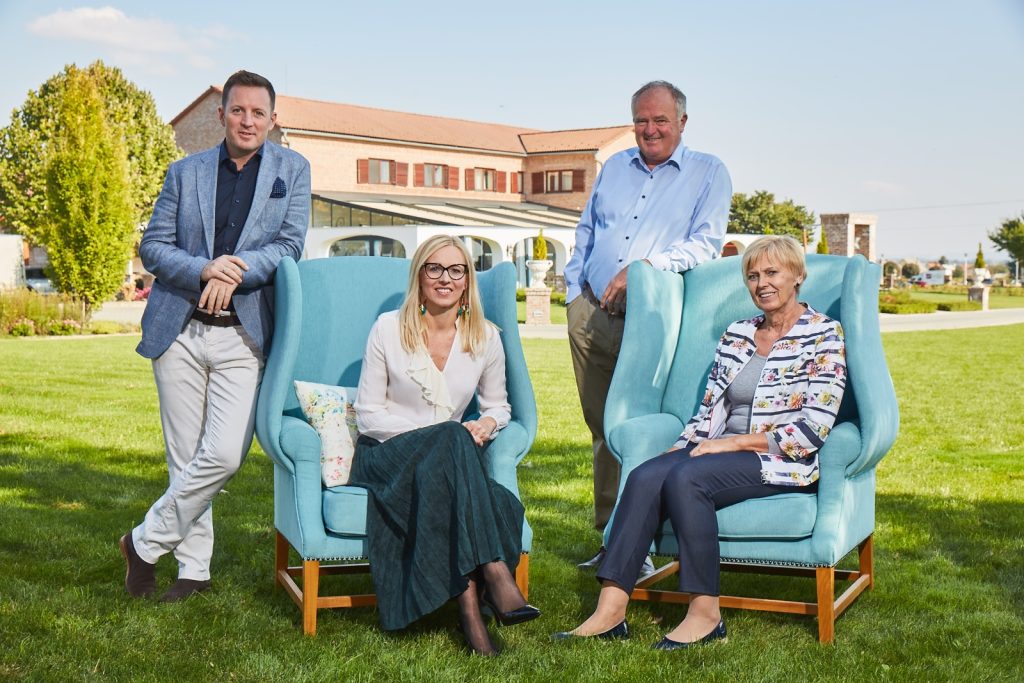
Andrea Gere had no idea what her father would say when they showed him the proposed new labels. Kopar worried her most. That wine held his memories, years of work and a name customers had long recognised. And she and her husband, Kristóf Csizmadia, had decided to change its appearance.
It was 2017. Designer Zsolt Unger and his team had come to Villány to present the winery’s new visual identity. They had been working on it with Andrea and Kristóf for more than a year.
“Dad disagreed with changing the design. When that happens, he says nothing; he just stands there silently. He felt no need for a change, and I had to fight for it. But he also realised that perhaps he was no longer quite so in touch with the market,” Andrea recalls.
Attila Gere looked at the proposals.
“Perhaps he would have preferred to sweep everything off the table, but all he said was: ‘I understand. If you say it needs to be done, then so be it.’”
Unger remembered his reaction differently from the anxious daughter. He felt Attila had very quickly understood what they had done.
“I could see that his experience allowed him to grasp the concept immediately. But he made it very clear, wisely and gracefully, that he would not interfere, that this was Andrea and Kristóf’s responsibility. He left the decision to the younger generation.”
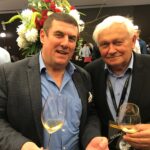
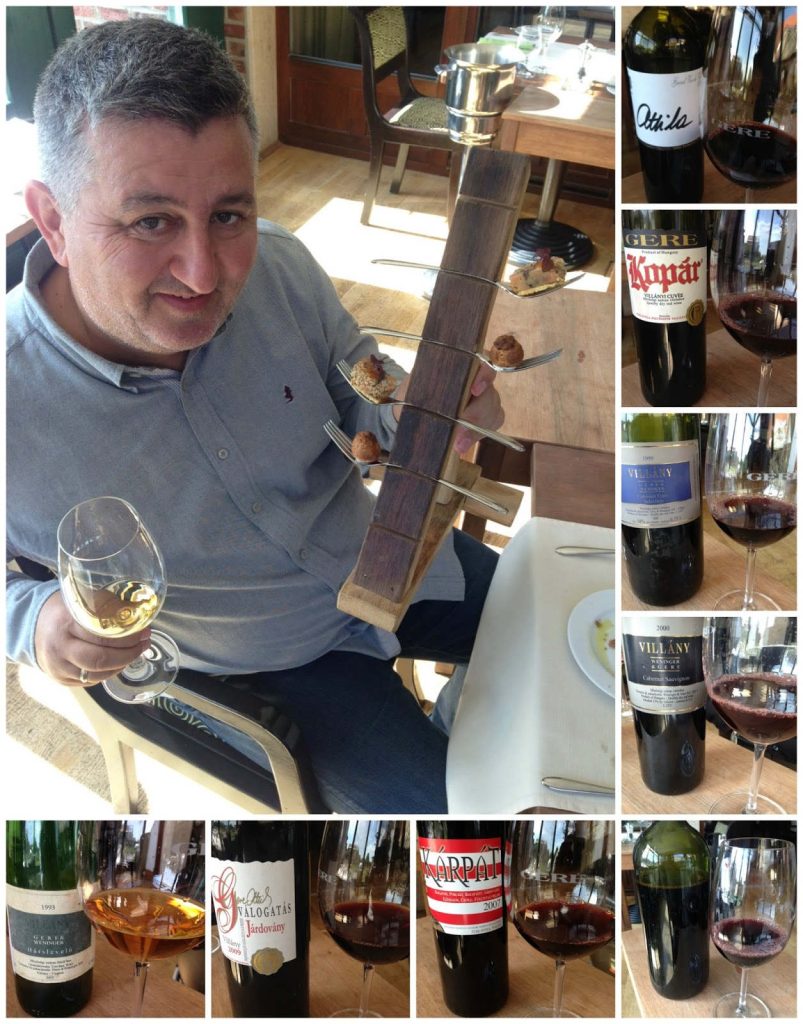
Kopar has a special place in my story of the Gere family. Andrea and Kristóf came to Osijek at my invitation to present a vertical tasting of that very wine. Long before that, we had been in Villány for the winery’s twenty-first anniversary, when Tim Ries performed. Those encounters have given Gere faces and music for me, alongside all the bottles I have opened in the meantime.
That is also why the meeting about the labels interests me. Kopar was well established enough for the father to fear changing it, and important enough for the daughter to insist on doing so.
The wine Andrea brought to Osijek originated when her father and his colleagues were still trying to find Villány a place among Europe’s great red wines. Its first vintage was 1997. Cabernet Sauvignon, Cabernet Franc and Merlot were already present in the region, but decisions had to be made about what to do with them.
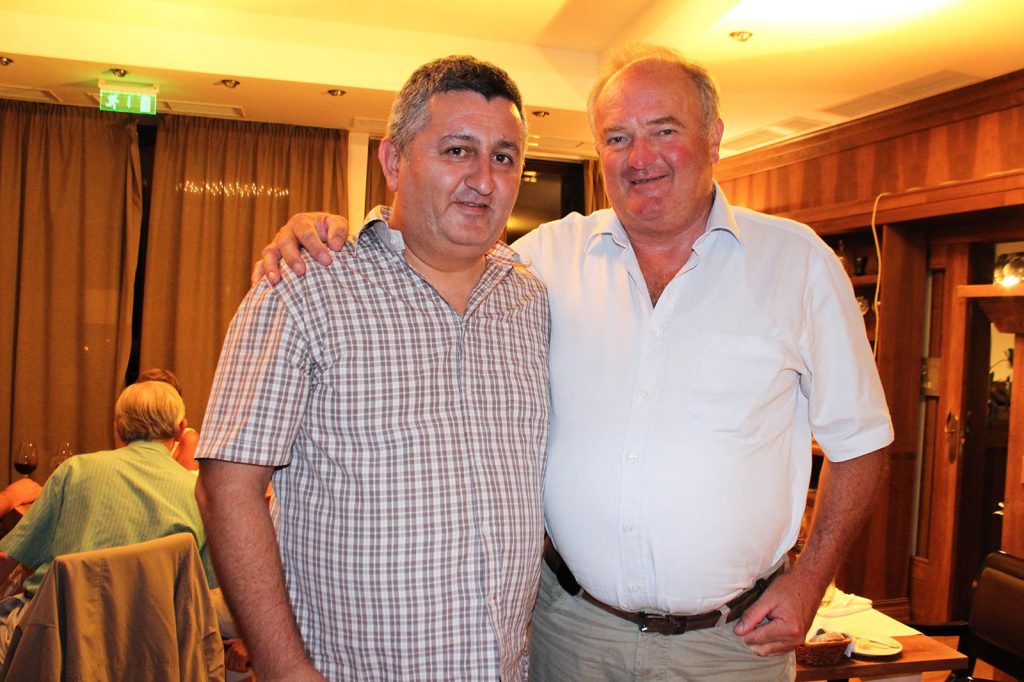
“I know what it was like before the 1990s. There were five of us: Tamás Gere, Józsi Bock, Ede Tiffán, Zoli Polgár and ourselves. We had already begun bottling more seriously in the late 1980s. By the time other wine regions were starting to think about it, we had been on the market for five or six years,” says Attila.
In the early 1990s, some of those producers travelled to Bordeaux. They visited châteaux, tasted and compared what they found in French cellars with the possibilities of their own vineyards. Attila returned with experience that would find its way into Kopar a few years later.
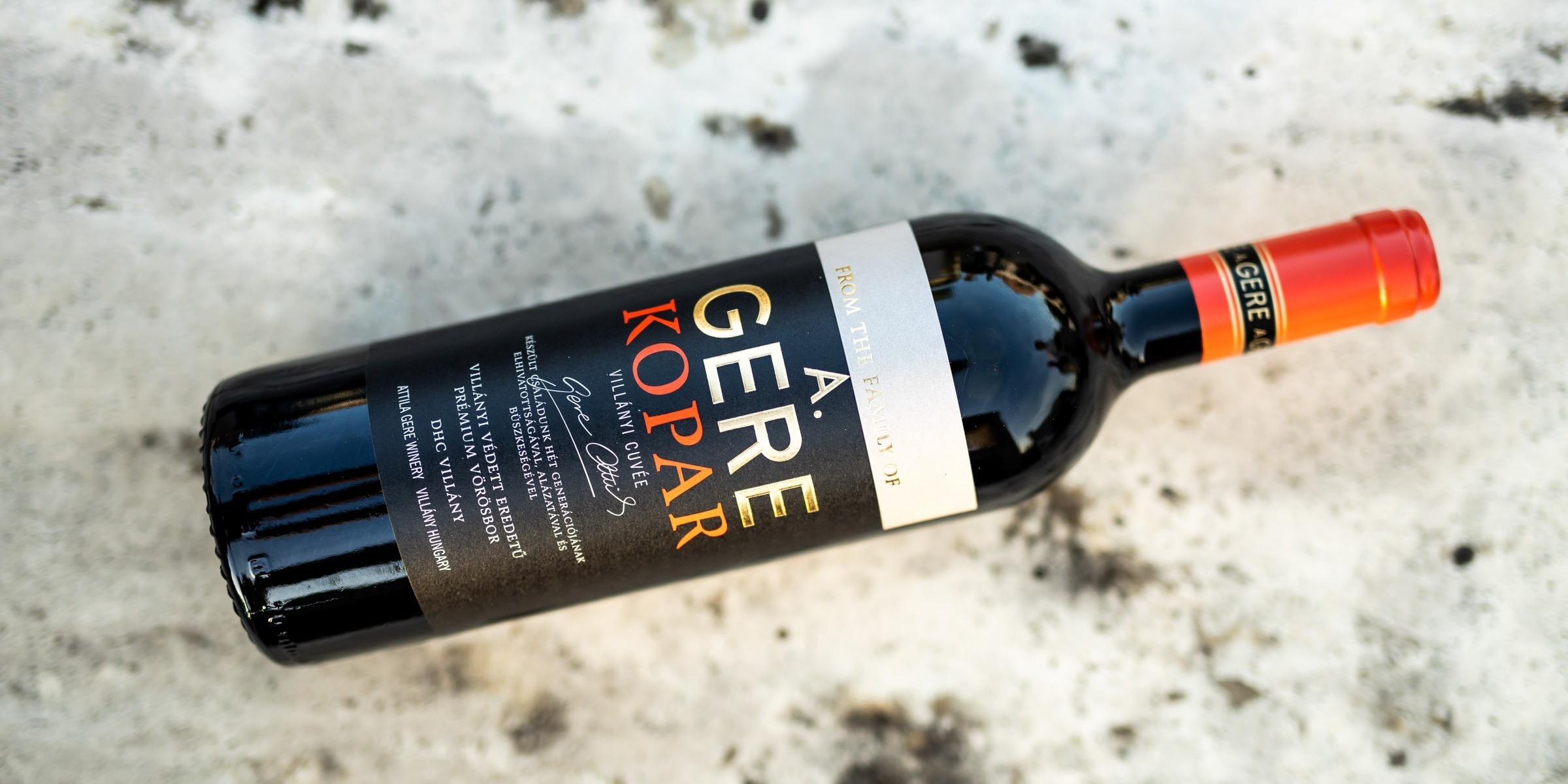
The name came from Kopár, one of Villány’s most highly regarded vineyard sites. Kopar, however, is not made exclusively from that vineyard. Its grapes are selected from several of the family’s finest sites, including Konkoly, Csillagvölgy and Ördögárok. The vineyard name remained on the label of a blend intended to show the best the family could assemble from three Bordeaux varieties.
The first Kopar, from 1997, contained 40 per cent each of Cabernet Sauvignon and Merlot, and 20 per cent Cabernet Franc. It spent eighteen months in new barriques. Looking at more recent vintages reveals how much the wine has changed since then.
The turning point was 2006. Cabernet Franc began taking the leading role, the proportion of Cabernet Sauvignon declined, and the oak influence became subtler. In the 2022 Kopar, the blend was already 50 per cent Cabernet Franc, 40 per cent Merlot and ten per cent Cabernet Sauvignon.
That is precisely what makes a vertical more interesting than a simple line-up of old bottles. Beyond different vintages, you taste changing decisions: what once took priority, what was gradually left behind and how Franc came to account for half the blend. In Osijek, the wine was presented by people who now help make those decisions: Andrea and Kristóf.
For Kopar, five or six selected bunches are left on each vine. At harvest, the grapes undergo manual and mechanical sorting. Varieties, vineyard sites and individual plots are aged separately, generally for sixteen to eighteen months, before blending begins. That process takes around two months: the candidate barrels are tasted, trial blends assembled and comparisons made again.
A single vintage therefore exists in many separate parts before its final proportions are established. The old 1997 Kopar and its 2022 counterpart bear the same name, but a quarter of a century of tasting separates their compositions.
Kopar also changed the way the Gere family sold wine. With wine merchant Bortársaság, they introduced advance sales inspired by Bordeaux’s en primeur system, with an important difference: customers were buying wine already in bottle, six months before its regular release. It was offered in twelve-bottle cases. Buyers thus committed to Kopar before it reached the shelves.
The family also remembers an episode in London. They visited a shop selling their wines and were told that Madonna’s manager had bought a bottle of Kopar while she was performing in the city. They do not know whether the wine reached her or whether she tasted it. They are still waiting for that part of the story.
What happened at a blind-tasting dinner at Campanile restaurant in Los Angeles, attended by James Suckling, is rather more concrete. Each guest was to bring a wine, the bottles would be served blind, and those responsible for the two lowest-ranked wines would pay the bill.
Among the bottles that finished near the bottom was a 1989 Pétrus purchased for $1,300. The 2000 Kopar did better. Suckling had not even known the wine before then, and afterwards wrote that the Hungarian bottle had been the evening’s great surprise.
Such episodes easily become stories about beating Pétrus. Yet there is another, less spectacular detail worth noting about Kopar: someone brought a bottle from Villány into a gathering of expensive collectors’ wines and accepted the possibility of having to pay for dinner because of it.
Despite its recognition, Kopar is not the summit of the family’s range. Andrea makes the distinction clear.
“The wider public primarily associates our winery with Kopar. Those who know our wines well understand that Attila stands at the very top of the pyramid. We often call it the essence of the winery, a wine through which we want to show the very best our family can offer.”
Alongside them is Solus, a Merlot whose origins took Attila to Tuscany, and whose very first vintage managed to disappoint him deeply.
In 1998, he visited Ornellaia. The head winemaker there was Tibor Gál, the Hungarian who enabled him to taste Masseto from barrel. Attila returned to Villány with a very specific wish: to try to make a great Merlot from Kopár grapes.
The first Solus was made in 2000. The grapes were selected, the wine fermented and transferred to barrels. At the first tastings, it failed to show what they had expected. It lacked the character and elegance Attila had hoped for after his Tuscan experience. For several months, he did not even look at it.
When he tasted it again, what had happened in the barrels surprised him. They later learned that Solus can close down during maturation, passing through periods in which it reveals little of its future potential. But at their first encounter, they had no such experience to draw on.
The name was not ready in time either. The wine already existed when a wine-loving couple came to visit. Attila mentioned that they were still looking for a name, and the visitors suggested Solus. They liked its sense of singularity and uniqueness, as well as the sun they recognised in the word sol, fitting for warm Kopár.
“Masseto will always remain our inspiration. That is why it is special for us whenever we can taste the two wines side by side. It was there that my father began thinking about what it would take to make that kind of Merlot in Villány,” says Andrea.
Unlike Kopar, Solus remains tied exclusively to Kopár. The stones absorb heat during the day and release it at night, while the roots reach the limestone. The harvest date is a particularly delicate decision there. Grapes picked too late cannot be put right afterwards by choosing the right barrel.
They tried different barrels for Solus and settled mainly on new three-hundred-litre casks made from Zemplén oak. The wine spends sixteen to eighteen months in them, followed by another six to twelve months in bottle before release. Judging when to take it out of wood is just as important: they want the complexity gained through ageing, but do not want to lose the fruit.
Before choosing vineyards, Attila chose the forest. As a boy, he listened to his great-grandfather’s stories about working as head forester for Count Drašković. By the age of seven, he had decided to follow the same profession. He graduated from the Kiss Ferenc forestry school in Szeged and took a job with the forestry enterprise in the Mecsek hills.
He spent more than fifteen years in forestry. When he married in 1978 and received his first vineyard, wine was not yet his main occupation. With his father-in-law’s help, he learned vineyard and cellar work. It was not until 1991 that he left forestry professionally and devoted himself fully to the family business.
Before he began making his own wine, he tasted his father-in-law’s Portugieser.
“It impressed me enormously. I could not believe that wines this good existed alongside the poor-quality wines made by large enterprises. That was when I understood Villány’s value. I knew I had to become involved. We continued tending vines and making small quantities of wine. But real development and major steps only became possible after the change of regime. Until then, our hands were tied. In 1991, we established our own family business,” says Attila.
Enthusiasm for his father-in-law’s wine did not mean vineyard work immediately became easy or enjoyable. At first, he saw it as a demanding additional job. He also bought grapes from other growers, but realised that achieving the quality he wanted would require more vineyards of his own. His father-in-law steered him towards higher sites, convinced that hillside grapes would make finer wines.
Buying land and returning neglected plots to production brought him work he enjoyed, but also encounters with administration for which he had no experience.
“For me, bureaucracy has always been the greatest challenge. We encountered so many such issues even when buying land, and we had no experience. Bringing old, neglected land back into winegrowing and improving the soil were also major challenges, but they gave me a great deal of pleasure.”
Forestry was behind him, but he speaks just as practically about cellar work. For him, order begins with washing equipment immediately after use: anything left unwashed can allow contamination to develop and spoil the wine.
“We pay attention to order and discipline. Where there is order, there will be no problem with the wine either,” says Attila.
Attila’s route to those cellars and barrels began with a very small vineyard. When he moved from Újpetre to Villány upon marrying, his father-in-law, Ádám Weber, gave the couple a third of a hectare. In the family, Weber was known as Opa.
“The wedding was on Saturday, and on Monday I was already in the vineyard. The old man showed me what we had been given,” says Attila.
Whenever the work became hard, his father-in-law would point him towards autumn: after the harvest, he would see it had been worthwhile.
“And it really was, every time. I learned a great deal from him. Even in his simplicity, he thought logically. He would ask himself what the logical answer was. I approached things in the same way. He used to say: ‘If we work honestly and make good wine, we can sell it.’ That is still how we work today.”
Andrea and her brother became familiar with the same vineyard early on.
“As children in nappies, we sat at the end of the row digging in the earth. I remember helping from primary-school age. As much as we could. Just so we would experience the work and understand that everything does not simply fall into our laps.”
Both parents had regular jobs. They went to the vineyard after work, taking the children with them. Later, the tasks became more specific: green work in the vineyard, bottling with a manual filler, sticking labels on bottles in the garage.
“We did whatever was needed. At the guesthouse that preceded our hotel in the 1990s, I cleaned rooms, served breakfast and helped wherever I was needed. I am grateful to have been part of all those processes and to have seen how much work goes into a single bottle of wine. Seeing the whole picture matters to me, and I will do my best to pass that on to my children,” says Andrea.
Holidays at Lake Balaton came when the work was done. The children grew up alongside their cousins Zsolt and Viktória Gere, whose branch of the family has a separate winery, Gere Tamás és Zsolt. Their vineyards were next to one another.
Yet childhood jobs did not automatically determine her career. Andrea loved what they had at home, but did not want to close off other possibilities too early.
“If I had known this would be my path, I would have trained as a viticulturist and winemaker. When I was choosing a career, I did not know what I wanted or what life would bring. Working with my parents frightened me a little, too: it is different when you have to confront someone you are emotionally involved with.”
Andrea did not immediately decide to stay. She studied economics and worked in Budapest for two years, first at a tax consultancy and then for a film distributor.
“I wanted to experience having a boss and living and working alongside colleagues. I learned a lot from it.”
Her parents bought her a flat in 1999. Her father assumed she would remain there.
“In those days, many people who went to Budapest stayed there. I used to tell my wife that this girl would never come back to Villány.”
Yet work from home followed her to Budapest. She translated labels and contracts, prepared brochures and spoke to international partners.
“She speaks perfect German and English, while we do not really,” Attila admits.
When he travelled to the capital for wine dinners, his daughter joined him. At Gundel, Alabárdos and Fortuna, she saw how people whose profession was hospitality treated her father and their wines.
“Over a white tablecloth, I saw the kinds of places a bottle of wine could open up. How much the people running those restaurants respected us, people from the countryside. That was where I realised what wonderful things we were making at home and how much value we were giving people. That was what brought me home.”
She returned in 2003.
“She called and asked whether she could come back. My wife and I just looked at each other,” says Attila.
She took on sales and travel, studied wine marketing at Davis and trained through the Wine & Spirit Education Trust. Her father handled investment in the winery and hotel. By the time Crocus Gere was being created in 2008, Andrea was already making decisions about its design and the organisation of hotel operations.
“I came home to learn. I did not want to turn everything upside down.”
On her return, she discovered that her father had more patience for her experiments than she had feared. She could test her ideas in the cellar, too.
“Dad is straightforward and determined, but flexible as well. I never heard him bang his fist on the table and say: ‘Andi, this is how it will be, end of story.’ He always gave my ideas a chance. If I wanted a wine of my own, I could go down to the cellar and blend it. He allowed us to spread our wings.”
Taking on management responsibilities did not end her involvement in wine selection and blending. The winery has its own vineyard and cellar specialists, but the family has not handed those decisions over to others.
“I take part in strategic decisions, future investments and ideas, but also in composing the wines. It is especially important to us that Gere wines remain recognisable. We are constantly fine-tuning and polishing. We have a winemaker and a viticulture specialist, but we do not let go of that process. Just as we have managers for the hotel and restaurant, yet still keep an eye on whether they are operating at the level we want,” says Andrea.
To some merchants, however, she was still the daughter of the man they were used to negotiating with. Business would be concluded, and then came the question:
“You will still discuss that with your father at home, won’t you?”
She would answer no. It took time for them to accept that her decisions needed no further approval.
“I had to work on myself to reframe the situation a little. Eventually I managed to say that it would not be a problem if I could not do everything the way my father did. My father is my role model. That is good in some ways and difficult in others, because I am afraid to touch things he has already done. But perhaps they need changing if we are to move forward.”
Kristóf found it easier to suggest change. He entered the business gradually, alongside his relationship with Andrea. An economist from a family of lawyers, he also had a father with connections to gastronomy, tourism and wine.

“It came as part of the package with me,” Andrea laughs.
“From the start, I could see that if things became serious, this would be the centre of gravity,” Kristóf replies.
They divide the work as needed and develop strategy together. Kristóf focuses more on sales; Andrea on viticulture and winemaking.
“We think very similarly. We argue more often about who will say something than about what we will say. Even when we disagree, we do not feel that one of us is right and the other wrong.”
“I think our palates are very similar, too,” Andrea adds.
Once, she had to find out how far she could rely on her own knowledge when Angelo Gaja arrived for a tasting. Her father was away. She knew the Italian visitor’s wines well, admired him and was nervous about guiding him through the family range.
When they finished, Gaja told her:
“Andrea, congratulations. Your father can be proud to have a daughter like you.”
At Mandula restaurant, photographs record other visits: Attila with Ferenc Mádl, the former Hungarian president, and with the Japanese imperial couple. There is also a handwritten note of thanks from Paul Bocuse, who visited in 2008.
For me, the Gere family also brings to mind a musical evening. At the winery’s twenty-first anniversary celebration, we listened to Tim Ries, the American saxophonist from the Rolling Stones’ touring band. Going to a winery anniversary and hearing a musician you normally associate with enormous concert stages is something you remember long after the order of the wines served has faded.
We bought tickets for that evening: a fine multi-course dinner as part of the winery’s anniversary celebrations, with a performance by Tim Ries. Andrea and Kristóf, meanwhile, came to Osijek at my invitation to present a vertical tasting of Kopar.
Andrea and Kristóf approach gastronomy as people who also enjoy sitting down to eat.
“I always feel something is missing if I have only water with a meal. When you take a bite and sip some wine, the flavours come together and create a third flavour. If someone misses out on that, I feel sorry for them, because I think they are missing something very good,” says Andrea.
“A dish is almost standing on one leg if we do not give it a wine alongside,” Kristóf adds.
In the more recent A.GERE restaurant project, they returned to family dishes and Swabian cooking. Chef Richárd Farkas brought Tuscan and other Italian experience to them. Among the ingredients was a twenty-year-old balsamic vinegar they had forgotten about and rediscovered. There are dishes of lamb, Mangalica pork and duck, as well as Mecsek porcini with rice in pickled vine leaves.
“We are returning to our roots, our identity and our childhood, and translating them into the language of contemporary gastronomy. We want guests to feel as though the Gere family is hosting them,” says Andrea.
Their experience of Covid also reveals who is involved in that family business. Employees from the closed restaurant and hotel were brought into vineyard work. They shared the uncertainty with them.
“My father also taught me that everyone’s work deserves respect. Everyone contributes to what makes a Gere wine a Gere wine. Giving our employees what they were due mattered more than having some extraordinary car or going on luxury holidays.”
Attila, meanwhile, has reached the point where he can hand the company over to his children.
“I always tell them they do not have to accept my opinion, because this is a different world now. I say what plain common sense tells me. I no longer have as much information.”
On the farm towards Újpetre, he has returned to his first profession, too: planting a forest. They also keep hens whose eggs end up at the hotel breakfast table. Andrea and Kristóf’s sons come to the vineyards, playing at bottling with Duplo figures and picking berries from the vines. In 2010, after a trial period, the family switched to organic cultivation.
Alongside the international varieties that made their name, Attila also left room for a lengthy experiment. In 2004, he approached the research institute for viticulture and oenology in Pécs. He wanted to know what else could be done with old varieties surviving mainly in collections.
They chose seven: Csókaszőlő, Bakator, Balafánt, Purcsin, Feketefájú Bajor, Kék Bajor and Fekete Járdovány. Two rows of each were planted beside the winery. That was not enough for separate wines, but it allowed them to observe the bunches, skin thickness and responses to disease and different vintages.
Fekete Járdovány interested them most. They began expanding it in Csillagvölgy, but could not simply order the required number of plants from a nursery. After the initial material from the institute, they had to rely on their own canes and gradual propagation. The planting grew in stages until they had enough grapes for their first wine, and they later planted it in Ördögárok as well.
The wine required different handling from Merlot and the Cabernets. There was no ready-made model for pruning, crop load, fermentation or ageing. They settled on second- and third-fill barrels so that the wood would not overwhelm the fruit. Járdovány gave them a lighter, spicy red, closer to what drinkers seek in Pinot Noir, Kékfrankos or Kadarka.
An estate known for Kopar, Solus and Attila thus acquired a wine that did not need the same concentration or new oak. Room had to be made for that difference, too.
Andrea also found a sphere of her own beyond bottles. After years of trials, in 2010 they began processing grape seeds into oil and flour. Those ingredients were used in treatments prepared at the hotel spa. Guests liked them so much that they wanted to take them home. From this, with Kristóf’s involvement, she developed Andrea Gere Skin Care, a cosmetics brand she ran without her father’s help.
“This is not mass production. We work with strict yield control. We leave four to six bunches on each vine, so the juice and seeds contain a higher concentration of active substances.”
“We were thinking about premium products from the outset. In Switzerland, I found a specialist who could develop the quality we had imagined. It is an entirely different market, and wine will always be my favourite. But I enjoy meeting different kinds of people through this work,” says Andrea.
A dermatologist was also involved, with development and production based in Switzerland. Andrea describes the undertaking as a leap without a safety net.

“You have to prove to yourself that you can do something, too. And my name is on the product.”
She did not seek her father’s signature for either the cosmetics or the labels. But she needed time to allow herself to do some things differently from him. Attila, for his part, had to learn that he would no longer make every decision himself. He put it most simply when speaking about stepping back:
“I can hand the company over to them with a clear heart. I told Andrea and Kristóf I could step down tomorrow and would simply like to live my life.”
Within the family, however, there was one man who was not easily convinced that better wine existed elsewhere. Opa, grandfather Ádám Weber, with whom everything had begun on a third of a hectare, remained devoted to Villány even when his grandchildren started bringing home world-famous bottles.
“We tasted an older vintage of Châteauneuf-du-Pape with him, or a Mouton Rothschild worth several thousand euros. We did not tell him how expensive those wines were,” Andrea recalls.
Her grandfather would taste. He did not know the price, but he knew what he liked.
“It’s good, it’s good. But it isn’t our Villány.”