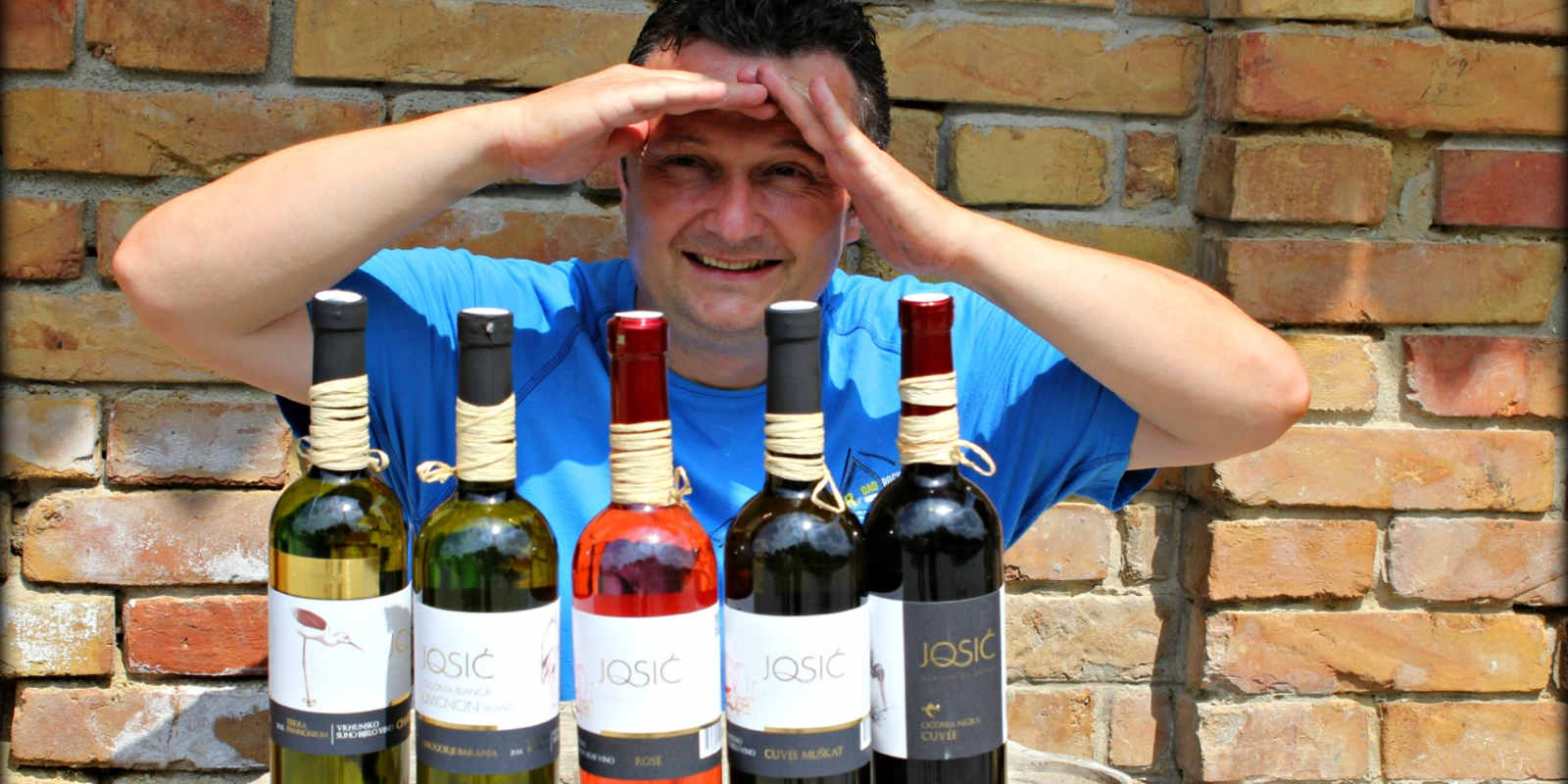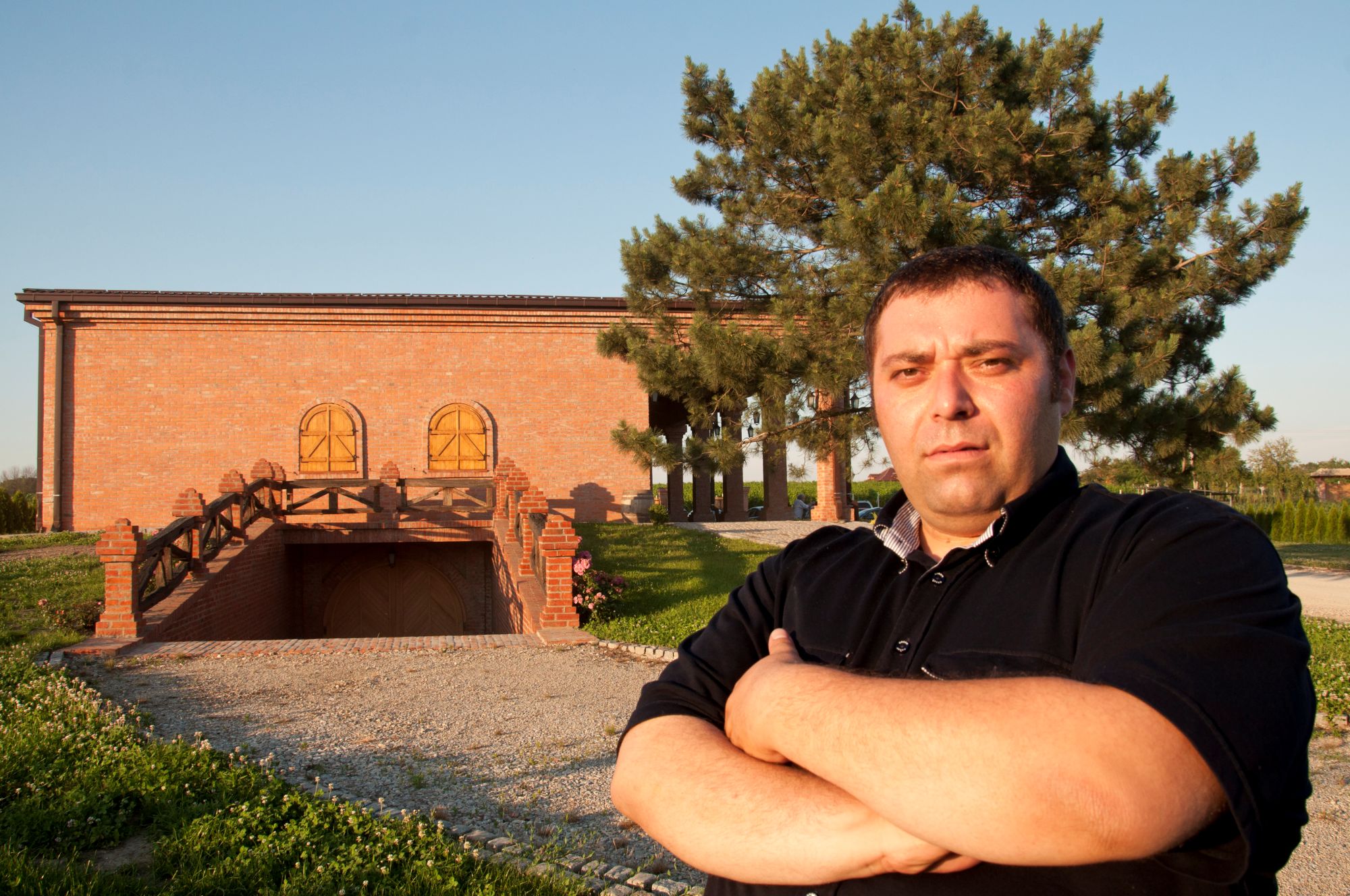
Dejan Milanović sleeps two metres from his fermentation tanks.
This is no poetic image of a winemaker listening to his wine through the night, but a fairly precise description of the layout. Only a wall separates his bedroom from the enormous vessels in which the wine ferments. If he wakes during the night, he does not have far to go to check what is happening with the Sila, Neoplanta or Probus.
And what is happening is usually something nobody before him has observed long enough to explain.
The winery stands on a high loess bluff above the Danube in Surduk. From the terrace, the view stretches across the river to Banat and Baranda, the village made famous by the television series Vratiće se rode–The Storks Will Return. Behind the winery lie vineyards planted with locally bred grape varieties, developed some ten kilometres away in the Faculty of Agriculture’s experimental vineyards in Sremski Karlovci.
Dejan was born neither in Surduk nor into a winemaking family. He was born in Osijek and spent his earliest years in Palača, a village fifteen kilometres away. For a long time, wine did not interest him. He did not visit wineries, study grape varieties or grow up with a family story awaiting its next chapter. At first, all he wanted in Surduk was a small vineyard and a weekend house.
He bought one plot, then another, then a third. What was supposed to remain a hobby began demanding space, equipment and decisions for which he had neither family experience nor knowledge of his own.
“We had no cellar for the first harvest. I took the grapes to my friend Gojko in Inđija because he had some old presses and crushers. That was when I first wondered whether I could take wine more seriously.”
Then Mladen Dragojlović appeared.
When I met them many years ago at Projekt 72 Wine & Deli in Novi Sad, Mladen was barely into his twenties. At secondary school, he told me then, he had been in love with chemistry until he discovered that wine could also be made from grapes. Despite his youth, Dejan trusted him almost unconditionally.
They had just completed an undertaking that required one of them to trust and the other to wait: they had made an ice wine from Sila.
The idea had not been Dejan’s. Left to him, the grapes would have reached the cellar much earlier. Mladen, however, judged Sila suitable for an ice harvest. A crossing of Chardonnay and Kövidinka, it was sufficiently resistant to botrytis and capable of remaining on the vine for a long time.
The problem was that winter refused to cooperate.
The grapes remained in the vineyard long after everyone else had finished harvesting. Days passed, temperatures refused to fall low enough, and the berries shrivelled until Dejan was convinced they were worthless. He waited for frost, increasingly looking at the vineyard as a place where a tonne and a half or two tonnes of grapes were going to waste.
Mladen kept telling him:
“Don’t look at the berries. Don’t look at the juice. Don’t try to imagine the outcome. Just be patient.”
The frost finally arrived on 18 January 2014.
“It’s easy to talk about it now, knowing what kind of wine we got. I can even joke that it was the first and last time we harvested our grapes before our friend Miroslav Kovačević that year. But I didn’t feel like joking then. As far as I was concerned, those berries belonged in the bin. When we pressed them, even what came out looked like something we should pour away. A catastrophe!”
Once again, he listened to Mladen.
The thick, cloudy juice gradually cleared, and the wine developed the flavour of quince compote. From 1,200 to 1,300 vines, which would normally have yielded between a tonne and a half and two tonnes of grapes, they obtained only around two hundred litres of ice wine.
“We made very little and sold even less. We gave most of it away. But I think every winemaker should treat themselves to an ice harvest every five or six years, whenever the vintage allows it.”
Dejan treated himself to just one. It was enough to teach him something more important than how to make ice wine: if you are doing something almost nobody has done before, you need to know whom to trust when you can no longer trust your own eyes.
His confidence in Mladen Dragojlović shaped much more than a single ice harvest. Together, they decided to build the winery around varieties for which there was neither a market nor sufficient practical experience. They could not visit ten cellars, taste different examples and ask colleagues how they had solved vineyard problems. Whatever they attempted, there was a strong possibility they were doing it first.
Sila, Neoplanta and Probus were developed in Sremski Karlovci through decades of breeding work by specialists from the University of Novi Sad’s Faculty of Agriculture. Twenty-four grape varieties were created there, but most never ventured far beyond the experimental vineyards. A variety can be officially recognised, described and preserved in a collection, yet remain distant from commercial vineyards, cellars, wine lists and people who might want to drink it again.
Dejan saw an opportunity.
“When I started, I had no tradition, recognition or story. It seemed logical to plant something other people didn’t have. And what could be more distinctive than grapes created ten kilometres from here?”
He planted his first Probus vineyard in 2008. Five years later, the winery had 5.6 hectares under vine and plans expanding much faster than its experience. Probus, Sila and Italian Riesling were the flagship wines served to its first organised groups of visitors.
Sila takes its name from the initial letters of Dr Sima Lazić, one of its creators. The variety was officially recognised in 1988. In Milanović’s cellar, it showed lightness, freshness and fruit, but offered no simple formula for repeating those results.
One year they were pleased, the next less so. Sometimes they seemed to have found the right direction, only for the following harvest to reopen the same questions. There were no other cellars whose wines they could taste, no borrowed experience or other people’s mistakes to learn from.
“The biggest problem is that we have nobody to exchange experience with or compare wines. Almost nobody else makes Sila. So we change something every year. One year we do it one way, the next another. We’re constantly searching.”
In the 2019 vintage, they vinified it in three different ways, then blended the resulting wines. The result was fuller and more structured than before, yet retained the freshness and airiness that had become the variety’s signature. It confirmed that years of searching were leading towards a serious wine, even if the road was never straight.
“We’re developing as we go, alongside Sila. It symbolises our approach: authentic, individual and untameable. It needs us because nobody before us has grown it and loved it as we do. And onwards we go, by persuasion or by Sila.”
The wordplay is deliberate: in Serbian, sila means force.
Neoplanta was the other white grape in the same adventure. A crossing of Traminer and Smederevka, it combined one parent’s aromatic character with the other’s resilience and defiance. It found a permanent home in Surduk and, over time, became one of the first wines to sell out.
Yet the variety that would secure Milanović a distinctive place in Fruška Gora’s modern wine history was neither Sila nor Neoplanta.
It was Probus.
A crossing of Kadarka and Cabernet Sauvignon, Probus was officially recognised in 1983. Its creators, D. Milisavljević, S. Lazić and V. Kovač, named it after the Roman emperor Marcus Aurelius Probus, born in Sirmium and credited with restoring viticulture on Fruška Gora. The Latin word probus means honest or upright, although few would describe the wine in such mild terms.
Probus grows vigorously, ripens late, is sensitive to low temperatures and readily succumbs to rot in rainy autumns. It loves sunshine and long pruning. Its grapes produce very dark, rich wines with powerful body, tannins and acidity, requiring time to settle.
Dejan describes it more vividly.
“Probus is incredibly strong and powerful. It’s barely containable. Its secret lies in balancing an excess of everything. Many people think Vojvodina’s vineyards aren’t suited to serious red wines, but our experience gives us no reason to agree.”
Accordingly, he warns against serving it with just any food. “If you drink it with a lightweight meal, there’s a danger the Probus will eat the meal. It needs the heartiest food. It’s the strongest wine for the strongest.”
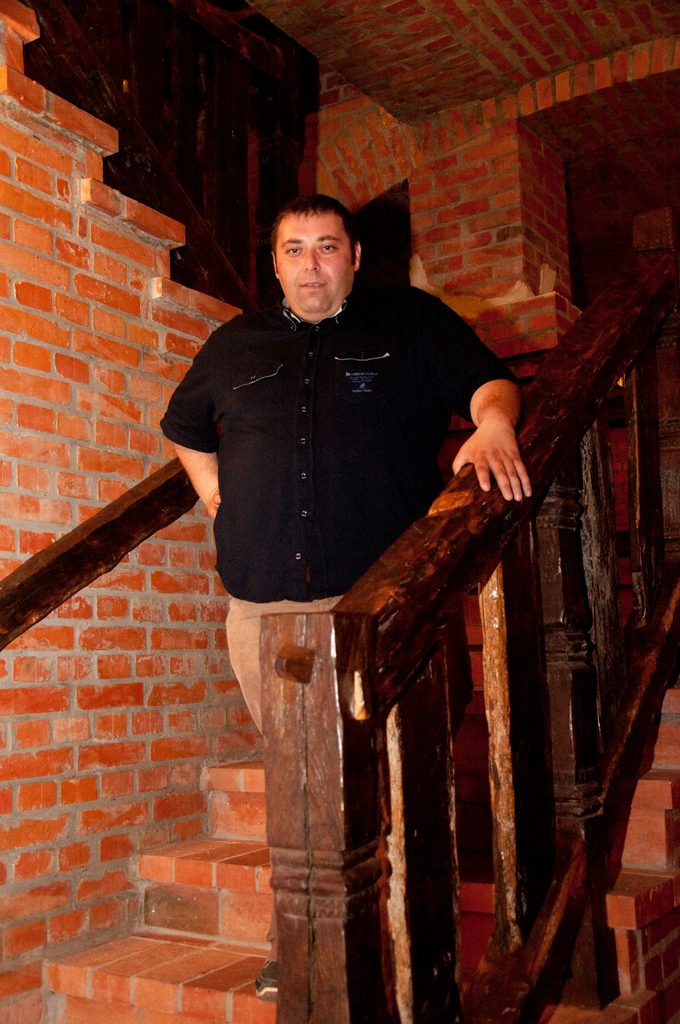
When he planted his first vineyard in 2008, Probus was largely regarded as useful for improving the colour of other wines. With far more pigment than Cabernet Sauvignon, Merlot or Prokupac, it was seen as a dark helping hand for grapes lacking colour, rather than a wine capable of carrying a label of its own.
Milanović and Dragojlović wanted to discover what would happen if they stopped treating it as an addition and allowed it to become the main character.
The answer came with the 2012 vintage. At an international wine competition in Belje in 2013, the barrel-aged Probus surprised almost everyone by winning its category. The vineyard was only in its fifth year, and the variety had almost no audience. The wine went on to repeat its success at several other competitions.
“I think that was when many people first remembered the name Probus.”
Victory did not mean that Dejan and Mladen fully understood it. After more than a decade of working with the grape, Dejan remained more cautious than people who had only just discovered it.
“The only certainties are that it loves sunshine and has great potential. Everything else is still in the realm of assumptions. We need more work with it, in different wineries, cellars and climatic conditions. Only then will we see how far it can go.”
Probus received another endorsement in 2016. The University of Novi Sad’s Rector’s Wine was named best red among 34 wines from eleven university centres at an international competition in Maribor. A variety that had spent decades largely confined to scientific descriptions was beginning to leave the laboratories and experimental vineyards.
Other producers then began planting it. Official figures from 2024 recorded 42.3 hectares of Probus in Serbia, with an estimated further twenty or thirty hectares of older, unregistered plantings. The wine Milanović had made when many still regarded the grape as a colour booster was becoming one possible answer to the question of which red wine might distinguish Fruška Gora from other regions.
Ten years after the winning vintage, Milanović Winery’s Probus 2022 was selected among five wines best demonstrating the variety’s potential.
Today, Dejan has just over three hectares of Probus. He makes no attempt, however, to turn his pioneering status into ownership of the grape. Quite the opposite: he wants as many winemakers as possible to plant and study it. Only with enough different experiences will it become possible to distinguish what Probus truly is from what happened to work for him in one vintage on one loess bluff.
Dejan had an unusual education for this work. He studied neither agriculture nor oenology, nor any other subject that might have prepared him for a vineyard.
He trained as a jeweller.
After completing the Polytechnic School in Belgrade, he spent three years in Paris learning to make jewellery by hand, work precious and semi-precious stones, and handle precious metals. No such school existed in Serbia.
Yet he never wore jewellery.
“People have asked whether I regret spending three years in France when I no longer do that work. I tell them my only regret is that I didn’t know then I would end up in wine. If I had, I could have learned something more useful in France.”
There is plenty of Dejan’s self-deprecating humour in that sentence, but perhaps the jewellery years were not entirely wasted. They taught him that a material’s value is not always apparent at first glance, and that its final form cannot be achieved in a single stroke. That was precisely what he did with Probus and Sila: spend years trying to discover what lay within something others had considered unworthy of a vineyard.
The difference was that he could hold a gemstone in his hand, examine it under magnification and work it until it took the desired shape. The vineyard allowed him only one attempt a year. If he made a mistake, the next opportunity had to wait until another harvest.
His choice of varieties initially met with ridicule. Neither the first bottles nor the awards entirely dispelled it. Every weaker vintage reopened the question of whether, in choosing such a distinctive collection of grapes, he had sacrificed the security offered by better-known varieties.
He could have planted Chardonnay or Cabernet Sauvignon and learned from hundreds of other people’s experiences. Instead, he chose the Chardonnay hidden within Sila and the Cabernet Sauvignon hidden within Probus, then tried to discover what their other parents-Kövidinka and Kadarka-had passed down to them.
Over time, the winery grew to approximately ten hectares, and wines whose names had initially required explanation found their way into restaurants and wine shops. Neoplanta became one of the first to sell out, Sila became synonymous with the winery’s white range, and Probus progressed from near obscurity to a wine increasingly considered part of the future of Fruška Gora’s reds.
That does not mean Dejan has found all the answers he sought.
Probus is far more widespread today than it was in 2008, but its planting material has yet to be sufficiently studied and classified. Mladen Dragojlović believes that serious progress requires clonal selection. Sila continues to demand a different approach from vintage to vintage, while Neoplanta has yet to show how far it can go beyond the few vineyards that have given it a chance.
Milanović therefore speaks of his own importance much more cautiously than those who later declared his Probus 2012 the beginning of the variety’s breakthrough.
“Our knowledge is still very limited. Probus needs to be planted on different sites and made in different ways. We need more wineries, more experience and more time.”
A trained jeweller would know what a finished gemstone should look like. Wine has never offered him that certainty. Perhaps that is why he sleeps beside the fermentation tanks: year after year, he is still listening to grapes for which there are too few books and too little experience to borrow.