“I’ll do everything you say, but you have to explain it all to me. I know nothing. Nothing!”
Tanja Đuričić smiled at the woman who had just taken over a winery and admitted something beginners usually try to conceal.
“That’s a huge advantage. It’s easier for me to teach someone who knows nothing than to correct someone who thinks they know.”
At that point, Jelena Ćuković really did know very little. All she knew about wine, she says, was that it came in white, red and rosé. Nobody in her family had grown vines, she had not grown up among barrels, and she had not inherited a vineyard she had heard about since childhood. Everything she would later learn about harvest dates, vine diseases, cellar work, sales and guests began with that admission that she was starting from scratch.
Fortunately, Tanja Đuričić, one of Serbia’s most respected winemakers, had stayed at the winery. In Jelena’s lack of knowledge, Tanja saw a clean slate, free of bad habits; in Tanja’s experience, Jelena found someone she could trust. Their first conversation thus became more than an agreement between owner and winemaker. It was a division of responsibility: Tanja would explain everything Jelena needed to know, and Jelena would not pretend she already knew any of it.
Jelena and her husband Đorđe Ćuković took over the Veritas winery in Sremski Karlovci in 2021 from Slobodan and Vesna Bošković, who had founded it eleven years earlier. Đorđe worked in the oil business and had long been thinking about something that might one day outlast his professional career. They were looking for a business that would be viable, rewarding and tangible enough for their sons to carry on, should they wish.
Wine was not unfamiliar to him. For twenty years, he had worked for a Singaporean company headed by a Frenchman who owned a château, and business gatherings often took them to wine regions. Meanwhile, Jelena was at home with the children. In her case, however, “at home” did not mean sitting still. She had a garden and a polytunnel, grew organic vegetables and enjoyed watching a seed become something that would eventually reach the family table.
Her motto was simple:
“From seed to preserving jar.”
When Đorđe asked whether she would take on the winery, he had no idea how great the difference was between a vegetable garden and ten hectares of vineyards. Neither did she.
“He said, ‘Come on, you’ll figure it out somehow. Give it a try.’ Neither of us had any idea what was waiting for us.”
Tanja did. Perhaps that was precisely why she immediately understood that Jelena’s greatest initial advantage was her willingness to listen.
I met Jelena at the Fruška Gora Wine Show at Villa Stanković near Čortanovci, a red castle built of brick from Beška and hidden in the woods.
In Jelena’s case, my prejudice spoke first.
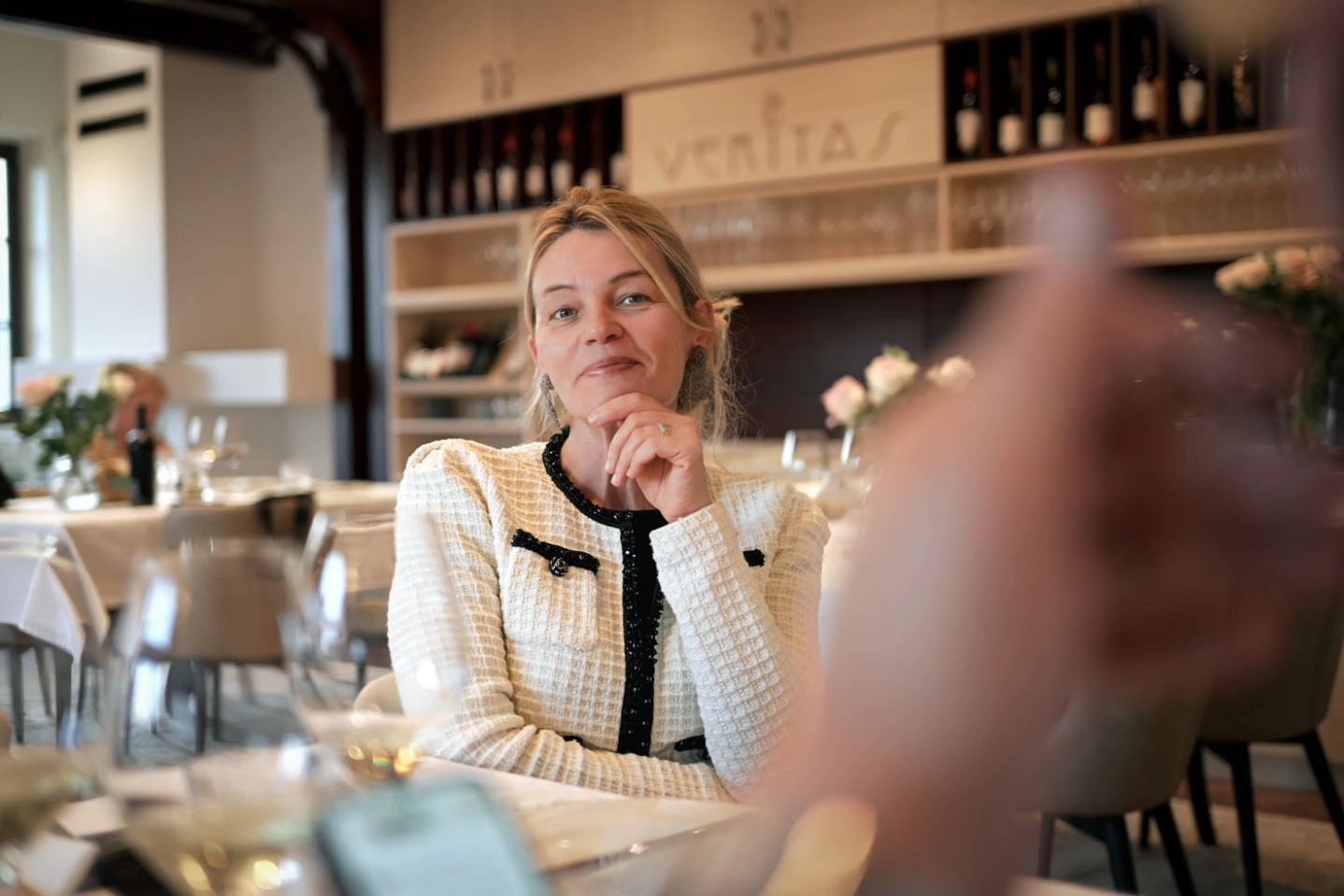
I knew her husband was successful in the oil business and that they had bought an existing winery. Jelena was new to the wine scene, with no family tradition or previous professional career. I hastily assembled all this into a story about a comfortably wealthy family for whom a winery was simply another investment. It took only a few minutes of conversation to realise how wrong I had been.
I asked what had prompted a woman who had spent her time running a household and raising two sons to leave the security of a familiar life for a business she knew almost nothing about.
“Perhaps because I’m blonde,” she replied without a moment’s hesitation.
Having disarmed the question with a joke, she began listing everything she could not possibly have imagined when they bought the winery. She had not known how many different jobs lay behind a single bottle, how long results took to emerge, or how quickly the business she was only supposed to try would occupy every day of her life.
An experienced winemaker explained what awaited her through an image she would often repeat: once she entered, she would become a hamster in a wheel. The wheel would start turning, and there would be no getting off.
Soon, she stopped counting the things she did not know and began recording what she had learned.
“Ask me anything. I’ll honestly tell you I knew nothing about anything. But I do know that we picked those tiny Cabernet Sauvignon berries on 21 October 2021, and the Merlot the day before. I remember dates and write everything down.”
Initially, she relied on Tanja for every decision involving the vineyard and cellar. At the same time, she noticed things at the winery that she understood from her home, garden and the way she organised daily life. She knew that people coming to taste wine needed somewhere they would want to stay.
So she removed two rows of vines and built a pergola.
It was not a decision made without calculation. She counted thirty vines, worked out that they yielded around sixty kilograms of grapes and concluded that the winery could bear the loss.
“We’ll survive without those sixty kilos.”
The pergola cost thirty vines but created room for guests. Even then, Jelena saw the winery as a whole: the wine made there also needed a place where people would want to taste it.
Excel, however, proved much less useful when it came to explaining how such decisions would lead to a self-sustaining winery.
Đorđe brought a managerial mindset from the business world. He wanted figures, deadlines and comparable results. For the first two years, Jelena struggled to explain that the winery did more than produce wine.
“I kept telling him we have two production processes here. First, you have to grow the grapes, and only then can you make the wine. Then there are sales, the brand, collecting payments and everything else. He couldn’t accept that results wouldn’t appear just because you’d entered them into a plan.”
Spreadsheets did not persuade him. Other winemakers did.
“They told him, ‘Đorđe, this is a different universe.’ Only then did he ease up.”
A winery operates to a rhythm that pays little attention to business forecasts. The vineyard demands investment before anyone knows the quality of the harvest, while the wine continues consuming time and money as it rests in the cellar for months or years. What has been produced has not necessarily been sold, and what has been sold has not always been paid for. Jelena was learning all these jobs simultaneously, with no chance to finish one before beginning the next.
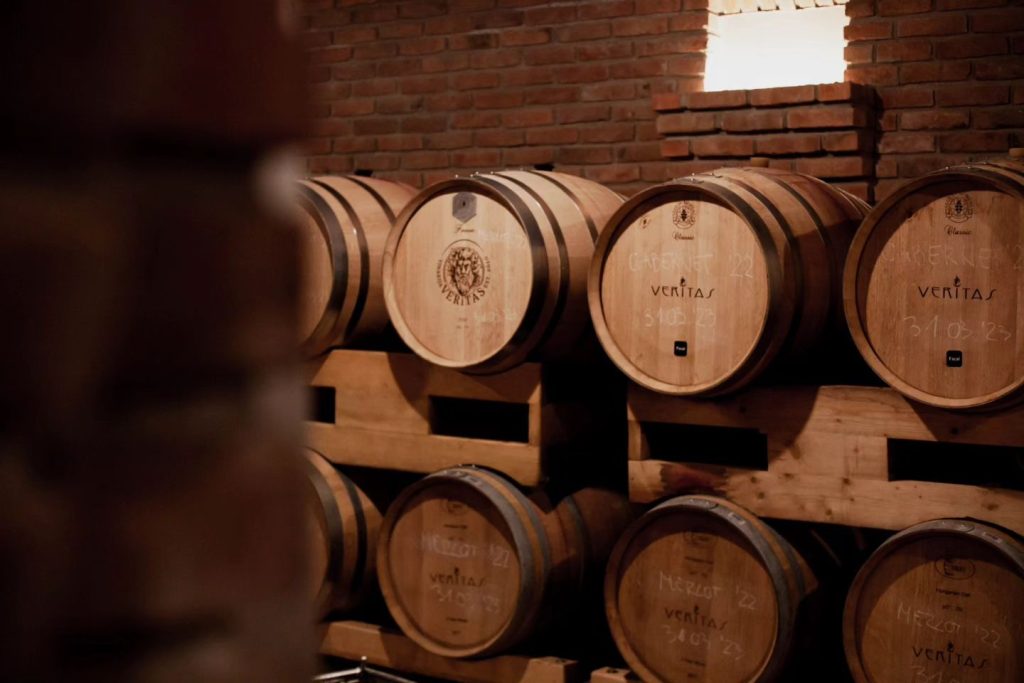
The wheel they had warned her about really had begun to turn.
There were periods when she spent an entire day solving problems, yet by evening could point to no result that justified her exhaustion. The vineyard still needed work, the wine needed time, and the bills needed money. At one point, she wanted to give up.
The first reason was the feeling that, despite all his support, Đorđe still did not understand why the winery could not be managed like his other businesses. The second was much simpler: she was exhausted.
“You work constantly, and there are no results. That was the hardest thing for me.”
She did not expect Veritas to support the family immediately or repay every investment within a few harvests. Her aim was for the winery gradually to stop depending on money earned in the family’s other business.
“Perhaps I won’t live to see the day when I make my living solely from the winery, but I want it to become self-sustaining.”
While Jelena was trying to make the winery independent of the family’s source of funding, Đorđe noticed that something had also happened in the opposite direction. Veritas had begun changing how other people perceived his business.
“He told me, ‘Veritas has given my company a face. People who had never heard of Naftachem know it now. You’ve opened us up to the world.’”
An investment intended for some quieter future chapter had become the most visible part of the family’s story. It had achieved this through the people who gave it a face: Tanja in the cellar, Jelena among the guests and, increasingly, the whole family in the vineyard.
For Jelena, simply learning how the winery had operated before their arrival was no longer enough. She wanted to find people with whom she could build what Veritas had yet to become. One came from Georgia, by way of some of Fruška Gora’s most recognisable wine projects.
Ramazi Inaishvili had spent years helping shape wineries and wines on Fruška Gora. He had worked on the Chichateau and Erdevik projects, and by the time he joined Veritas, he could afford, as he puts it, the luxury of choosing the people he wanted to work with.
At the Ćuković family’s winery, the deciding factor was neither vineyard size nor equipment, nor the prospect of immediately making a wine that would attract the market’s attention.
“It was Jelena. And the fact that everything here is still at the beginning, so we can create a new story. I can work somewhere I feel good.”
“She’s a novice, and that’s precisely why she’s perfect. She has no preconceptions or bad habits. I look at the details and see that everything is organised. I’ve never seen a better-organised harvest.”
Harvest is where order falls apart fastest. People arrive before dawn, grapes must be picked and processed within a short time, crates are filled and emptied, machines run, and juice ends up everywhere it should not. At Veritas, Jelena was trying to maintain order even on the days when people told her it was impossible.
That was why Ramazi called it a woman’s winery.
“No buckets lying around, no rubbish. Two drops of oil on the concrete cause a drama. Everything is so lovely I could live here.”
Ramazi nevertheless found one weakness.
“Jelena has got to the very heart of how a winery works, but she’s missing one little refinement: she hardly drinks wine.”
Đorđe tried to explain that sometimes she would have to sit down with winemakers, keep pace with their drinking and thereby understand things that could not be learned in meetings.
“I told him he was out of his mind. Who was going to work the next day?”
She had been like that before Veritas too. Her world then consisted of a garden, a polytunnel, vegetables and flowers rather than rows of vines and barrels. When she took over the winery, she did not leave that life behind. She moved it among the vines.
“My polytunnel soothes my nerves.”
Jelena had grown up with the image of her grandmother in Mačva bringing almost everything the family needed to the table from her own garden and yard. Later, she tried to create that life in her own home. She was drawn to the whole journey from seed to fruit and the reassurance of knowing how her food had been grown.
“We had dinner recently, and everything on the table was ours. I’d done it.”
At Veritas, she extended that idea to the guest experience. If the wine was made a few metres away, then, as far as possible, the food served with it should belong to the same place.
They began turning the tasting room into a restaurant amid the vineyards, while Jelena brought tomatoes, asparagus, herbs and flowers from the polytunnel. During asparagus season, she sometimes picked three kilograms a day. Guests enquired about the tomatoes as seriously as they asked about the wine.
Ramazi pointed out Jelena’s hands.
“Have you ever seen a multimillionaire’s wife with hands like these?”
“What matters more is that everyone went mad for my tomatoes.”
She did far more at the winery than set tables and welcome guests. She worked in the polytunnel, went into the vineyard, followed the harvest and learned what was happening in the cellar. Yet it was in the guest spaces that she could most directly connect what she had known before Veritas with what she was only beginning to learn.
She also began making dough for the restaurant. In time, Ramazi concluded that the greatest threat to the winery’s development was no longer Jelena’s initial lack of knowledge.
“My biggest fear is that she’ll open a bakery in Novi Sad and lose focus completely.”
His concern was prompted by Boulangerie Paremi in Vienna, which Jelena had fallen in love with for its bread, flowers on the counter and a space arranged with the care she wanted to bring to Veritas. She was drawn to the completeness of a place where the product, aromas, flowers and service all belonged to one idea.
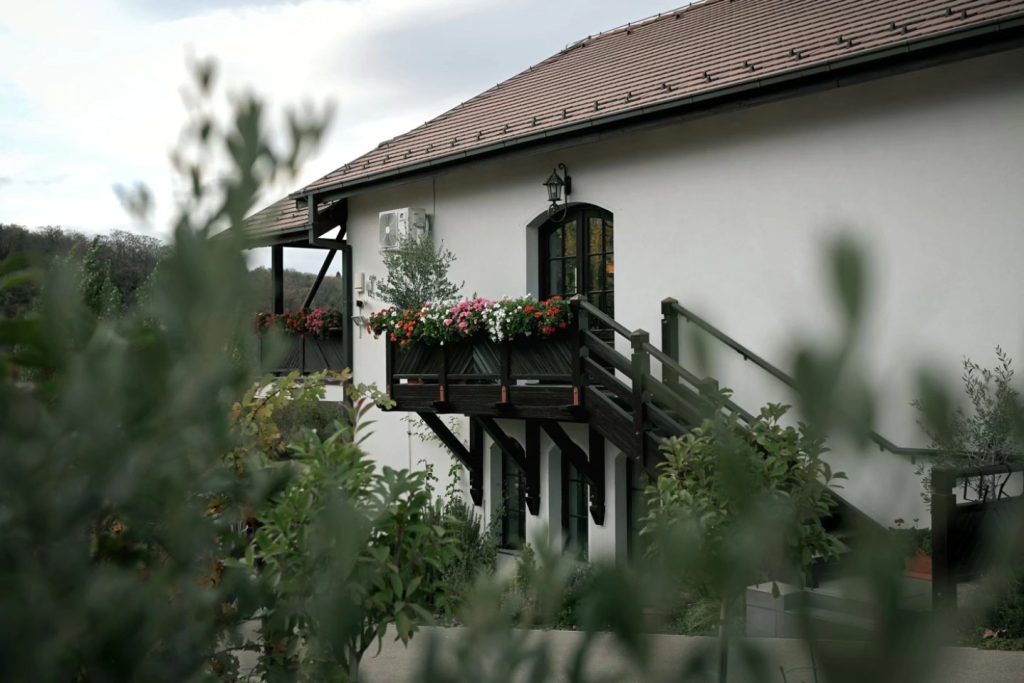
That was the Veritas she wanted to build: a place that would draw people into the vineyard and make them want to spend time there. The plan is to sell between thirty and forty per cent of the wines at the cellar door. For a ten-hectare winery, that means less dependence on distributors, but also much greater responsibility towards every guest.
At the same time, she wants to move the vineyards gradually towards organic production. They are working with agronomist Miloš Marković, who gained experience in Austria. Her ambition is not to expand the vineyard area and make Veritas a major player. Ten hectares are enough for the niche she is trying to create.
From the outset, Jelena and Đorđe wanted to give their sons the option of continuing the winery, without making it an obligation.
Their elder son Aleksandar studies physics in Vienna, far removed from the winery’s daily life.
The younger, Novak, was thirteen and a half when he decided to get up at four in the morning and join the pickers. Jelena did not turn his participation into a romantic lesson in family tradition.
“I told him, ‘All right. I’ll pay you a day’s wage.’”
In the meantime, Veritas needs to build an identity that does not depend solely on the Ćuković family or the individuals currently running it. Here, an unusual problem already exists: one of its wines is better known than the winery.
“Veritas’s biggest problem is that its Momentum Cabernet Sauvignon is better known than Veritas itself,” says Ramazi.
For many producers, that would be a welcome problem. If customers remember the label and ask for the wine, a brand clearly exists. But one successful label cannot carry the vineyard, restaurant, future wines and the family story they are still building. A guest who comes for Momentum should leave remembering Veritas and a reason to return.
When I asked Jelena what she ultimately wanted to achieve, she spoke neither of hectares nor bottle numbers nor awards.
“I want the name Veritas to become more important than our own names.”