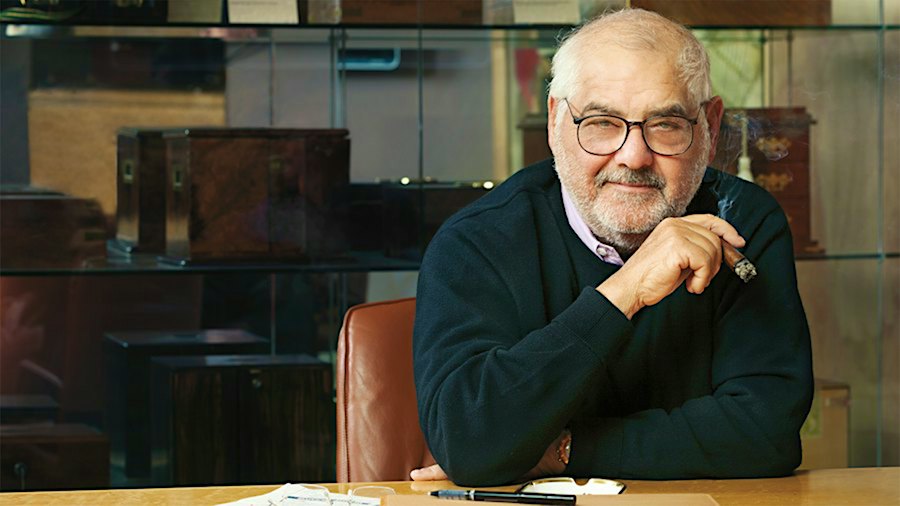
A few weeks ago, I reread Benjamin Wallace’s The Billionaire’s Vinegar, a book essential to understanding the contemporary wine world. Its account of fabulously expensive bottles, their questionable origins and the people determined to own them lays bare an entire culture: how wine authorities acquire their standing, what a reputation is worth and what happens when our desire to believe a magnificent story becomes stronger than our need to verify it.
Among the people I found myself returning to during that second reading was Marvin Shanken, the publisher of Wine Spectator. Wallace portrayed him with the ambition, passion and weaknesses that make a prominent public figure so much more interesting. Little did I know that, just a few weeks later, I would be returning to him to write about his death.
One moment in particular stayed with me: the moment when a man who encouraged millions of people to discover wine desperately hoped that someone else would buy a particular bottle.
Marvin Shanken suddenly realised that a bottle of wine could ruin him.
He was sitting in the back row at Christie’s in London, having raised his bid to £100,000, and waiting. Only moments earlier, he had been furious at the prospect of someone else walking away with the wine for which he had flown across the Atlantic. Now he was praying that the same person would outbid him.
It was 5 December 1985. On offer was a bottle of 1787 Lafite, supposedly from Thomas Jefferson’s cellar. Shanken had come for a piece of American history, convinced that he would somehow find the money to pay for it. Thirty thousand dollars had seemed the outer limit of the madness he could allow himself. Then he found himself in a bidding duel with Kip Forbes, the son of publisher Malcolm Forbes, and that limit disappeared.
When he bid £100,000, almost $150,000, he was no longer thinking about Jefferson. He was thinking about spending the rest of his life paying for the bottle.
Then Kip Forbes raised a finger.
One hundred and five thousand.
Shanken kept his hand down.
In The Billionaire’s Vinegar, Benjamin Wallace describes that moment as a spectacular return to his senses for a man who, seconds earlier, had surrendered completely to auction fever. Forbes got the bottle. Shanken got the chance to carry on with his life without financial catastrophe.
For the wine world, that would prove a rather fortunate outcome.
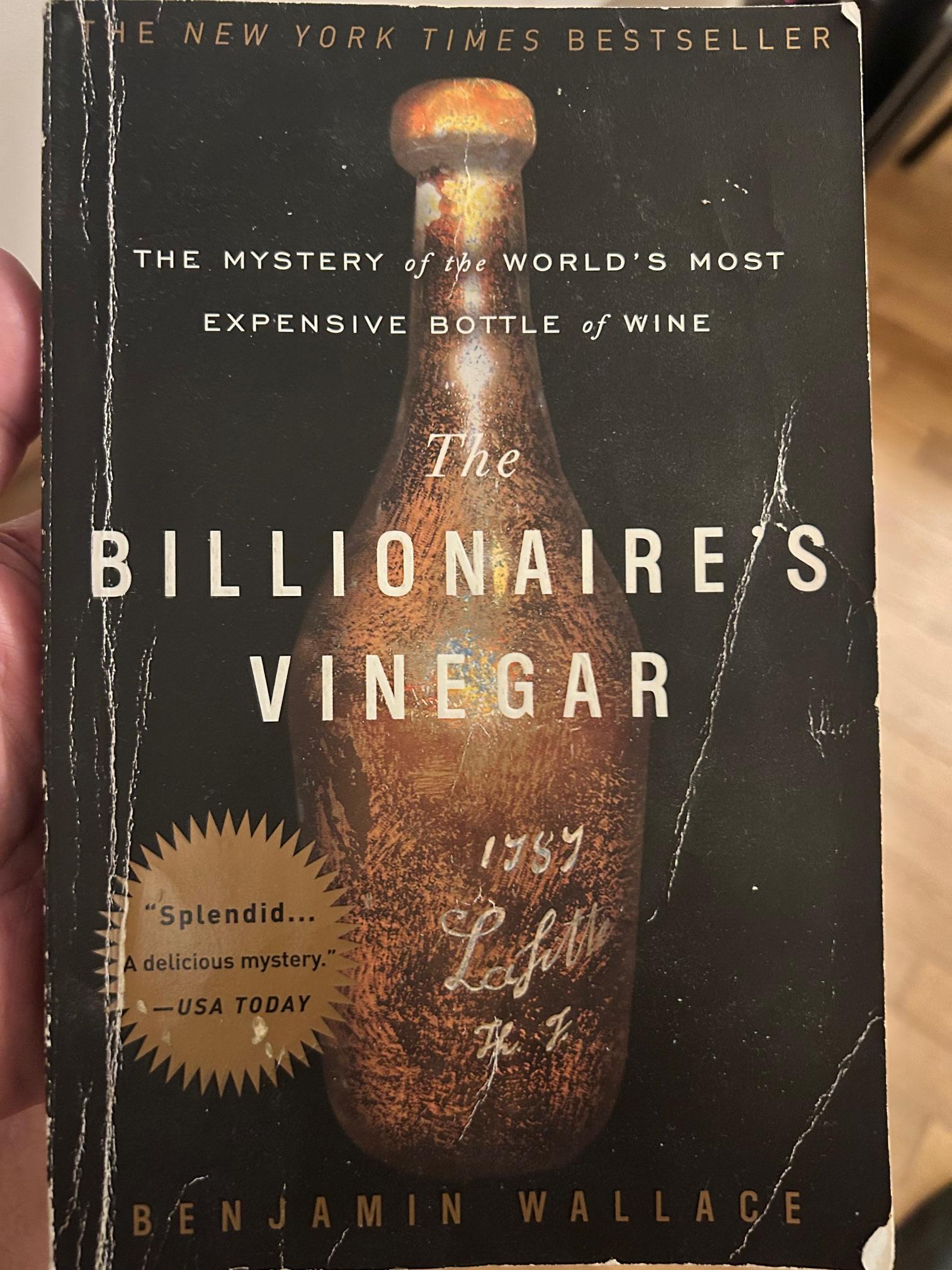
Marvin Shanken, the publisher of Wine Spectator and one of the people who most profoundly influenced how wine is written about, discussed, understood and bought, died on 29 October 2026, a few weeks after his 83rd birthday.
He left behind magazines, events, educational initiatives and an enormous audience to whom he had brought wine closer over the decades. But Wallace’s book also preserves a less ceremonial Shanken: ambitious, impulsive, funny, captivated by history and expensive objects, confident enough to bid against people wealthier than himself and honest enough to admit afterwards how frightened he had been.
Such a portrait is valuable. The biographies of great wine figures can easily become collections of accolades. Shanken was more interesting than his accolades.
When he bought Wine Spectator in 1979, he took over a modest newspaper distributed free in wine shops. He turned it into a magazine whose ratings, recommendations and selections mattered to producers and buyers around the world. Yet Wallace takes us back to a time when that success was far from assured. In 1985, as Shanken raised his bids for Jefferson’s bottle in London, his magazine was struggling to survive.
The future powerhouse of wine publishing still had to worry about making it through the following week.
That is why the London episode is much more than an anecdote about extravagant spending. It reveals a man whose desire briefly outgrew his means. A publisher who wanted to bring wine to a wider audience suddenly found himself longing for an object that almost nobody in that audience could afford.
In Wallace’s account, Shanken intended to show the bottle to visitors at his Wine Experience. He was drawn to the opportunity to put before them something that connected wine with American history. As a young man, he had volunteered for John F. Kennedy’s presidential campaign; presidential memorabilia held a particular fascination for him.
But the Jefferson story did not end with his defeat in London.
When a half-bottle of 1784 Margaux, also attributed to Jefferson, subsequently came up for auction, Shanken decided to try again. This time, he stayed out of the auction room and authorised Michael Broadbent to bid up to $30,000 on his behalf.
He got it.
He became the owner of what was then the most expensive half-bottle of wine ever sold. Yet even victory did not bring complete satisfaction: he wondered about the mysterious rival whose bids had driven the price right up to his limit.
The man who had previously been desperate for someone to outbid him now wondered whether his opponent had existed at all.
That small change of mood captures much of the world Wallace describes: the desire to possess, the excitement of competition and the unease that follows when it is time to explain what has actually been bought.
The Billionaire’s Vinegar is not a book from which we can extract only the glamour of famous labels and disregard the questions surrounding their provenance. The story of the bottles supposedly linked to Jefferson gradually reveals how a seller’s reputation, a taster’s authority and a compelling narrative could take the place of solid evidence.
Shanken occupied a particularly sensitive position in that world. He had bought one of the disputed bottles, while also publishing a magazine that was supposed to report on such objects and their market.
Wallace records that Wine Spectator covered individual episodes in the affair. He also records a moment when its editors backed away from an offer of an exclusive story about fraud, explaining that the subject was sensitive.
That part of his portrait deserves to remain in a tribute written after his death. Shanken’s influence was too great to be reduced to an innocent love of fine wine. He participated in the market he covered, a man whose personal passions intersected with the responsibilities of his magazine.
Wallace’s book allows us to see him in that complexity, without feeling obliged to tidy up his biography after the fact.
Meanwhile, his business grew.
Wine Spectator introduced readers to wines, winemakers and regions. The Wine Experience brought them together around a shared interest. In 1992, Shanken launched Cigar Aficionado, demonstrating that he could build a substantial audience around another of his personal passions.
According to Wallace, when people described his company as a publishing business, he would correct them: he was in education.
That was an important part of his success. Readers needed someone to explain how to choose a wine, what to expect from a region and why a particular producer deserved their attention. Then they needed a reason to open the next bottle and keep learning.
Wallace illustrated the importance of cigars in Shanken’s life with an anecdote that could almost serve as his biography in miniature. When his wife banned cigar smoking in their Manhattan apartment, he bought the apartment next door and turned it into a smoking lounge.
So he respected the ban. He simply bought somewhere it did not apply.
There was something of his business instinct in that solution: he always tried to make enough room for his passions. Cigars got the apartment next door and, later, a magazine of their own, Cigar Aficionado. He knew how to share what gave him pleasure, explain it to others and turn it into a business. And he evidently found it difficult to accept that he might simply have to give up something he loved.
In 1996, he found himself at another auction of presidential memorabilia. This time, the object for sale was a humidor-a box for storing cigars-that had belonged to John F. Kennedy.
Shanken thought it might cost around $30,000.
He bid $520,000.
With the buyer’s premium and sales tax, the bill rose to $622,000, according to Wallace. He framed it and hung it in his office.
Eleven years had passed between the London bottle and the New York humidor. The passion was recognisably the same. What had changed were the means of the man indulging it.
In London, someone else’s raised finger had saved him. In New York, he could finally afford to make the last bid himself.
At the end of the book, Wallace thanks Shanken, who graciously shared stories of his auction battles in a Manhattan office filled with cigar smoke.
It is a fitting scene with which to say goodbye. A publisher who had spent years making room for other people’s stories sits down with a writer and tells his own. Among them is one in which he had not behaved particularly sensibly.
It is precisely that story that gives him a human dimension.
Marvin Shanken helped build a world in which wine acquired a vast audience, media power and cultural prestige. He enjoyed that world, made his living from it and occasionally got dangerously carried away within it.
And one afternoon in London, among all the bottles he wanted to own, he found one that was best left to somebody else.