When the Great Book of Serbian Wine is eventually written, it will have to find room for a conversation between Boža Aleksandrović and Milan Ubavić.
They had both arrived at the same place with their wines. Boža brought one of his Trijumfs, a wine already enjoying cult status, while Milan brought a Grašac he had finally made exactly as he wanted. They tasted, compared and were pleased. Then Milan approached Boža as though he had something terribly important to tell him.
“Come here and let me give you a hug. Your wine is wonderful, but now I know I never want to make anything like it in my own wine story.”
“Why?”
“I don’t want to become that big and be obliged to produce so much wine!”
His wish was partly granted. Vinum remained a relatively small winery in Sremski Karlovci, focused on limited releases from its own vineyards. Everything else got somewhat out of hand.
Today, his name stands behind more than ten wine labels, while the medical business that is his actual profession has grown to fifteen laboratories across Vojvodina, employing more than a hundred doctors, biochemists and medical laboratory technicians.
“I’m a megalomaniac. I never thought I’d have so many medical laboratories either! Whatever I start, I have to have it all: ten wines and fifteen laboratories. Either I do something properly and on the scale I want, or I do nothing.”
At the winery, however, something happened that he does not permit in his laboratories: he no longer controls everything. Vinum now looks almost like a pharmacy, the stainless steel gleaming and everything in its place, but trained winemakers and technologists run production. Milan appears occasionally, tastes and asks a question they might have preferred not to hear.
“This will sound strange to many people, but after more than twenty years, I no longer feel like a winemaker at all. The technologists run everything now. Yeasts are added, temperatures monitored and records kept. It’s no longer what I used to do with my best man. Had I known it would all develop this way, perhaps I’d never have started making wine.”
Yet selling the winery and walking away is out of the question.
“Wine has shaped my life, and I want to live with it until the end.”
He made that decision around ten years ago, while considering what else he might build. At one point, the choice came down to a medical centre or a winery. A hospital, he judged, was more than he could complete alone, but a medical centre was possible. He nevertheless chose the winery because he needed it as an escape from work rather than an extension of it.
“I’m satisfied with everything I’ve achieved. Now I just need to remain in this world a little longer and enjoy it all.”
Had he received what he asked for many years earlier, perhaps he would have had none of it to enjoy. Fortunately, his grandfather had given him the fig.
“The fig?”
“You know the gesture: the thumb between the index and middle fingers.”
“I know what it looks like. I don’t know why your grandfather showed it to you.”
“Well, that’s another story. A long one.”
In Serbian, dobiti šipak-literally “to get a rosehip”-means getting nothing, or being firmly refused. The gesture makes the answer unmistakable.
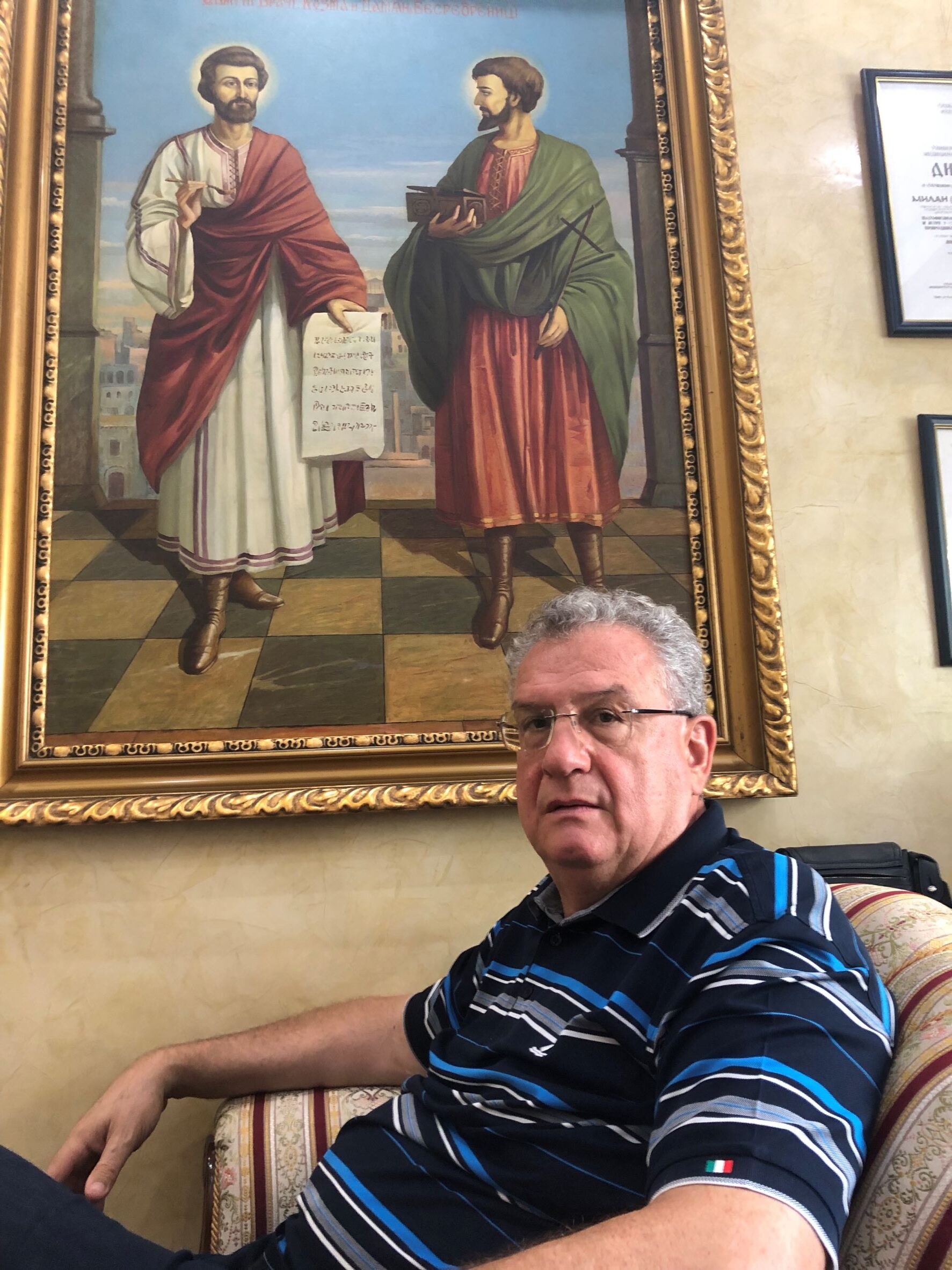
In Milan’s office at Medlab headquarters, an enormous painting of Saints Cosmas and Damian hangs behind his desk. The early Christian martyrs practised medicine and, after death, divided their patronages: Cosmas became a patron of doctors and surgeons, Damian of apothecaries and pharmacists. It would be difficult to find a more appropriate image for a man who spread a network of medical laboratories across Vojvodina.
At Medlab’s entrance hangs another picture, at least equally important to him: a large framed photograph of his grandfather Dina Stražmešterov.
Dina had no vineyards, although he owned plenty of land. Before the Second World War, he held more than a hundred hectares in Bečej, but the land was confiscated in socialist Yugoslavia. After a lengthy dispute with the state, he recovered around thirty hectares in 1993.
Milan’s paternal grandfather, also Milan Ubavić, had owned a vineyard. He came from the Toplica Valley, around Prokuplje, and made Prokupac. Those vineyards were grubbed up long ago, and Milan had little direct connection with that part of the family history.
“They drank wine there from tall, narrow, stemless glasses. You held the glass between two fingers and had to finish it in one gulp.”
That was almost his only connection with wine before graduating. When the madness of the early 1990s arrived, medicine occupied his thoughts far more.
He was a doctor specialising in pathophysiology, a field offering little scope for private practice, and saw no particularly promising future in the public system. He considered leaving the country. The alternative was to take over his grandfather’s recovered land, employ people to cultivate it and turn to agriculture.
Emigration seemed almost impossible. His father had already died, and he would leave behind his mother, grandfather, grandmother and an aunt with a disability. He was an only child.
“Leaving them all and going away would have been an abomination to me.”
So he presented Dina with the other plan: he would take over the land and hire workers to farm it. His grandfather listened and gave him the fig.
“He told me that if I insisted on doing his work, he would sell everything. If I wouldn’t do what I’d trained for, he’d spend the proceeds himself.”
The gesture achieved what persuasion probably could not. Milan abandoned agriculture and returned to medicine. His friend and colleague Mirjana Dobrosavljev suggested opening his own medical laboratory, and his grandfather supported that idea financially. He refused to let Milan take over his work, but helped him begin his own.
He opened his first laboratory in Novi Sad when private medical practice barely existed in Serbia. Initially, he did everything himself: received patients, took blood, processed tests and wrote reports.
“I’d worked in a public laboratory and knew its weaknesses well, from unavailable tests to frequent problems with reagents. I offered patients something they couldn’t get there: same-day results.”
The business expanded remarkably quickly. One laboratory became Medlab, which gradually spread across Vojvodina. Today, it covers the full range of laboratory diagnostics, from blood counts and biochemistry to microbiology, pathology, histology and genetics.
“So Covid arrived at just the right time for you?”
“Unfortunately, it helped us. It would have been better if it had never arrived.”
Rather than use their existing laboratories for testing, they established a separate PCR centre in Novi Sad for suspected and confirmed cases. Milan saw little cause for celebration in that business opportunity either.
As Medlab grew, he left the Faculty of Medicine in Novi Sad. He considered it unethical to work at a public institution while developing a private business. He later resumed his academic career at a private Faculty of Pharmacy, then at ICEPS, a college of professional studies.
Over time, he found people at Medlab capable of working without him, allowing him to retreat to the winery more often. Wine, however, had entered his life much earlier through his best man, Igor Mitić, also a doctor, originally from Sremski Karlovci. After graduating, they began distilling small quantities of rakija as a hobby, using grapes from Igor’s grandparents’ vineyard. It hardly warranted grand plans: one barrel a year, enough for friends to gather and see what they had made.
Then Grandma Anđa Cvetić gave them the use of the underground cellar beneath her roughly three-hundred-year-old house in Sremski Karlovci. It was small, low-ceilinged and lacked any equipment that might persuade two beginners they had become serious winemakers. But it offered something no medical laboratory could give Milan: somewhere to switch off.
“Igor drove the whole thing. He absorbed new trends, read and experimented, while I was the cabin boy. Still, the atmosphere of that cellar and its extraordinary energy drew me further into wine.”
They made around a thousand litres annually. They bought grapes from the Institute of Viticulture in Sremski Karlovci, usually Graševina SK-54, although Igor cared little for keeping varieties separate. Fifty crates of one, twenty of another, then everything together in what Milan calls a vineyard blend.
“Today, those wines would be called orange wines. That’s why I don’t like orange wines now: I spent twenty years drowning in them. We worked without selected yeasts, proper equipment or anything beyond very modest conditions. It all looked rather primitive.”
Primitive, but liberating. After days spent with patients, test results, university obligations and Medlab’s expansion, washing bottles in a basin, racking wine and waiting for a barrel to do something neither could explain became a ritual. Milan entered wine seeking peace of mind rather than another business.
In 2000, he nevertheless began his own wine venture and called it Vinum. The name looked sufficiently Latin to suit Sremski Karlovci, while concealing a simple acronym: VIN, Ubavić, Milan.
He did not want his full name on the label.
“I was expanding the laboratories and didn’t want medicine and my love of wine mixed together in public. I was a little afraid too. Wine wasn’t the field I knew best, and I depended on other people to guarantee quality.”
When he decided to leave the shared venture with Igor and make wine independently, he did what he usually does: rented a cellar, renovated it, bought some vessels and prepared to purchase grapes. He was convinced he would continue as he had in Anđa’s cellar, only under slightly better conditions.
Winemaking specialist Vladimir Puškaš listened and asked a simple question:
“What kind of wines do you want to make?”
“The same as before.”
“If you want to bottle them, forget everything you’ve done so far. You need controlled fermentation and cold stabilisation.”
“What’s that?”
Milan genuinely did not know. He had fitted out the cellar before understanding what it needed.
“Where can I see what that looks like?” he asked.
“Nowhere here. Go to Slovenia.”
He followed the advice, visited several better-equipped small wineries in Goriška Brda and returned with a far more expensive picture of his intended hobby. Soon, he fitted ten tanks with fermentation temperature control, acquired a cold-stabilisation tank and hired a specialist to guide him from improvisation towards modern winemaking.
Winemaker Tanja Đuričić later joined Vinum and, according to Milan, carried the wine venture through its first decade, taking it to another level. Although the winery grew, his original intention remained: volume would never determine everything else.
“My aim is to make perfumes: small quantities of wine, little batches from our own vineyards, to enjoy with friends.”
That was why he could embrace Boža Aleksandrović, praise Trijumf and conclude with relief that he never wanted to become so big. The only difficulty was that a self-confessed megalomaniac could hardly remain satisfied with one or two labels.
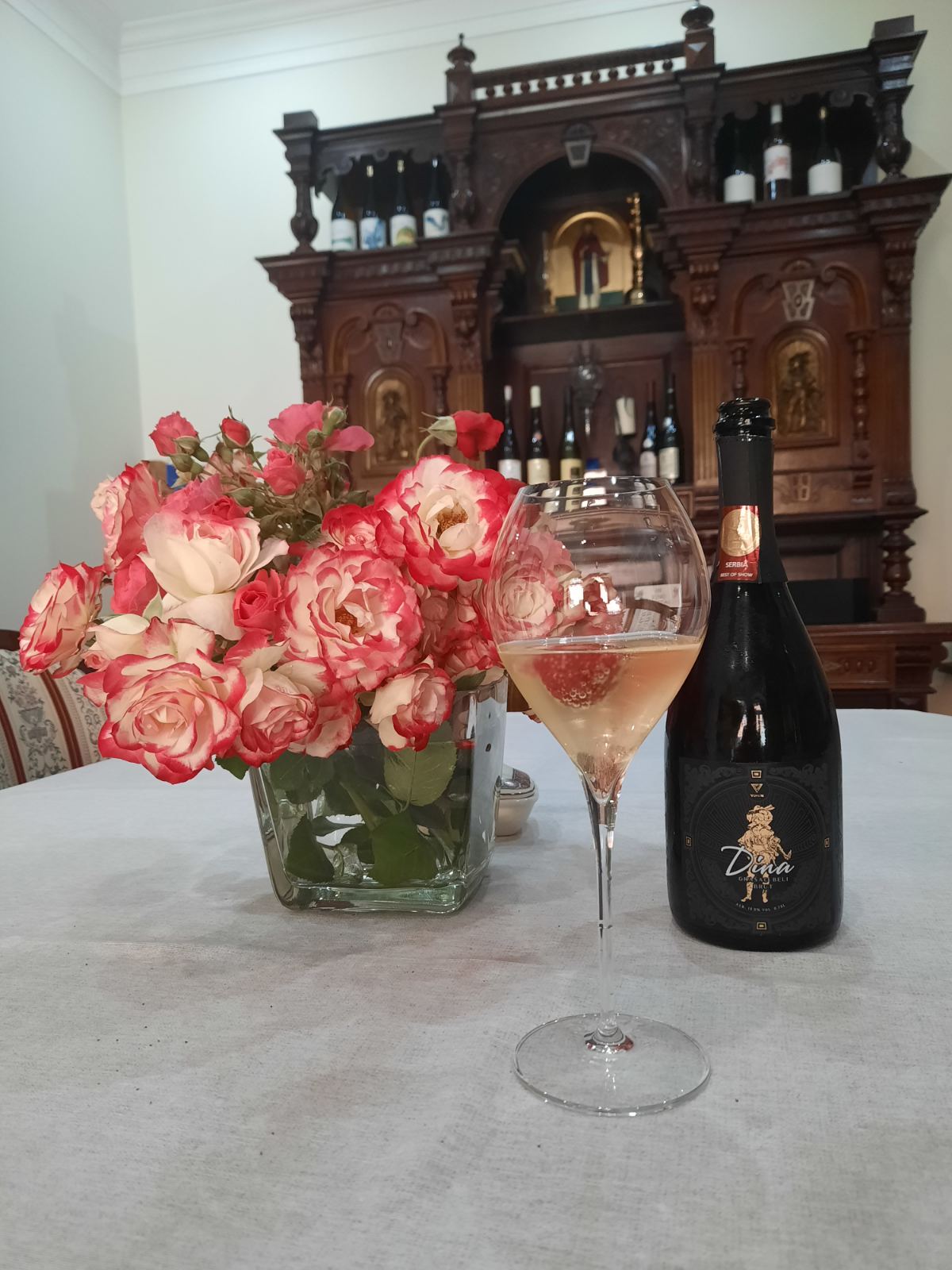
Among the wines that gradually appeared at Vinum, the most important place went to Dina, a traditional-method sparkling Grašac named after his grandfather Dina Stražmešterov. The man who had once given him the fig and threatened to sell his land rather than let his grandson abandon medicine eventually received a wine as his monument.
“He made all this possible. At the crucial moment, he refused me the land but gave me money to do the work I’d trained for. Dina is the crowning achievement of my winery, and I’m especially glad it’s made from Grašac.”
In 2021, Dina 2018 was named Serbia’s best wine through a joint assessment by the Balkan International Wine Competition jury and Vino.rs. It subsequently won the trophy for best sparkling wine at GROW du Monde, a success repeated by the 2020 vintage at the following year’s competition in Croatia.
The awards also confirmed Milan’s longstanding loyalty to a grape Vinum was among the first to champion seriously on Fruška Gora. When they still bought grapes from the institute, Graševina SK-54 had been a reliable starting point. When they began planting their own vineyards, Grašac was his first wish.
“Many people now consider us among those responsible for its return, but we weren’t thinking about a renaissance then. I simply knew I wanted it in my vineyard.”
Among his first international competition entries was a Blaufränkisch made from purchased grapes. At the tenth Vinalies competition in Paris in 2004, it received praise that persuaded him Vinum could outgrow a hobby, although he still had no wish to increase volume at any cost. He was more interested in how far one grape, one site or an idea the winemakers considered worth exploring could go.
That freedom also produced Grašac 26A, named after the winery’s street number on Karlovačkog Mira Street. The oak-aged Grašac attracted considerable praise, although its owner does not like pronounced oak influence.
Grk is partly to blame.
“Every summer, I went to Lumbarda on Korčula and drank Grk, which was then made only in wooden barrels. The wood always weighed on me. When I enter a restaurant, my first question is whether the wine is barrel-aged. I simply don’t like those wines, other people’s or my own.”
He nevertheless allows his winemakers to make them. Indeed, he encourages new ideas and better solutions. But when he detects bitterness lingering at the back of his palate, he asks them to soften it.
He accepts barrique only when, as he puts it, it stays backstage: present, but quiet enough not to take over the performance.
Similar freedom led to Mustra, an unusual blend of Traminer and Yellow Muscat. For several years, Traminer had failed to produce results they liked, and they were discussing grafting another variety onto the vines. Milan suggested trying a blend with Muscat instead.
“We even toyed with calling it Mustra Bečka.”
The expression, literally “a Viennese specimen”, is a teasing description of a crafty character.
When we first spoke at the Traminer Festival in Ilok, Milan had just learned that Vlado Krauthaker had presented a blend of the same grapes and named it Muštra. He was delighted like a child. That a major Croatian winemaker had arrived at a similar idea pleased him: it confirmed that Mustra was more than a solution for Traminer that had spent several years unsure what to do with itself.
Vinum thus accumulated more than ten labels, despite its owner’s initial claim that he wanted only small batches to enjoy with friends. Volume never became imperative, but the number of ideas did.
Milan might not have wanted to make much of one wine, but making many different wines was another matter.
Eventually, producing good wines was no longer enough. He wanted them to bring people to Sremski Karlovci, into its cellars and into contact with a town that readily presented itself as a wine destination but had not learned to make collective use of everything wine offered.
He brought the idea for Open Cellar Days from Villány, later encountering similar programmes in Istria and other regions. He imagined a weekend when Karlovci wineries would open simultaneously, minibuses would carry guests between cellars, and restaurateurs, kuglof cake makers, the municipality, police and railway would participate. The plan was worked out with almost laboratory precision. All he lacked were people willing to implement it together.
The first meeting showed how difficult such an event would be without municipal and provincial support. Through the winemakers’ shared group, Milan offered contacts, help with vouchers and a willingness to work through the entire plan together. He invited them to Vinum for a meeting.
Nobody came.
“I don’t know whether it’s because several winemakers opened shops in the town centre, whether they lack space for visitors or whether it’s something else. I only know we all have to promote Karlovci. If everyone opens their own shop and thinks only of themselves, we won’t get far.”
He had experience of this too. Five winemakers had tried jointly running a wine shop, Naša Vina, in central Novi Sad, but the project never took off. Milan concluded that a shared shop was insufficient: each winery had to welcome guests, then connect with the others to create a reason to visit Karlovci and stay.
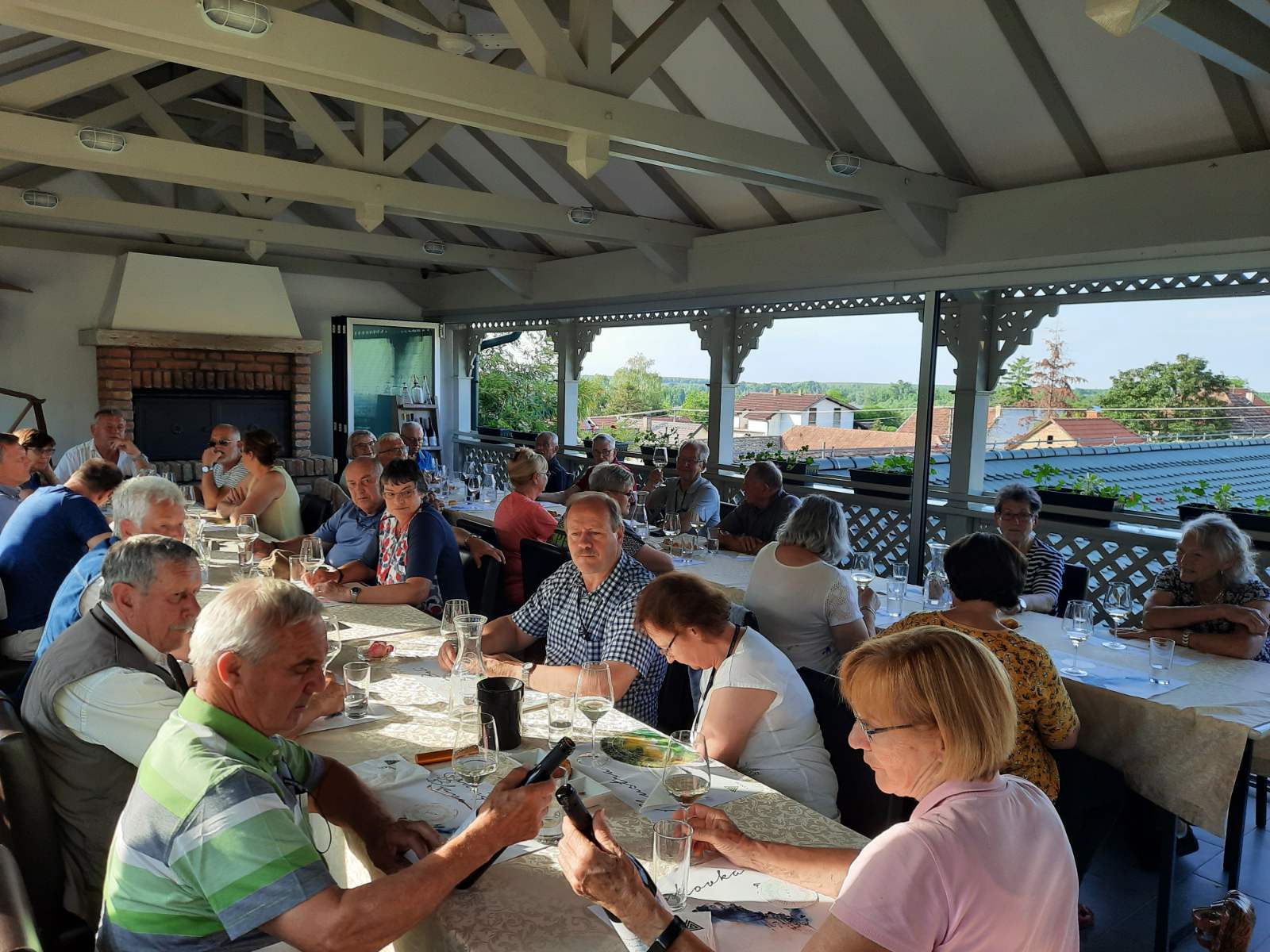
With no wider agreement, he organised an Open Cellar Day at Vinum himself. They provided tastings, food, music and everything needed to make guests stay longer than intended. He decided to open the winery at least twice yearly, linking events with Kuglof Day and Pinole Days, hoping his colleagues would eventually join.
“I thought I could bring the Karlovci winemakers together and share something of what I’d seen in Chile, Rioja, Georgia and elsewhere. I’m sixty-five and haven’t managed it yet, but I won’t give up.”
His failure contains an intriguing paradox. The man who built fifteen medical laboratories from one could not bring together winemakers from a few neighbouring streets. In medicine, he created a system capable of functioning without him. In wine, he was still trying to persuade people that some things could be achieved only together.
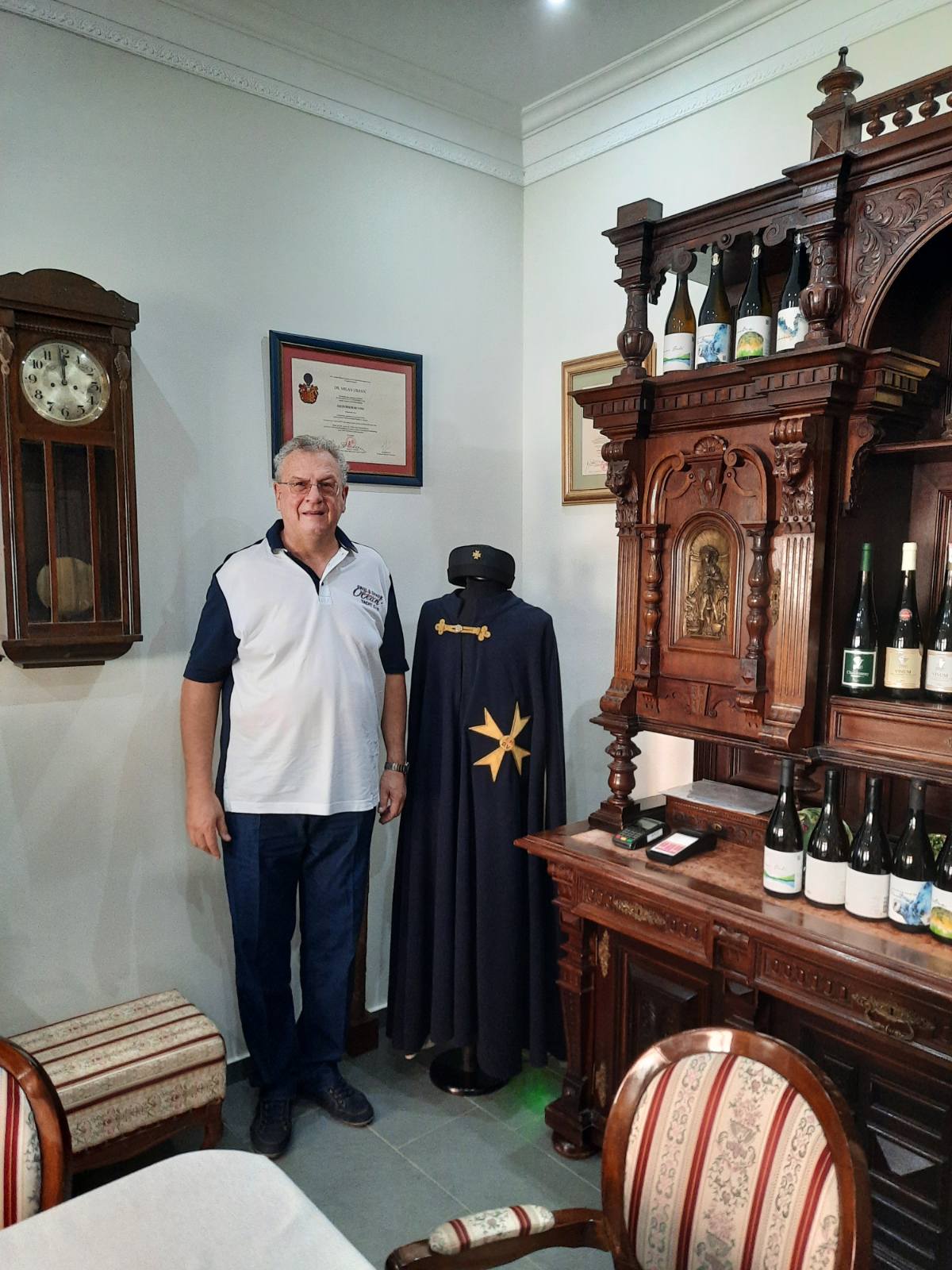
Meanwhile, Vinum opens its own doors. Milan wanted somewhere guests could taste wines, hear the house’s and vineyards’ story, and linger in the courtyard over local food, rather than a restaurant or café. Old tools and barrels stand beside modern glasses in the tasting room, while an orderliness nothing escapes betrays his laboratory background.
Yet he insists people make both Medlab and Vinum, rather than equipment. At the winery, he readily names the winemakers, technologists, growers and cellar workers without whom none of his ideas would reach a bottle. He assigns himself a much smaller role.
“I’m the cherry on the cake. I appear occasionally, taste something, raise a glass and chat. Decisions about fermentation temperatures and when to harvest belong to the people in the vineyard and cellar every day.”
Over time, he learned that an owner who is not a winemaker must let specialists broaden his horizons, even when they make an oak-aged wine he would never order in a restaurant. He retained the right to ask awkward questions, reject what he disliked and praise a wine wholeheartedly when it thrilled him.
After more than twenty years, he may therefore no longer feel like a winemaker, but has no intention of leaving the winery. Vinum became precisely what he sought when choosing a cellar over a medical centre: somewhere work never stopped, but at least smelled different.
It all began because his grandfather refused to let him farm his land. He gave him the fig, sent him back to medicine and helped open the first laboratory. That became Medlab; Medlab created the need for an escape; the escape became Vinum; and Vinum produced Dina, the sparkling wine named after the man who set the entire circle in motion with a refusal. Sometimes it really does pay to be told no.