Two decanters stood before British wine merchant Roy Richards. One held the 2000 Columella, the other the 2001. Eben Sadie had assembled both blends in front of him, taking fifty millilitres from each barrel. He wanted Richards to taste exactly the wine he had made. He had no money for bottles and corks.
– No special blend for the press, but the real thing! – he recalls.
Richards tasted slowly. Too slowly for Eben, who was waiting for his verdict.
– I was terribly nervous because I had no plan B. I did not know many people on the business side of the wine world. Fortunately, I had met Roy a few years earlier, and when he came to South Africa, there was an opportunity for him to taste our wines. I also wanted to show him the vineyards, all the meticulous work and care we had put into those first three hectares. He seemed to take an eternity to taste those two wines. My stomach turned over four times.
Richards finally spoke. The wines had quality and class. He was willing to buy them in advance, before they were bottled.
– He bought sixty per cent of the production from both vintages. The rest went to Swedish and German importers I met over the next two years. It all grew from there.
Richards took out a card bearing the Richards Walford letterhead, wrote and signed an agreement on it, and sent the money the following week. The man whose wines buyers around the world would later scramble to obtain could not then afford even bottles and corks. Richards’s purchase allowed him to bottle his first two vintages.
When I asked whether he had ever thought of giving up in those early years, he replied:
– Giving up was never an option. I would rather have died trying!
Today, he and his family are agreeing on how the estate will be managed and drawing up a plan for the next hundred years. Between Richards’s purchase and that vision of a century ahead lay the rescue of old vineyards, years spent preparing land for new plantings, and work on two continents. Meanwhile, his children were growing up, and it was for them that he eventually decided to return home for good. When I ask which of his achievements he would most like to show his late father, he answers:
– More than showing him what I have achieved, I wish he had met his grandchildren and been able to spend more time with my children. Those are the important things in life.
There is no wine cellar in his childhood memories. There is a bicycle, friends, and houses you could walk into without much warning. His family moved from KwaZulu-Natal to the West Coast, and it was there that the world Eben still remembers with such affection took shape. Both his father and mother worked for the state railways. School was not what made him look forward to a new day.
– I grew up carefree, mostly on a bicycle, with friends, going from house to house, from neighbourhood to neighbourhood. Everything was connected. School came second. Life happened outdoors: the ocean, surfing, swimming, diving, windsurfing and sailing. Nobody was rich, nobody was poor, nobody ever went away on holiday. Life was simply there, and that was where the world began and ended.
He remembers that childhood as simple, fulfilling and blessed.
– I would not change it for anything in the world. School could have been better, but then again, life is not perfect.
In his family, food was there to satisfy hunger. Only later would he discover that it could also be a source of pleasure, surrounded by an entire world of knowledge and conversation. Wine was no part of his family inheritance either. The ocean, however, he had loved since boyhood.
– It amazes me that we explore space, yet still do not know, understand or respect our oceans, which are the main reason we can exist on this planet at all. I love the fact that they are still such a mystery to us.
Surfing, diving, sailing, kitesurfing and windsurfing remain part of his life.
– My whole world falls silent, and my heart fills with joy. In the ocean, we have to use all our senses to stay alive. We are better adapted to life on land, so being in the ocean sharpens our senses, because that is how they need to be there. All the unimportant nonsense in life simply disappears. You become smaller, and nature takes over in every way.
Even in the ocean, he recognises something akin to a vineyard’s terroir: the influence of a place on what it produces. The seabed changes from one location to another, shaping the waves above it. For Eben, this too is a world of differences that are not immediately apparent.
– Most people just look at the ocean and, at best, notice that it is blue or salty. It is the same with wine: most see the obvious, but there is a much deeper world.
He wanted to become a marine biologist. His father, a man with strong ties to the land and agriculture, suggested agricultural studies.
– Listening to your parents is a great blessing. We do not always have to do everything they tell us, but we should listen with an open mind. Parents generally want only the best for their children. I am a father myself, with children aged twenty-eight, twenty-six and twenty-two. Especially between the ages of seventeen and twenty-one, parents usually see much further ahead than their children. That is precisely when we make decisions about a profession, our studies, work, sometimes even starting a family. It would be unwise not to seek the opinion of those who know you better than you know yourself.
He had already been introduced to agriculture at school and had developed an early love for it. He accepted his father’s suggestion and went to study in Stellenbosch. Today, he is grateful for that advice.
– I love what I do every day, and the ocean is still part of my life. In the end, I lost neither.
He describes his father as a humble man of principle: direct, honest and persistent, deeply respectful of others.
– I learned a great deal from him about human dignity and standing firmly by your principles. I have not yet achieved his humility. And both of us, you might say, could have worked a little on our patience. It was a great privilege to call him Dad.
– Do not let your surroundings and present circumstances dictate your actions. Build on the values and foundations laid in childhood. Do not try to please people; do what is right.
It was difficult to study agriculture in Stellenbosch without encountering wine. Eben joined a tasting group and began working in restaurants so that he could afford the wines he wanted to discover. Among those who opened that world to him was winemaker Marc Kent, later known for Boekenhoutskloof. By the age of twenty, he had already tasted Latour, Mouton, Haut-Brion, Cheval Blanc and Ausone. Those wines showed him what he might one day aspire to achieve.
When I asked whether he remembered a bottle for which he had had to give up something else, he did not single out one label.
– We saved as much as we possibly could just to buy some of the world’s incredible wines, taste them, and dream of making something similar one day. The wines of the world still inspire me to work harder and remain committed to improving.
As he has often said, wine first drew him in through tasting. Only then did he decide to learn how it was made. He graduated in 1994, the year of South Africa’s first democratic elections. For him, it also marked the beginning of access to the world in which he wanted to work.
– Before 1994, it was simply impossible to become truly involved in the life and work of European countries. Once we were accepted again and the embargo was lifted with the end of apartheid, we could communicate with the wine world, exchange ideas, learn and improve.
He compared his need to leave to the ambition of a cyclist who wants to ride the Tour de France. Training around your own neighbourhood is not enough: you have to go among the best and see how they work every day. Eben, too, wanted to learn from the winemakers whose wines he admired.
His first job abroad took him to the German winery Aldinger, where he stayed for six months. He spent most of his time in the vineyards, joining the work in the cellar when harvest began.
– The unknown always makes you uncomfortable, but at the same time it lays the foundations for growth. Few South Africans had worked abroad before then. It was a time when even sending a fax was expensive. I kept in touch with my family at home by letter.
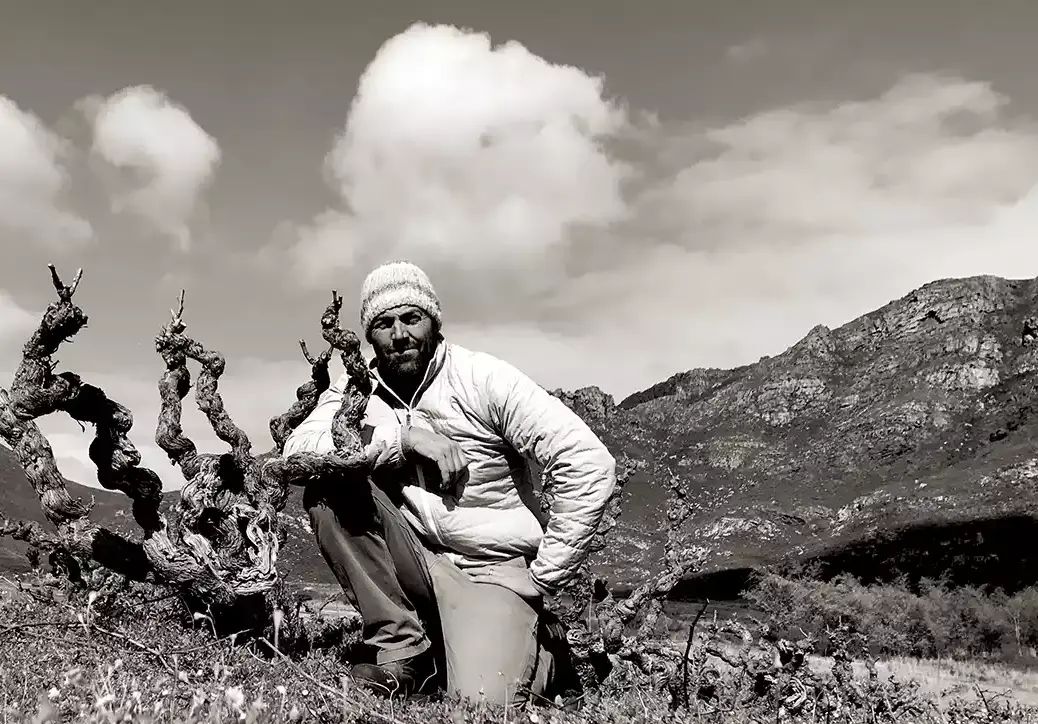
In Germany, he met one of his most important teachers, Gerhard Aldinger senior. Aldinger was already in his seventies, yet however hard young Eben tried, he could not keep up with him in the vineyard. Alongside him, Eben learned how to care for the vine, but also how to see it: as a living plant to be understood, with needs to be recognised.
– I have met few people in my life, if any, who loved the vine so much and cared for it so deeply. We spent more than eight hours together every day. I learned an enormous amount from him, especially about loving the vine and the importance of caring for it.
Jobs and harvests followed in Austria, France, the United States and Spain.
– Every person I have worked with has changed my understanding of vineyards and wine. That continues today. Every year I visit many winegrowers around the world so that we can talk, learn and exchange experiences. It is the only way we can move forward. It is important to know how to ask the right questions and how to observe when visiting and meeting others.
Charles Back, owner of the well-known Fairview winery in Paarl, gave young Eben a major opportunity: he entrusted him with winemaking at his new Spice Route project. The project was based in Swartland, a region whose potential for winegrowing was then poorly recognised. Back was looking for someone who would live what he created and be willing to take risks. After the very first harvest, he was convinced that he had found precisely that person in Eben. He would later call Eben a national treasure of South African wine.
– I was simply the lucky person who got the job. Even today, I cannot believe how much trust they placed in me when they appointed me, and I was only twenty-five. I could experiment, they let me follow my heart, and I learned a great deal during those four years.
Sadie struggled to fit into a business environment where grand promises about making the best wine in the world would be withdrawn as soon as the costs appeared in an Excel spreadsheet. To him, shortcuts that saved money at the expense of quality meant abandoning the original goal. He remained grateful to Charles Back, but wanted a project in which he could decide for himself how far he was prepared to go.
– In time, I wanted a smaller, more focused project to which I could devote myself more intensely, without any compromises. That is how The Sadie Family Wines came into being.
His first Columella came from the 2000 vintage. He named it after the Roman writer Columella, author of a work on agriculture. The white Palladius, which would join it later, also bears the name of a Roman agricultural writer. But before those names became familiar to wine lovers around the world, production costs had to be paid and a family supported, without income from his own wines.
– My wife Maria, or Magriet, was always by my side. She simply said, “Go and make it happen.” We were completely committed. We started making our wines in something like a shed or a garage. We had no money, so we had to work incredibly hard. I took on extra jobs as well to get us through those first thirty-six months. We did not sell a single bottle of wine; we only had expenses.
– Production was small, and we lived very simply. They were beautiful days. What matters is that we never compromised. That has remained the case to this day.
Magriet prefers to keep her distance from people. She lives in a world of her own which, Eben says, brings a new colour to their lives.
– She is a very strong person and knows how to fight when necessary. She is the glue that holds everything together. She knows every part of our history because she was there at every step.
While he worked harvests and travelled, much of the responsibility for their three children, Markus, Xander and Lisi-Maria, fell to her. Magriet understood how much his work meant to him, but his travels often meant raising the children without his daily presence.
Eben’s father died in 2001, just as his son was beginning to build an independent life in wine. He had lived to see the Spice Route years and, Eben says, enjoyed every moment. He did not live to see what followed.
In 2001, Eben and German winemaker Dominik Huber founded Terroir al Límit in Catalonia’s Priorat. He was drawn to the old vineyards, the mountains, and people whose knowledge of the land had passed from one generation to the next.
Among them was local winegrower Jaume Sabaté. His connection with the vine reminded Eben of what he had experienced working alongside Gerhard Aldinger in Germany.
– In him, as in Gerhard Aldinger, I recognised an immense love of the vine and care for it. His dedication to the vine is unsurpassed.
To support his family, Sabaté had spent some time working in construction. He was able to return to the vineyards when Priorat’s wine renaissance began. In him, Eben recognised knowledge acquired through long years of working the land, and a dignity that reminded him of his father.
For years, Eben worked harvests in both Priorat and Swartland, taking advantage of their different timing in the northern and southern hemispheres. That rhythm brought experience and connections, but constantly pulled him from one place to the other.
– That life allowed me to develop extremely quickly and build a worldwide network of contacts. But the biggest problem was maintaining continuity on both sides. As soon as I gained momentum on one side, things would slow down again on the other, and vice versa.
As his eldest son Markus approached his thirteenth birthday, Eben decided he wanted to spend more time at home.
– At the end of 2009, I decided to return to South Africa permanently. I felt that the time I would spend with him as a father was worth more than what drew me to Spain. The best decision of my life!
He returned to the country where he would one day be buried, wanting to leave his mark there.
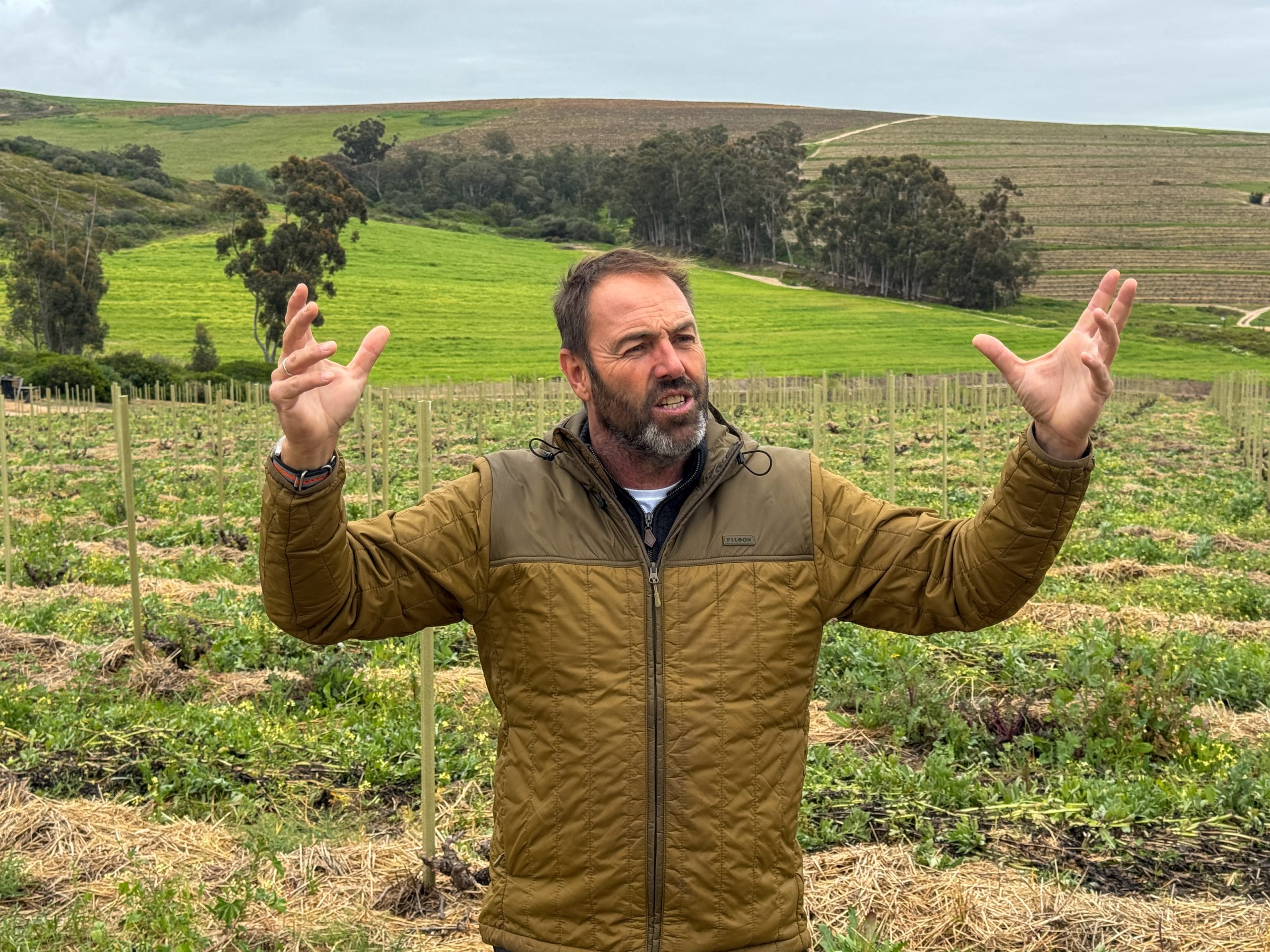
Ten thousand eucalyptus trees grew on the land where he intended to plant his own vineyards. He removed them with two workers, gradually, as he managed to earn the money. He worked in restaurants and wineries, advised other producers, and even traded scrap metal. First they cut and burned the trees, then removed the stumps, and finally pulled the remaining roots from the ground. In this way, as he described it, he had to burn the same property three times. The work stretched over ten years. He then sowed cereals and legumes, added compost, and restored the depleted soil. While preparing the land for his own vines, he made the wines that were earning him a reputation from other vineyards he farmed. On rented parcels too, he directed all the growing, from pruning to harvest.
In his decisions about the estate’s future, he showed a patience that was not always apparent in his sometimes fiery manner. He weighed those decisions for years, aware that the consequences of a single planting would extend far beyond a winegrower’s working life.
Swartland had an advocate in him long before it became a desirable destination for wine travellers. In a region known for grain, Sadie sought out old vines and studied the differences between soils. The granite of the Paardeberg, schist, sandstone, clay and rare limestone parcels offered different growing conditions and gave the grapes different characteristics.
Geology became so important to him that he spent four years working on a geological map of Swartland. Differences between soils were his starting point in deciding what to plant and how to farm each parcel. He also relied on specialists who used satellite imagery and detailed measurements to study the terrain, sunlight and air movement. Before planting, he wanted to understand as fully as possible the place to which he would entrust the next hundred years.
He built his two best-known wines on bringing those differences together: the red Columella and the white Palladius. Both blend several varieties from different vineyard sites. Each variety and each site brings something of its own, and its contribution also depends on the year: conditions that favour one variety may not suit another equally well.
That was why he did not necessarily want to bottle even an outstanding wine from a particular parcel on its own. He believed that, combined with wines from other vineyards, it could make an even better Columella or Palladius.
Columella changed over the years. Alongside Syrah and Mourvèdre, the blend included Grenache, Carignan, Cinsault, Tinta Barocca and Pinotage. Palladius, first made in the 2002 vintage, developed into a white blend of many varieties: alongside Chenin Blanc, these include Grenache Blanc, Marsanne, Roussanne, Viognier, Semillon, Palomino, Clairette Blanche, Colombard and Verdelho. Chardonnay, used in the early vintages, was later left out.
The Chardonnay grapes came from a vineyard he had fallen in love with. Over time, however, he concluded that the variety did not contribute enough to Palladius and stopped including it in the blend.
Alongside Columella and Palladius, he began making wines from individual vineyards. In doing so, he drew attention to parcels whose grapes had previously been sold cheaply, with no recognition of their distinctive character. Together with viticulturist Rosa Kruger and other advocates of old vineyards, he showed why vines often dismissed as too unproductive to be commercially viable were worth preserving.
Mev. Kirsten was one of the wines born of that work. While visiting a friend in Stellenbosch, Eben noticed old, neglected Chenin Blanc vines on a neighbouring property. He sought out the owner, Anna Kirsten, and offered to take over the care of the vineyard. She agreed, and he named the wine in her honour. Mev. Kirsten means “Mrs Kirsten”: Mev. is short for mevrou, the Afrikaans word for Mrs.
The vineyard, whose first vines were planted in the early twentieth century, was neglected and exhausted. Eben began restoring the soil and tending the surviving old vines. He gradually replaced dead vines with young plants propagated from selected vines in the same vineyard, preserving its genetic diversity. He wanted the vineyard to continue living and producing healthy grapes.
Each of these wines comes from a separate vineyard. Skurfberg is made from the Van Lill family’s Chenin Blanc, grown on sandstone soils, while Kokerboom comes from old Semillon Blanc and Gris vines. Pofadder is a Cinsault, Soldaat a Grenache from the Citrusdal Mountain area. Treinspoor, made from Tinta Barocca, has a firm tannic structure and needs longer ageing. In describing them, Eben gives them human characteristics too.
He compared Treinspoor to the quiet man at the end of the bar who does not let you get close easily. Pofadder, by contrast, is the one buying everyone drinks and dancing with the girls.
Skerpioen comes from the West Coast, from a vineyard where Chenin Blanc and Palomino grow together on limestone soil. Eben was struck by how harmonious a wine could emerge from such a wild landscape. Palomino tolerates the sun well, while Chenin is more sensitive and ripens differently. Together, he found, they achieved a balance neither could give him alone.
’T Voetpad holds a special place in Eben’s work: a remote vineyard where old vines of Palomino, Semillon, Chenin Blanc and Muscat of Alexandria grow together. The vines’ survival owed something to the illicit production of spirits that once brought travellers to stop there. Later, the grapes went into cheap wine, until Eben recognised their potential and began making a wine bearing the vineyard’s name.
In 2019, drought exhausted the vines so severely that he decided to sacrifice the crop to save the vineyard.
– It was the third year of extreme drought. If we had not removed the crop shortly after flowering, we would have exhausted the vines and the vineyard would have suffered too much. Even with that measure, we lost fifteen per cent of the vines during that period. But the vineyard has since recovered, and the wine has never been better. It was the right decision at the time.
There was no ’T Voetpad to sell that year. When I asked what decisions made out of conviction had cost him, he replied:
– Refusing to compromise has a financial, personal and interpersonal cost. It demands everything of you to remain committed and uncompromising. After a while, it simply becomes a way of life.
The early Columellas established his reputation, but over time he found certain aspects of them increasingly difficult to accept.
– I grew tired of woody aromas, excessive fullness and ripeness in the wines, so I began changing my approach. We did it all gradually. Essentially, it began in 2010, and I would say most of the changes were fully in place by 2017. That applies not only to winemaking but also to changes in viticulture.
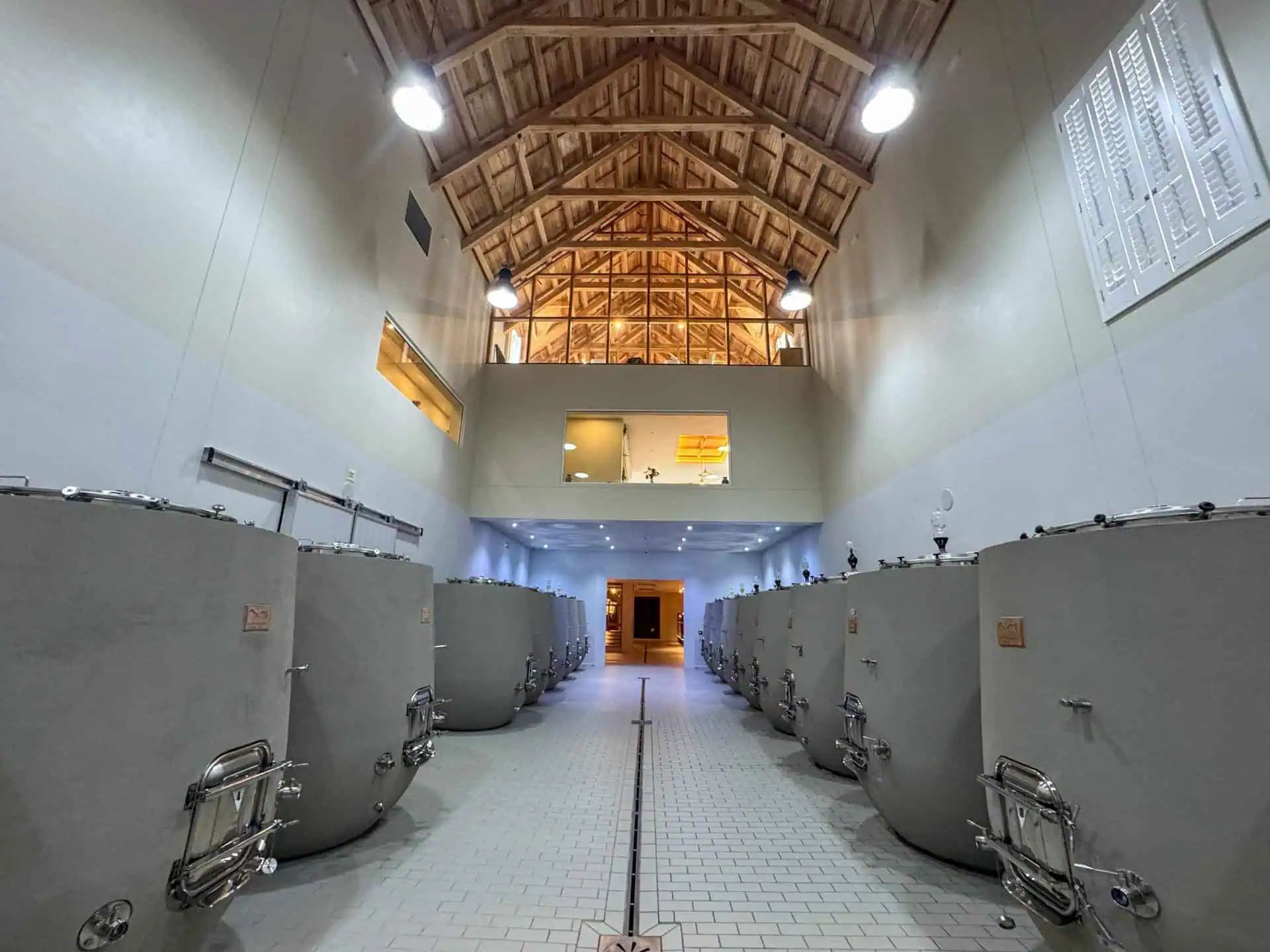
In the cellar, the influence of new oak diminished, extraction from the skins became gentler, and some of the ageing moved into large old casks. For white wines, he increasingly used amphorae and concrete vessels. He introduced changes gradually, giving himself time to assess their effects. If he changed every process each year, it would be difficult to tell what the vintage had brought to the wine and what was the result of his own work.
He compared his gentler approach to making red wines with a shift from making coffee to making tea: he wanted to draw colour, aromas and tannins from the grape skins more gently.
He also reconsidered his vineyard work. He admits that he had once gone too far with pruning and restraining the vines’ growth.
– From 2005 to 2010, I think we pruned the vines too severely and reduced their vigour too much. After 2010, we found a better balance. The grapes ripened better, and their composition and the balance of phenolic compounds improved too.
Today, alongside restoring old vineyards, he plants new ones. He must think about the conditions in which those vines will live for decades: which varieties will withstand an increasingly hot, dry climate, and how to grow them with the water available.
Viticulture specialist Jaco Engelbrecht also helps him study new sites. His detailed maps make it easier to decide what to plant and where.
By his own account, he was investing a fifth of annual revenue in research and development. Even after decades of work, with wine lovers already waiting for his bottles, he felt that the best was still to come. He compared himself to an athlete at the stadium, still putting on his running shoes and settling into the starting blocks. The vineyards had been planted, but he expected their greatest potential to emerge only in another twenty years or so.
He was astonished by how heavily winegrowing around the world relied on a narrow range of popular varieties, despite the enormous differences between wine regions. He did not believe that the same selection could suit a cooler European site and dry, hot Swartland equally well. So he spent years seeking out and testing varieties better able to cope with scarce water. They include Assyrtiko, Grillo, Vermentino, Grenache, Carignan and Cinsault. He wanted healthy vines that, even in a warmer future, would produce grapes from which he could make fresh, balanced wines.
He is equally careful in selecting the vines from which new planting material will be propagated. By choosing a number of valuable vines from an existing vineyard, a process known as massal selection, he preserves its genetic diversity. But before propagation, the selected plants must be checked for health. A cutting from a famous vineyard is worth little if it brings a virus with it. That is why he insists on testing planting material and, where necessary, eliminating viruses from it.
He compares the health of vines to that of athletes: a sick team is unlikely to win the Olympic Games.
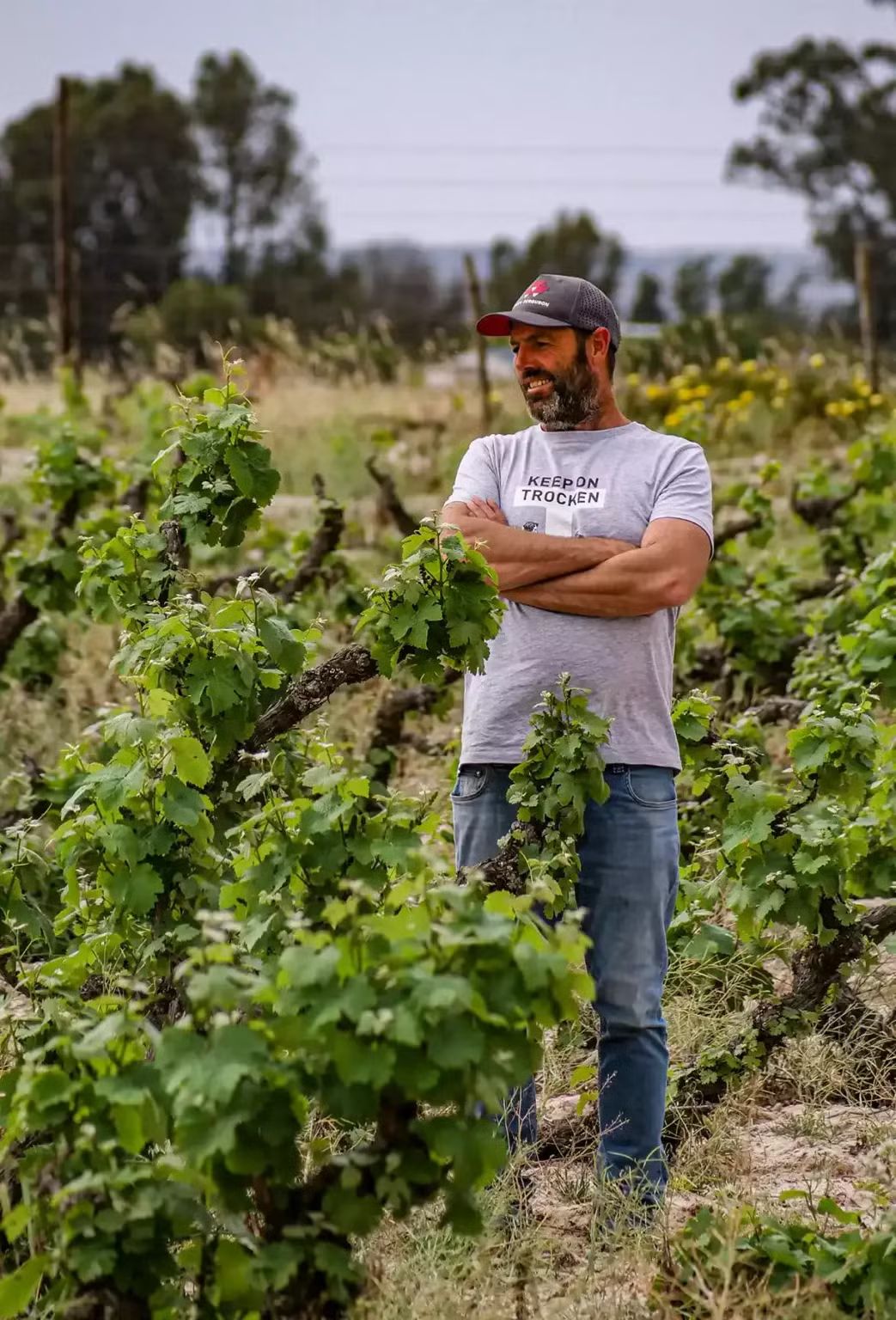
In his vineyards, the vines are trained as bushes, their leaves protecting the bunches from strong sunlight. He gives the vines enough space to avoid excessive competition for scarce water. He also conserves moisture with plants sown between them: after mowing, these remain on the ground to protect it from drying out.
He regards every drop of water as precious. On the estate, he collects, treats and reuses it, and when a tank needs repairing, he is willing to get up before five and tackle the job himself.
He has studied organic farming and biodynamics, but does not trust ready-made formulas. What benefits one vineyard may be wrong for another. He constantly reassesses his decisions, observes the vines, and changes his methods when he sees they are not producing the desired results.
When Morné Steyn began managing his vineyards, he did not know he was working for one of South Africa’s most famous winemakers. Eben talked to him about soil and vines, so for roughly six months Morné had no idea of Eben’s standing in the wine world. He discovered it only when someone suggested he type Eben’s name into Google.
Eben also enjoys inventing names for new vineyards. He creates them from Afrikaans words, then checks with language specialists in Stellenbosch to see whether they make sense. Slangdraai means a snake’s turn, Sonvang a sun catcher, and Twiswind an argument with the wind. That last vineyard is so exposed that it is sometimes hard to tell who is arguing with the wind: the vines or Eben.
After all his years in European vineyards, he wants his wines to belong unmistakably to Africa.
– Africa has a wildness within it. It is incredibly diverse and pure, and we try to bring all those qualities into our wines.
That is why he grows different varieties on different sites, seeking the best way to express the character of his region. He links this to the Latin word Liberatus, “freed”, which appears on the labels of Columella and Palladius. It describes his intention to work in the vineyard and cellar in a way that allows the qualities of a place to be felt in the wine.
He mockingly called South African winemakers’ excessive fascination with Bordeaux “Bordeauxitis”. He learned a great deal from Europe, but believes it is time for his country to stop imitating French wines and show what it can produce in its own right.
He had like-minded colleagues in Swartland’s transformation: winemakers Adi Badenhorst, Chris and Andrea Mullineux, and Callie Louw. Together they launched the Swartland Revolution, an event featuring tastings and visits from international producers. They wanted to bring great wines and the experience of their makers closer to people who could not travel to the world’s vineyards themselves. Their collective work helped build the reputation of the entire region.
Sommelier and winemaker Tongai Joseph Dhafana also spoke to me about Eben’s willingness to offer support. With great gratitude, he recalled the trust Sadie and Chris Mullineux had placed in him when he was just entering the world of wine. When I asked Eben to remember how they had met, he returned to the restaurant Bar Bar Black Sheep, where he had first encountered young Joseph.
– Joseph was eager to learn, attentive and willing to work hard. He just needed a little luck to get an opportunity, and he has achieved an incredible amount. We are all very proud of him. Above all, he is a good person.
Winemakers Sophie and Julien Schaal speak of Eben with equal warmth. He knows himself what another person’s trust can mean at the start of a journey: his own business survived partly thanks to Roy Richards.
When I asked him to introduce someone from the vineyards or cellar whose contribution was essential but whose name was unknown to customers, he did not want to single anyone out.
– Our team currently has forty-two members, and we work as a whole. Every day, we all eat together. From the gardener to the company director, no position is more important than another. Everyone matters, and each person’s commitment creates a whole that is always greater than the sum of its individual parts.
He prefers to introduce his colleagues to guests around a shared table.
– We have lunch together every day at 12.30. If we have visitors, it is an opportunity for them to meet everyone. Everybody matters.
Investing in a permanent vineyard team gave workers and their families security throughout the year. The people who prune the vines and pick the grapes remain on the estate between those tasks too. They get to know the vineyards, follow their changes, and build their knowledge from one harvest to the next.
Asked about the education of his workers’ children, he answers by speaking about the future of the whole country.
– I want my grandsons and, I hope, granddaughters, as well as my sons and daughter, to work in a better, stronger and more educated environment in the future. Apartheid left an enormous void in South Africa, and the state cannot fix everything. The private sector is getting involved, but it could do more. Then we could change that paradigm in a very short time. It requires a national effort that goes beyond government action.
– All children matter, and they all belong in this world. Caring for them and enriching their lives is our fundamental task. Our task is not to make money!
He worries about a society where owners’ children go to excellent schools while workers’ children go to poor ones. If their prospects diverge so early, what can later hold them together in the same community?
He also wants his relationship with customers to last longer than a single successful wine release. When bottles began disappearing from sale at a speed he compared to Rolling Stones tickets, he realised the old system no longer made sense. Why should someone who had supported them for eight or ten years have to wait for the right moment every season, send a message in the opening minutes, and hope to succeed this time?
Existing customers were therefore given priority in the annual wine allocation, with limits on the quantities they could order. New customers must wait for a place to become available. Sadie opposes buying for quick speculative resale: he wants his wines to reach people who intend to drink them or keep them for future enjoyment.
The allocation rules are part of the relationship he builds with customers. He expects them to honour the agreement and not use the bottles for speculation. For his part, he sends them a detailed letter once a year about everything that has happened on the estate.
When I asked what he wanted a customer to understand on opening one of his bottles, he did not speak of rarity, price or the prestige of ownership.
– That everything has been done to put the truest possible expression of a particular place and space into the bottle. That it is the work of a group of people deeply committed to that goal. Our wines speak more of honesty than perfection.
His children grew up with wine, but Eben does not want them to become copies of him. Markus and Xander also gained experience beyond the family estate. In California, Markus worked with American winemaker Tegan Passalacqua, and Xander with his fellow winemaker Morgan Twain-Peterson. Markus also worked in Austria, Argentina, Piedmont and Bordeaux, encountering different ways of working before returning home.
Eben did not force Markus to become a winemaker, but gently encouraged him towards the profession. At eighteen, Markus spent two months working with Adi Badenhorst and came to know the demands of daily working life. When he later returned to the family winery, working with his father was not straightforward.
Father and son thought differently about the work and initially struggled to find common ground.
Markus wanted to prove himself, and his defensive reactions made working together more difficult. Eben now acknowledges that both sides had to adapt.
– In any relationship, both sides have to move towards a common middle ground, and that is not always our first instinct. It has to be learned. It comes from a deep desire to create something lasting and meaningful. I have to remind myself that I cannot expect Markus at twenty-eight to think the way I do at fifty-four. I have to give him time to reach that future point. Our working relationship has taken a very good direction, and the future is bright.
It was in California that Markus met his future wife, Jessica Neal, who brought her own viticultural experience and knowledge into the family. Eben particularly values her ability to grasp the scientific side of the work quickly. Jessica has become involved in vineyard mapping and the research that is increasingly important on the estate.
Reports had suggested that 2027 would be Eben’s final harvest in the cellar. In our correspondence, he explicitly corrected that detail.
– I think there was some confusion in how the message was conveyed. I intend to spend the next two years with the full winemaking team, and I plan for 2028 to be my last harvest in the cellar.
When Paul Jordaan, the long-serving head winemaker at Sadie Family Wines, left the winery, Eben had to become more involved in winemaking again. Once he hands the cellar over to the next generation, he wants to devote more of his time to the vineyards and the people.
– I want to focus on developing our people further, building on what we have already achieved, as well as on the future vision for the estate as a whole. We do a great deal of viticultural research, and Jessica helps me with that. There are simply never enough hours in the day. Our research and development programme is enormous and essential because it shapes the future.
Xander already has a young son. Markus and Jessica are expecting a boy in April 2027. When Eben plants for future generations, he already has someone in mind.
– The next generation, and even the one after that, is already in sight. Wine is a story that spans generations. The great wines of the world are the result of work and relationships developed over several generations. In my own generation, I have merely laid certain foundations. It will be for future generations to give the vineyards and wines true greatness. Each generation plants for the next.
Even when Markus was a boy, Eben was thinking that his son might one day achieve what he himself was only laying the foundations for. Now the family is agreeing on how the estate will develop beyond their own generation.
– We are writing a family constitution – Eben says.
That is his term for a document in which the family agrees on the rules for managing the estate and passing it on to future generations.
– For The Sadie Family Wines, we are preparing a vision for the next hundred years, together with a timeline that will help us achieve it.
I asked what he would like his grandchildren to understand about the man who planted those vineyards.
– The wine will tell the story of my time, provided they work honestly, with dedication and care. The vineyards are planted on incredible sites, and they will only improve with age.
He sent me his answers from Frankfurt Airport, on his way home from his final trip to Europe that year. He apologised for how long it had taken. Ahead lay blending wines for bottling in early December, and there was still plenty of work in the vineyards. His year, he wrote, had been impossible to put into words.
Yet he had found time to return to the boy on a bicycle, his father with his railway job, Gerhard Aldinger in the vineyard, and Magriet telling him to go for it. He returned, too, to his two sons, his daughter and his grandchildren. As he plans for a century he will not live to see, the ocean still gives him what it gave him before the first Columella: a moment in which the world falls silent, and a person becomes smaller.
– Most people see the obvious – he says. – But there is a much deeper world.